Get Full Government Meeting Transcripts, Videos, & Alerts Forever!
Get email alerts on the Regulation Heavy Duty Vehicles topic
No spam. Unsubscribe anytime.
MassDEP hears split testimony as municipalities seek longer delays and health groups push to keep heavy-duty vehicle rules
Summary
At a Dec. 9 MassDEP online hearing, municipal officials urged longer delays or exemptions for public works and contractors to avoid service interruptions and high costs; environmental and health groups opposed delays, citing large public-health benefits from timely implementation of the Heavy Duty Omnibus and Advanced Clean Truck rules.
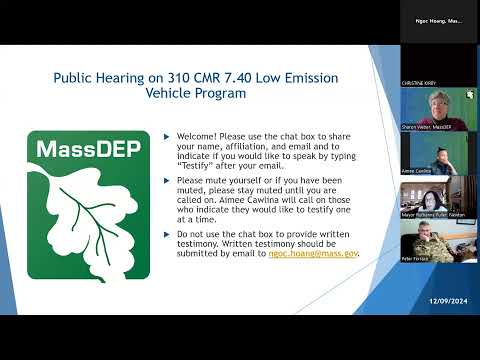
BOSTON — The Massachusetts Department of Environmental Protection on Dec. 9 heard more than two hours of oral testimony on emergency amendments to 310 CMR 7.40 implementing portions of California’s heavy-duty vehicle standards, with speakers sharply divided over whether to delay or keep the rules.
Mayor Ruth Ann Fuller of Newton told the department she supports the goals but warned that "with the current timelines, the regulations are actually likely to backfire," citing high vehicle costs, limited availability and local grid constraints that could leave municipalities unable to operate essential equipment. "The cost for medium and heavy duty CEVs are essentially double the cost of the current, clean diesel vehicles," Fuller said, calling for at least two additional model years before full implementation.
The Massachusetts Municipal Association and multiple public-works directors urged broader exemptions for public works and contract operators and longer delays than the department’s one-year postponement. Mark Valente, Lexington’s manager of operations, warned the equipment-replacement cost could double and "when you incorporate infrastructure upgrades, it will triple," and urged a multi‑year deferment to allow budgeting, transformer lead times and planning.
Municipal speakers described operational limits that, they say, make electrifying medium- and heavy-duty fleets impractical now: long lead times for compatible transmissions, reduced payload because of battery weight, two-plus year waits to receive some models, and local distribution-grid limitations reported by utilities such as Eversource and National Grid.
Environmental and public‑health groups countered that delays would prolong exposure to nitrogen oxides and fine particulate matter that harm respiratory and cardiovascular health. Daniel Fitzgerald, director of advocacy in Massachusetts for the American Lung Association, said Massachusetts "must reject the delay and weakening of these air quality standards," citing studies that medium- and heavy-duty trucks contribute a disproportionate share of NOx emissions. Kevin Shen of the Union of Concerned Scientists presented an analysis estimating that a one‑year delay in the Heavy Duty Omnibus could result in up to about 25 premature deaths and $300–$400 million in public‑health costs statewide.
Several testimony threads also addressed carve-outs and regulatory scope. Transit agencies sought clarity on the transit exemption for buses; James Nee of the MetroWest Regional Transit Authority asked the department to adopt the CARB diesel-engine exemption language that preserves cleaner‑than‑diesel CNG options for transit providers. Contractors and dealers urged exemptions for off‑road registered equipment, hazardous-material vehicles and for contractor fleets that perform municipal work.
Advocates for electrification said available market options and incentive programs reduce the burden of transition. Jordan Stutt of CALSTAR said the number of 0‑emission medium and heavy‑duty options is growing and pointed to Massachusetts programs such as the More EV Trucks rebate and Mass EVIP as financing pathways. Environmental groups urged MassDEP to develop a state-specific action plan, increase air-quality monitoring in impacted communities and use federal and utility funding to help municipalities convert fleets where feasible.
MassDEP staff said the emergency regulations were filed Nov. 4, 2024, became effective on filing, and that the department will consider oral and written comments before determining permanent regulations; written comments are due by 5 p.m. on Dec. 19, 2024. The hearing record will be followed by a department response posted to its website and emailed to participants.
There were no formal motions or votes at the hearing. The department closed the session at 2:44 p.m. and said it will publish the department’s response and the permanent-regulation notice after considering the record.
The department faces a choice between preserving the emergency rules to secure earlier reductions in NOx and particulate matter or granting further delays and exemptions to address near‑term operational and procurement constraints raised by municipalities and contractors. MassDEP did not announce a decision at the close of the hearing.