Get Full Government Meeting Transcripts, Videos, & Alerts Forever!
Get email alerts on the Environmental Regulation Heavy Duty Vehicles topic
No spam. Unsubscribe anytime.
MassDEP holds hearing on emergency heavy‑duty vehicle rules; industry urges more delay, advocates press for ACT adoption
Summary
At a Dec. 9 MassDEP online hearing, industry witnesses welcomed a one‑year delay to parts of 310 CMR 7.40 but said electric medium‑ and heavy‑duty trucks remain impractical in Massachusetts; environmental advocates warned the delay would undercut climate and public‑health goals and urged full adoption of Advanced Clean Truck standards. Written comments are due Dec. 19, 2024.
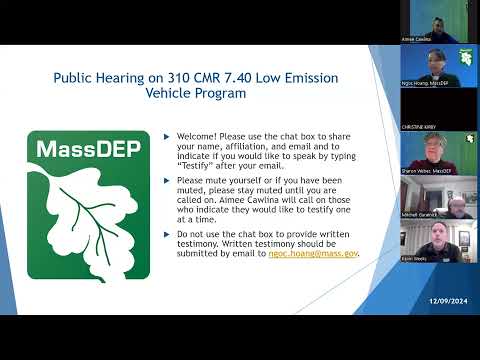
The Massachusetts Department of Environmental Protection on Dec. 9 held an online public hearing to gather comment on emergency amendments to 310 CMR 7.40, the state’s heavy‑duty vehicle regulation, including a one‑year postponement of certain heavy‑duty omnibus provisions and incorporation of California Air Resources Board model‑year 2026 legacy engine standards.
At the hearing, industry and environmental advocates offered opposing views on the timing and scope of the changes. "First off, I want to thank the DEP for the well‑intentioned one‑year delay of the HDO rule," said Kevin Weeks, executive director of the Trucking Association of Massachusetts. Weeks told the panel that the delay "does not address the pressing issue of cleaner trucks in the Commonwealth," arguing that few buyers are ordering medium‑ and heavy‑duty electric trucks because of limited range, cost and charging infrastructure. "As I speak to you today, there are less than 10 new medium and heavy duty trucks on order from any Massachusetts dealer," he said, adding that at the same time last year "there were over 1,000 on order." Weeks recommended that regulators consider alternatives such as renewable diesel, hydrogen, hybrids or operational measures like reduced idling and auxiliary power units while infrastructure and technology mature.
Rebecca Wilden, senior adviser for transportation at the Sierra Club, urged MassDEP not to delay or roll back the Advanced Clean Truck (ACT) provisions. Wilden said ACT is a critical tool for meeting the state’s transportation decarbonization goals and cited health‑benefit estimates in the state’s 2023 report: electrifying medium‑ and heavy‑duty trucks could yield an estimated $11 billion in health benefits for Massachusetts from 2020 to 2050 and help avoid more than 1,000 premature deaths and tens of thousands of asthma attacks. "Weakening these standards would be a win for manufacturers," she said, accusing some manufacturers of encouraging dealers to oppose the rules.
MassDEP staff opened the record for written comments through 5 p.m. on Thursday, Dec. 19, 2024, and said materials and the Department’s eventual response to comments will be posted and emailed to participants. The emergency regulations took effect upon filing Nov. 4, 2024 under Massachusetts General Law Chapter 30A, but the agency must complete a public review before deciding whether to make the regulations permanent.
The hearing closed after two people offered oral testimony and one participant noted he had filed testimony earlier. MassDEP will consider all timely written and oral comments as part of the rulemaking record.