Get Full Government Meeting Transcripts, Videos, & Alerts Forever!
Get email alerts on the Natural Resource Damages topic
No spam. Unsubscribe anytime.
MassDEP summarizes 2024 Natural Resource Damages work, from settlements to restoration planning
Summary
Michelle Craddock, coordinator of the Natural Resource Damages Program at the Massachusetts Department of Environmental Protection, summarized 2024 settlements, restoration planning steps and active grants, including public solicitation windows for Gloucester Harbor and Woods Hole restoration projects.
Michelle Craddock, coordinator of the Natural Resource Damages Program at the Massachusetts Department of Environmental Protection (MassDEP), presented the NRD program's highlights for calendar year 2024, outlining recent settlements, restoration-planning milestones, grant solicitations and projects moving toward implementation.
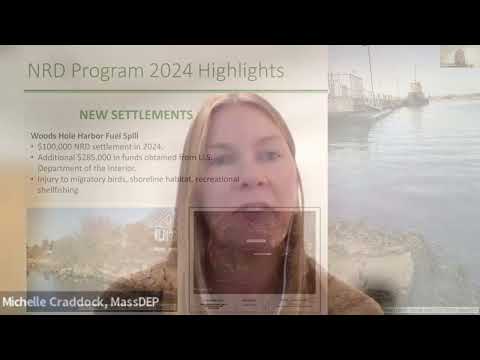
Craddock said MassDEP completed one NRD settlement in 2024 tied to a 2018 fuel release by the marine vessel Ocean King into Great Harbor in Woods Hole (Falmouth). "We settled 1 NRD claim this year," she said, and described shoreline coating, a large sheen on the harbor, temporary closure of recreational shellfish beds and injury and death to migratory birds. MassDEP entered a $100,000 NRD settlement and, working with trustee agencies including the U.S. Fish and Wildlife Service, secured an additional $285,000 from the National Natural Resource Damages Program through the U.S. Department of the Interior to fund restoration related to that injury.
Craddock also told attendees that another settlement was expected to be made public in late December or early January and that the consent decree would be posted for public comment once finalized.
She described the formal restoration-planning process that follows joint federal-state settlements, citing compliance with CERCLA regulations and DOI NRD regulations. Using proceeds from large trustees' settlements, she said, the trustees solicit project ideas, draft a restoration plan for public comment and then implement selected projects.
As an example of the restoration-planning process, Craddock said trustees reached a multimillion-dollar settlement tied to contamination at the Gloucester Harbor manufactured-gas-plant (coal tar) site and began restoration planning in fall 2024. Trustees held an October public meeting at NOAA's offices in Gloucester (about 30 people in person and 20 online), released guidance on eligible project types, and opened an online portal for project ideas through December 20, 2024. Submissions will be evaluated and a draft restoration plan released for public comment before implementation.
Craddock said the Woods Hole fuel-release settlement likewise moved quickly into restoration planning: a virtual public meeting was held in November and the project solicitation remained open through January 13, 2025, after which trustees will evaluate proposals and prepare a plan for public comment.
She reviewed completed and ongoing restoration projects funded with NRD proceeds. Trustees released the final restoration plan for the Bouchard B 120 oil spill directing $5.5 million toward restoration on Ram Island (Mattapoisett) to restore tern nesting habitat, salt marsh and shoreline. MassDEP is working with MassWildlife to issue requests for design and permitting services with construction expected in the next two to three years.
Craddock described a state-only settlement from a 2019 asset spill in Colrain that produced $225,000; because that settlement was state-only, MassDEP issued a grant solicitation (not the federal restoration-planning process), and she said the solicitation closed the prior Friday with funding decisions expected within roughly two to three months.
The presentation highlighted several active NRD-funded grants across the state. Craddock named the Industrialplex NRD settlement (just under $5 million) and said the program provided grants to the cities of Winchester and Woburn to design and permit stream-channel and wetland habitat restoration, with roughly $2 million identified for conversion of a channelized stream into a more natural, sinuous channel and native vegetation. She said design/permitting grants will be followed by construction funding when designs are complete.
Other grants cited included support for fish-passage improvements at Centennial Dam in Lowell (using Nyanza settlement funds, implemented with the Lowell Parks and Conservation Trust) and a new grant to the town of Tewksbury for wetland and groundwater restoration on two town-owned properties.
Craddock said the Bouchard B 120 settlement also funded volunteer and contractor efforts to clean up the outer Boston Harbor islands in partnership with the National Park Service, Boston Harbor Now, NOAA, the Department of Conservation and Recreation and the Center for Coastal Studies. She said volunteers completed multiple days of work and that the effort removed tens of thousands of pounds of debris from five islands and included monitoring to track bird responses to the cleanup.
She closed by highlighting a five-year watershed-education program supported by the GE Housatonic NRD settlement and implemented by Mass Audubon. Craddock said the program reached 347 classrooms across 22 schools, ran 25 community education and stewardship events, piloted a summer-camp feasibility study and leveraged additional funds from ARPA and the Municipal Vulnerability Preparedness (MVP) program to sustain parts of the work.
Craddock thanked partners and staff for the program's progress and said more developments were forthcoming.