Get Full Government Meeting Transcripts, Videos, & Alerts Forever!
Get email alerts on the PFAS Remediation topic
No spam. Unsubscribe anytime.
MassDEP bench study finds limited PFAS mobilization risk from proposed thermal cleanup at Framingham site
Summary
A MassDEP bench‑scale experiment simulating in situ thermal remediation at the General Chemical site in Framingham found faster transformation of some PFAS precursors at elevated temperature and measurable PFAS in condensate and vapor capture media, but estimated net soil fluorine transformed to mobile PFAAs at roughly 2%, and MassDEP plans robust monitoring if thermal treatment is selected.
Natalie Johnson of the Massachusetts Department of Environmental Protection presented a bench‑scale study showing that heating contaminated soil—an approach planned to remove dense nonaqueous‑phase liquids (DNAPL) at the General Chemical site in Framingham—accelerated transformation of some PFAS precursors but likely produced only a small increase in mobile perfluoroalkyl acids (PFAAs).
Johnson told advisory committee members the study was motivated by concern that remedial technologies targeting chlorinated solvents could "make things worse" for PFAS by converting currently immobile precursors into more mobile compounds. "Will my remedial technology potentially make things worse?" she asked at the session, framing the experiment's central question.
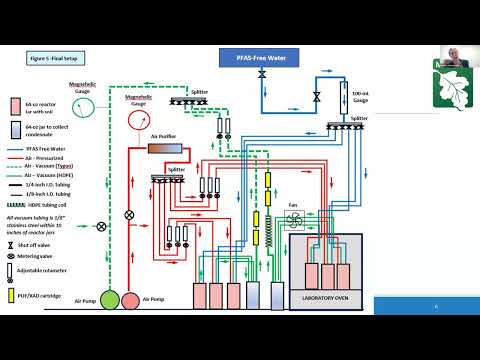
The bench test used six replicated glass reactors filled with Framingham soil and ran three at elevated temperatures (ramped up and held near 97 °C for 30 days) and three at room temperature. The team measured targeted PFAS by EPA method 1633, ran non‑target assays including a total oxidizable precursor (TOP) test and extractable organic fluorine (EOF) for soils, and captured vapors and condensate for additional analysis.
Key findings
- Precursor transformation increased at elevated temperatures. Several short‑chain PFCAs and intermediate fluorotelomer sulfonates showed statistically significant increases in the heated reactors compared with controls, indicating faster conversion of precursors under heat.
- Net soil impact small in mass terms. Johnson reported that target analytes measured by EPA 1633 rose by about 150 nanograms per gram and EOF rose by about 500 nanograms per gram in heated reactors over baseline concentrations near 7,000 ng/g; she estimated "approximately 2% of the total fluorine mass in the soil in those heated reactors was transformed from a immobile precursor to a more mobile PFAA" (the control reactors exhibited substantially less, under 1%).
- PFAS6 (Massachusetts drinking‑water metric) showed no clear difference. Although averages for the PFAS6 suite were higher in heated reactors, variability—especially across control replicates—meant the difference was not statistically significant. Johnson noted similar inconclusive results for PFOA due to high variability.
- Vapor/condensate captured PFAS and raised waste‑management questions. Condensate and vapor cartridges contained measurable PFAS (reported in micrograms of fluorine). The team detected volatile precursors such as PFOSA and, unexpectedly, some heavy PFCAs (e.g., PFDOA), suggesting volatilization or transformation of volatile precursors and signaling that treatment or disposal of vapor‑capture media requires careful planning.
- Analytical uncertainties complicate totals. Johnson warned that non‑target methods for soils are imperfect: two commercial labs returned EOF values for the same soil subsamples that differed by roughly 20‑fold. She also described cases where EPA 1633 measured higher summed targets than the TOP (oxidation) assay, an outcome that highlights method limitations for complex soils.
Context and implications
The study focused on a site where MassDEP has an elevated role and funding for investigation and remediation. Groundwater samples at the site showed a different contaminant fingerprint than soils: Johnson said groundwater exhibited low PFOS (about 15 ng/L) but very high levels of fluorotelomer intermediates (in the 1,000s to near 10,000 ng/L), indicating fluorotelomer foam impact in groundwater while soils displayed higher PFOS signatures.
Johnson emphasized practical takeaways: non‑target analytical methods need refinement for soils, precursor transformation occurs faster at elevated temperature but produced a relatively small fraction of total fluorine as mobile PFAAs in these bench conditions, and thermal remediation could remove some PFAS by evaporation. She recommended robust, site‑level air, condensate, and groundwater monitoring if in situ thermal treatment is selected.
Quotes and stakeholder input
"Will my remedial technology potentially make things worse?" Johnson said, summarizing the program's central concern.
On the scale of observed change, she said, "We estimate that approximately 2% of the total fluorine mass in the soil in those heated reactors was transformed from a immobile precursor to a more mobile PFAA."
Next steps
MassDEP is seeking feedback from advisory committee members, licensed site professionals and the community on method interpretation and monitoring design. Johnson said follow‑up work with labs to reconcile EOF/TOP discrepancies is ongoing and that any full‑scale thermal remedy would be paired with robust monitoring to detect unexpected outcomes.