Get Full Government Meeting Transcripts, Videos, & Alerts Forever!
Get email alerts on the Natural Resource Damages topic
No spam. Unsubscribe anytime.
MassDEP, U.S. Fish and Wildlife solicit restoration projects for Ocean King fuel spill; about $370,000 available
Summary
MassDEP and the U.S. Fish and Wildlife Service opened a public process to seek restoration projects tied to the 2018 Ocean King fuel release in Great Harbor (Woods Hole). Trustees say $100,000 in settlement funds plus federal support bring the pool to roughly $370,000; project forms are due Jan. 13, 2025.
Michelle Craddock, Natural Damages Program Coordinator at the Massachusetts Department of Environmental Protection, told a public meeting that trustees have $100,000 in settlement funds from the Ocean King fuel release plus additional U.S. Department of the Interior support for a total of about $370,000 to fund restoration projects tied to the spill.
"The funds that we receive, they can't be used to fund required cleanup activities. So these funds are really intended to go above and beyond what's required as part of the cleanup, and to compensate the public by restoring these injured natural resources," Craddock said, summarizing how natural resource damages (NRD) funds differ from cleanup funds.
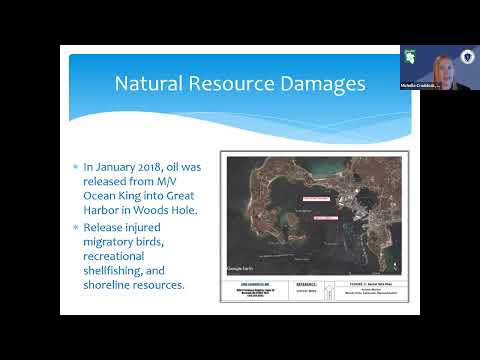
Why it matters: Trustees said the money is intended to restore or replace public natural resources injured by the Jan. 2018 release from the vessel Ocean King in Great Harbor, Woods Hole. Craddock described injuries that include about 29 oiled migratory birds recovered near the site, shoreline oiling and a temporary closure of recreational shellfishing beds that did not reopen until Sept. 15, 2018.
Eligible projects and limits Trustees are seeking projects that provide a direct nexus to the injured resources — principally migratory birds, coastal and shoreline habitat, and recreational shellfishing. Craddock cited wetland and salt‑marsh restoration (for example, removing historic fill or replacing undersized culverts), invasive species removal and native planting, coastal land protection, eelgrass and shellfish restoration, stormwater‑reducing projects that improve coastal water quality, and marine debris cleanup as the types of work that have qualified in other NRD cases.
Craddock emphasized examples of ineligible spending: "Any activities that are otherwise required by law or permit, things like cleaning up a contaminated site, a wetland mitigation project, or required stormwater improvements wouldn’t qualify for this funding." She said projects should restore the same or similar injured resources and that projects without a clear nexus to the Ocean King injuries (for example, playgrounds or general recycling programs) would not be appropriate uses of NRD funds.
Application, evaluation and schedule Trustees will release a project information form (fillable PDF) the morning after the meeting; the form will be emailed to stakeholders and posted on MassDEP's website. Craddock described the form as an intake tool, not a formal funding proposal, and said applicants may attach supporting documents. Trustees encouraged use of the standardized form to help the evaluation process.
Craddock outlined evaluation criteria: physical proximity to the injured site (with a preference for projects in Falmouth and Woods Hole but consideration for other towns with a clear nexus), the extent to which the project restores harmed resources, feasibility and permitting likelihood, cost‑effectiveness, likelihood of success, potential negative effects, and whether multiple natural resources would benefit.
The project information forms are due Jan. 13, 2025. Trustees plan to evaluate submissions in winter and spring 2025, release a draft restoration plan in fall 2025 with a public comment period, and publish a final restoration plan in spring 2026. If projects are selected, trustees typically provide funding to proposing project proponents via grants or agreements rather than implementing projects directly.
Enforcement and related payments Craddock said Patriot Marine, the vessel owner, paid an administrative consent order penalty of about $48,000 to MassDEP for failures including not reporting the release and failing to take response actions. She also said the U.S. Coast Guard negotiated to recoup its cleanup costs while NRD negotiations were ongoing.
Public questions Chuck Martinson, the Falmouth shellfish constable, asked whether leveraged or matching funds would be weighted more heavily in evaluation and whether applicants should submit a full proposal now. "If there is a leverage or match, is that weighted, heavier in the decision making process or not?" he asked. Craddock replied that match is not required but is considered favorably; she also said NRD funds can be used as match for other state and federal grants. She recommended that interested parties complete the project information form and may attach additional documentation.
What happens next Trustees said they will post the form, slides and a video of the meeting on MassDEP's website within days, accept project information forms through Jan. 13, 2025, evaluate submissions over winter and spring 2025, and aim to publish a draft restoration plan in fall 2025 with a formal public comment period before a final plan in spring 2026. Chosen projects would then move forward under grant or agreement terms.