Get Full Government Meeting Transcripts, Videos, & Alerts Forever!
Get email alerts on the Pay As You Throw topic
No spam. Unsubscribe anytime.
MassDEP webinar offers Pay-As-You-Throw tune-up with fee examples, contract tips and town case studies
Summary
MassDEP municipal assistance coordinators gave Massachusetts towns practical guidance on Pay-As-You-Throw design, fee-setting, contracts and outreach, with numerical fee examples, six municipal case studies and information on grants and technical assistance.
Massachusetts Department of Environmental Protection staff led an online “PayT tune-up” webinar for municipal officials and staff, offering practical steps to sustain and expand Pay-As-You-Throw (PayT) waste-reduction programs and pointing participants to grants and technical assistance. The session, presented by MassDEP municipal assistance coordinators, covered fee-setting, contract language, monitoring and community examples from Dartmouth, Malden, Natick, North Attleboro, Weston and Worcester.
Why it matters: Pay-As-You-Throw programs aim to make waste costs transparent and incentivize recycling and composting while balancing equity concerns for seniors, low-income households and multifamily dwellings. Municipal officials in more than 160 Massachusetts communities have adopted PayT approaches, and MassDEP said getting fee structure, contracts and outreach right is essential to program stability and public trust.
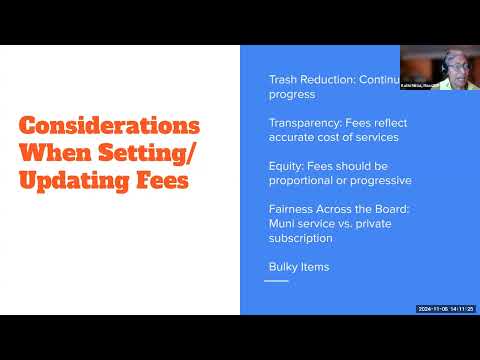
“We recommend reviewing your fees on an annual basis,” said Kathy Mirza, branch chief for municipal waste reduction at MassDEP, who walked through a worked example of a bag fee. Mirza used a $100-per-ton tipping-fee assumption (2,000 pounds per ton → 5¢ per pound) and an average 33‑gallon bag weight of 25 pounds to show roughly $1.25 in disposal costs, plus an estimated 40¢ bag cost, which supported a rounded $2 per bag fee to provide margin for municipalities.
Speakers stressed contract language and enforcement as tools to preserve program integrity. “Add clauses so the hauler will only collect trash in an approved municipal PayT bag,” Julia Green, a MassDEP municipal assistance coordinator, advised, recommending liquidated-damages language and clear specifications for carts, bags and overflow options to limit improper collections.
Case studies illustrated different local models: Missy Hollenbeck highlighted Malden’s hybrid approach—municipal blue PayT bags that can be used inside a 35‑gallon cart or a sticker option that allows residents to use other retail bags with a sticker—while Dartmouth, Natick and Worcester were cited for higher participation, active CHaRM recycling centers and supplemental services such as organics collection. Presenters noted that 35‑gallon carts are considered a hybrid PayT model by MassDEP and help keep programs eligible for certain grants when implemented within that size limit.
Presenters also urged routine data monitoring—reconciling truck weight slips, tracking tonnage changes after program shifts, and maintaining contract files—to spot irregularities and justify fee changes. Brian Walsh reviewed pre-webinar survey results showing general program favorability and invited attendees to provide additional input.
On funding and technical help, Ron Cochran, a MassDEP municipal assistance coordinator, described available grant programs and technical-assistance resources, including the Recycling Dividends Program and MassDEP grant assistance administered through Municipal Assistance Coordinators. He encouraged towns to apply for technical assistance grants if they need staff time to model program changes.
During Q&A, attendees asked operational questions such as Worcester’s bag-vending-machine experience; Missy Hollenbeck said the vending machine is inside a staffed convenience center and monitored by an employee, and she reported limited complaints on local social media.
The webinar recording and slides will be posted on MassDEP’s PayT page and the agency’s YouTube channel; MassDEP asked attendees to contact their municipal assistance coordinator for follow-up and offered further cohorts and resources to support implementation.