Get Full Government Meeting Transcripts, Videos, & Alerts Forever!
Get email alerts on the Water Transportation Grant topic
No spam. Unsubscribe anytime.
MassDEP opens Boston Harbor water-transportation grant, lists site-specific awards and application schedule
Summary
The Massachusetts Department of Environmental Protection described a $2.51 million Boston Harbor Water Transportation Fund grant program funded by chapter 91 license contributions, outlined eligible applicants and projects, and set a schedule (RFR release on the 21st, questions due Nov. 6, applications due Dec. 13).
Neil Padgett, waterways program chief for the Massachusetts Department of Environmental Protection, opened a public information session to outline a new grant program tapping chapter 91 license contributions held in a Boston Harbor water-transportation expendable trust. "This is a public information session, not a hearing," Padgett said, and DEP staff laid out who is eligible, what projects qualify and key deadlines for applicants.
The grant aims to support water transportation projects that move people across Boston Harbor, DEP legal and policy adviser Ben Hanna said. Eligible applicants are governmental, quasi‑governmental or nonprofit entities; private, for‑profit organizations cannot be direct recipients but may participate through partnerships with eligible applicants, according to Courtney Starling, a MassDEP grant administrator.
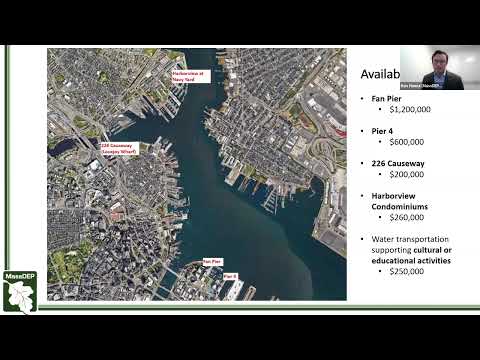
Most funding is site‑specific, Hanna said: projects must support water transportation at the site that contributed the funds under its chapter 91 license. DEP identified four contributing sites and maximum available amounts: Fan Pier (the largest contributor) — $1,200,000; Pier 4 (Seaport) — up to $600,000; Harborview in the Navy Yard (Charlestown) — up to $260,000; and 226 Causeway/Lovejoy Wharf — up to $200,000. Separately, up to $250,000 is available for cultural or educational proposals that use water transportation in Boston Harbor. DEP said the $2,510,000 figure discussed does not represent the entire trust and that some license‑specific funds require more work to determine eligible uses.
DEP set key timing and administrative terms: eligible activities may be retroactive to Jan. 1, 2024; work funded by the grant must be completed by Dec. 31, 2026; awards will generally be disbursed on a reimbursement basis, with limited exceptions for upfront funding if an awardee can document need; and award decisions are expected a few months after the application deadline. The RFR and application cover sheet will be posted on COMMBUYS and the MassDEP website on the 21st; written questions to DEP are due Nov. 6, and DEP aims to post written answers by about Nov. 22. The application deadline is Dec. 13.
During a robust Q&A, agencies and stakeholders pressed DEP on practical eligibility questions. Dave Perry, director of ferry operations for the MBTA, asked how narrowly DEP will interpret geographic boundaries for contributing sites; Hanna and Padgett said the answer depends on project type and license conditions, and that DEP will apply judgment based on project nexus to a funding site. Rich McGinnis of the City of Boston Planning Department asked about coordination with land‑based transportation and city agencies; Padgett said DEP expects to consult with city offices where applications rely on city services.
Applicants asked whether non-physical projects such as digital signage, discounted fares or workforce training could qualify. Hanna and Padgett said non-physical items may be eligible if they demonstrably support water transportation (for example, discounted tickets or vessel‑piloting training that results in operational capacity), but DEP will consider license requirements to avoid funding items already required of licensees. DEP encouraged applicants to coordinate with dock licensees when proposals depend on private pier owners.
On eligibility, Starling clarified that state law (the anti‑aid amendment) and Massachusetts grant rules prevent direct grants to private, for‑profit entities; however, she said private organizations may partner with eligible public or nonprofit applicants. Jamie Fay, who has worked with contributing licensees, urged DEP to consider extending the Dec. 31, 2026 deadline to allow multiyear projects; DEP said the deadline is dictated by the trust terms as currently structured but that DEP has previously renewed the trust and could seek extensions if warranted.
Padgett posted the application URL and contact email (dep.waterways@mass.gov) during the session and said the presentation, recording and Q&A will be posted to MassDEP’s website and on COMMBUYS. "We will be answering questions up until it gets posted on COMMBUYS," he said.
Next steps: DEP will publish the formal application materials on COMMBUYS and its website on the announced date, accept written questions through the stated deadline, post answers publicly, and evaluate proposals on merit. Awards will be disbursed by reimbursement unless an awardee documents a need for upfront funding.
Funding specifics, site‑by‑site license conditions and formal application materials will be posted with the RFR/solicitation; prospective applicants should consult those materials and contact DEP at dep.waterways@mass.gov with accommodation requests or questions.