Get Full Government Meeting Transcripts, Videos, & Alerts Forever!
Get email alerts on the Emergency Response topic
No spam. Unsubscribe anytime.
MassDEP official says take-back program removed more than 46,000 gallons of PFAS foam; grants, trainings and offshore exercise highlighted
Summary
Kathy Kiley, MassDEP’s statewide coordinator for emergency planning and response, reported that the agency’s AFFF take-back effort has removed over 46,000 gallons of PFAS-containing foam since 2018 and outlined training, a multiyear marine-oil study and $690,000 in recent grants to boost local spill preparedness.
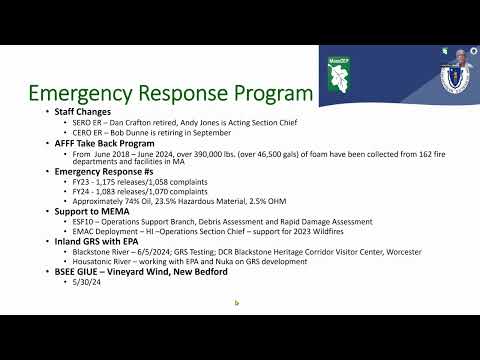
Kathy Kiley, the Massachusetts Department of Environmental Protection’s statewide coordinator for emergency planning and response, told agency staff that the department’s AFFF take-back program has removed more than 46,000 gallons of PFAS-containing firefighting foam since the program began in June 2018.
"We've been able to remove over 46,000 gallons of the foam that's been collected," Kiley said, adding that the program has engaged more than 160 fire departments and facilities across the state. "It's been a very successful program to get that foam that has PFAS out of the environment or out of the working environment."
Kiley provided a summary of response activity for fiscal years 2023 and 2024, saying both years saw roughly 1,000 incident responses and a little over 1,000 complaints. She said incident types historically break down to about 74% oil-only incidents, about 23.5% hazardous-materials-only incidents and roughly 2.5% that involve both oil and hazardous materials.
The emergency response (ER) program also supports interagency efforts, Kiley said, serving as lead for Emergency Support Function 10 (hazardous materials) and providing mutual-aid staff through interstate assistance compacts. She said the department sent ER staff to assist in Hawaii after the 2023 wildfires, deploying one staffer for about six weeks.
Kiley described ongoing collaboration with the U.S. Environmental Protection Agency on inland Geographic Response Strategies (GRS) for protecting sensitive inland waterways. She noted the Blackstone River GRS has been developed and exercised, and said the department and EPA — working with contractor Nuka — are developing a GRS for the Housatonic River.
On offshore preparedness, Kiley said the department participated in an unannounced Bureau of Safety and Environmental Enforcement (BSEE) exercise with Vineyard Wind at the New Bedford facility to test oil-spill preparedness and response plans. "This was an opportunity to exercise Vineyard Wind's oil spill preparedness and response plan," she said.
Kiley said the MOSFRA program contracted a multiyear evaluation of marine oil-spill threats and climate resiliency; the final report was not yet posted to the department’s website at the time of the briefing but is expected to be posted in the coming weeks.
She also summarized training and grant activity: five GRS training and testing sessions were held in the spring and five more were planned for the fall, and the program awarded 15 grants in a spring funding round totaling about $690,000. Kiley listed funded projects including forward-looking infrared and night-vision gear for fire departments, drone programs, expanded first-responder training, wildlife-responder training, a survey-and-disposal project tied to oil aboard the USS Massachusetts, and preliminary dockside pump-out designs in New Bedford.
Kiley closed by saying the combination of equipment, training, planning and targeted grants are intended to strengthen local and regional prevention, preparedness and response capabilities across Massachusetts.