Get Full Government Meeting Transcripts, Videos, & Alerts Forever!
Get email alerts on the Cost Modeling topic
No spam. Unsubscribe anytime.
New AIR cost models show rising child-care costs; CCFA rates cover 63–125% of estimated per-child costs
Summary
American Institutes for Research updated EEC's cost-of-care models to 2024 prices and found center per-child costs rose 14–26% and family child care 12–19% since 2022; facility rental costs drove large increases (28–29%); CCFA rates now cover 69–125% for centers and 63–110% for family childcare depending on region and age.
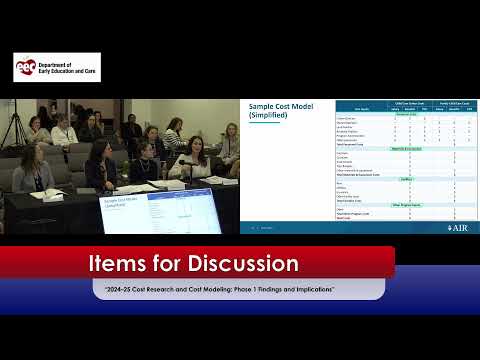
EEC staff and the American Institutes for Research (AIR) presented Phase 1 updates to Massachusetts' per-child cost models, revising 2022 assumptions and prices to 2024 dollars and triangulating C3 administrative data, Provider Cost of Quality Calculator (PCQC), BLS and commercial rental sources.
Key findings: Across regions, AIR calculated per-child cost increases between 2022 and 2024 of roughly 14–26% for centers and 12–19% for family child care programs. Wages increased roughly 7–9% in the period, food costs rose about $1,000 per child (roughly $3–4/day), and facility (rental) costs rose about 28–29% — the latter a major driver of higher per-child costs in centers. Comparing the 2024 CCFA rate schedule to the estimated costs, AIR found CCFA rates cover between 69% and 125% of per-child center costs (by region and age) and between 63% and 110% for family child care.
Interpretation and recommendation: AIR recommended using the 2024 cost estimates to target limited rate-increase funds toward the largest gaps (notably center infant/toddler care and family childcare for over-2 children) and suggested keeping the current rate structure in place while further refining models in Phase 2 to assess whether structural rate changes are warranted.
Phase 2 priorities: AIR will further refine staffing assumptions (including aspirational staffing and credential inputs), collect additional family-childcare data to better reflect owner-operator labor, expand models to show how program size and staffing structure affect costs, and investigate school-age and informal care cost inputs more deeply.
Board reaction: Members praised the updated modeling as critical for informed rate-setting and stressed the need to refine facility cost assumptions and the family-childcare staffing model in Phase 2.