Get Full Government Meeting Transcripts, Videos, & Alerts Forever!
Get email alerts on the Stormwater topic
No spam. Unsubscribe anytime.
White House seeks FEMA watershed study after summer floods; city details projects, enforcement and pond expansion
Summary
Residents described repeated flooding this summer as the White House stormwater advisory board outlined local projects, enforcement actions and a FEMA-funded watershed study the city is applying for; staff said the study would cost about $303,500 with a city share of $37,937.50.
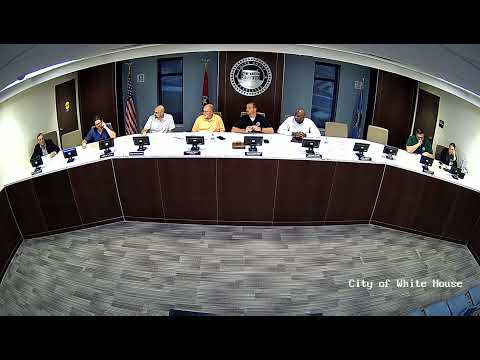
The White House stormwater advisory board on Sept. 9 reviewed repeated neighborhood flooding after heavy summer storms and outlined current and planned work while announcing the city has applied for a FEMA watershed study that officials say would update floodplain mapping and guide mitigation.
"It's coming through my yard and flooding our garage," said Carl Menes, a resident during the public-comment period, describing runoff that has repeatedly inundated properties in his neighborhood. Stormwater staff told residents the city is prioritizing homes where water reached living quarters and that Menes’s location is on a list for follow-up inspections and potential road or curb work.
Stormwater division staff said the city has submitted a pre-application and is preparing a full FEMA grant application for a comprehensive watershed study. "We're applying for a grant to FEMA to study the entire city's watershed," an unnamed stormwater staff member said during the presentation. Staff gave a total project cost in the presentation of $303,500 and said the city’s share would be $37,937.50 if the grant is awarded; the application will be routed through the state emergency management office and reviewed by a board in December.
Why it matters: Board members and residents said older subdivisions are showing infrastructure limits during intense storms, and city staff said a citywide, engineering-based study would delineate subbasins, quantify runoff for multiple storm-return intervals and identify where conveyances and pipes lack hydraulic capacity. That analysis would help prioritize projects and federal or state funding requests.
What staff reported: The board heard about several active projects and enforcement steps. The city is paying CSR Engineering $42,100 to study drainage in Covington Heights, which will evaluate flows in 2-, 5-, 10-, 25-, 50- and 100-year storm events and provide alternatives for ditches and pipes. Staff described a planned Calista/Callisto retention-pond expansion requiring acquisition of 0.867 acres for $100,600 from stormwater land-acquisition funds; that expansion will be bid once property and excavation issues are resolved.
Staff also described progress on the Apache Trail/Boxcoville box-cover projects after a winter hold related to a streamside salamander; two final box-cover sections were installed in June and staff said sidewalk and curbing repairs will precede paving and an anticipated Oct. 1 completion. The city reported shutting down six projects recently for illicit discharges and told a developer to excavate Collins Crossing Pond to the required depth and remove inappropriate stone used under an outfall.
Permits and limits: Staff repeatedly cautioned that in-stream work is governed by state and federal rules. The stormwater presenter said the city operates under an MS4 permit and that an ARAP (aquatic resource alteration plan) and other permits from the Tennessee Department of Environment and Conservation (TDEC) may be required before heavy equipment or excavation can occur in creeks. Staff also noted the U.S. Army Corps of Engineers and county flood-hazard plans are part of the broader context for watershed work.
Residents’ questions and timeline: Daniel Whited, a resident and planning-commission member, asked whether the FEMA study would change flood-insurance mapping; staff said part of the study’s scope is to identify areas that might be added to the floodplain and that the county typically handles disaster declarations that can trigger other federal assistance. Staff told the board they expect the application to be taken to the state emergency-management review board in December and that some outcomes could take many months to implement.
Board business and votes: The board approved the June 10 meeting minutes and approved a recommendation that would remove the finance director from the advisory board and add the city engineer; that recommendation will be forwarded to the mayor and board of aldermen for two readings and a public hearing. Both motions were made and seconded and passed with aye votes and no recorded opposition.
Next steps: Staff said the city will continue to work through a list of more than 100 stormwater projects while pursuing the FEMA study and will submit the annual stormwater report by Sept. 30. If the FEMA grant is awarded the study would inform future capital priorities and potential property acquisitions or engineering fixes.