Get Full Government Meeting Transcripts, Videos, & Alerts Forever!
Get email alerts on the Criminal Justice Reentry topic
No spam. Unsubscribe anytime.
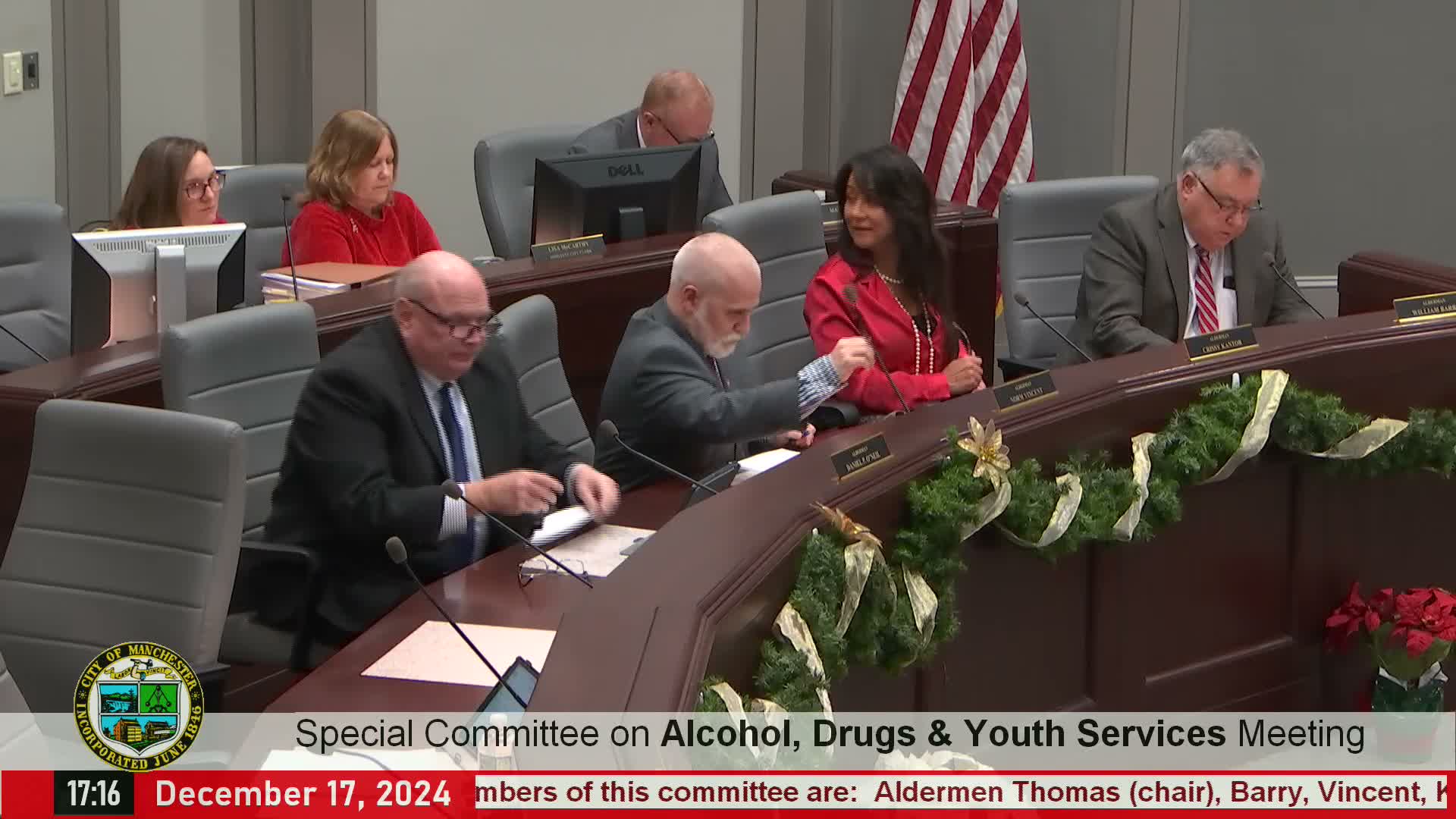
Hillsborough County presents ACT reentry program to Manchester aldermen, cites housing and transport as top needs
Summary
Hillsborough County Department of Corrections presented its in‑house ACT (Accept and Commit to Treatment) program to the Manchester Board of Mayor & Aldermen, reporting 84 referrals, 27 active participants and a focus on housing, employment supports and electronic monitoring fees offset by opioid abatement funds.
The Hillsborough County Department of Corrections on Monday presented its in‑house ACT program to the Manchester Board of Mayor & Aldermen, describing a yearlong, sentenced treatment program for people with co‑occurring substance use and mental health disorders and highlighting housing and transportation as the program’s biggest implementation challenges.
Superintendent Joseph Costanzo (who self‑identified as 'Joe Costanza' when speaking) said the program — retooled from an earlier SOAR contract and brought in‑house after the COVID pandemic — is an evidence‑based transition model aimed at reducing recidivism and supporting reentry into the community. "It's co‑occurring. We treat both at the same time," Costanzo said during the presentation.
Programs director Alyssa Ng gave the program’s current metrics: 84 total referrals accepted in a little more than a year, with 67 referrals from Hillsborough North Superior or Manchester District courts and 12 from Drug Court North. Ng said 35 participants have completed or are near completion ("35 plus 2 pending completions"), 19 are participating in‑house, eight are on electronic monitoring in the community and 27 are active overall. She said there have been four returns and three terminations among participants.
Ng and Costanzo described the program’s structure: a one‑year sentenced placement with classroom work five days a week using curricula such as Thinking for a Change, Seeking Safety and Helping Men and Women Recover, plus journaling, art and music therapy. Costanzo said early‑release tools in New Hampshire (RSA provisions governing two‑thirds time) often mean participants serve roughly eight months in custody, then begin a year of probation upon release. Staff coordinate a warm handoff to probation and parole and tailor transition plans that specify housing, work, drug‑testing schedules and levels of supervision.
Electronic monitoring is monitored around the clock via bracelet geofencing, Costanzo said, with graduated responses to violations. He told aldermen that some or all electronic monitoring fees (about $60 per week) are sometimes covered by opioid abatement funds or by inmate commissary funds so that inability to pay does not prevent participation.
Board members pressed for details on housing and employment. Ng said the program prefers stable or sober housing and typically places participants in Manchester ("4 or 5" housing partners), with Nashua providing one or two partners. Costanzo described efforts to address transportation barriers, including coordination with Manchester Transit, bus‑ticket support for initial travel and assistance reinstating driver licenses when needed.
Costanzo also cited peer recovery partners: Revive meets with sentenced and pretrial populations weekly to provide peer recovery support. The superintendent said the program also serves as a sanction pathway for drug court participants.
Aldermen praised the program’s emphasis on accountability and compassion and asked how the city could help. Costanzo recommended public education about ACT, continued collaboration with the city solicitor’s office, police chiefs and the public defender, and greater focus on creating affordable, stable housing for people leaving custody.
No formal votes on program funding or city action were recorded in the transcript. The meeting record shows a motion to adjourn by Alderman Vincent, but the transcript does not specify a seconder or the outcome of that motion.
The presentation closed with board members thanking the DOC team; the record does not show any immediate policy decision or commitment by the Board of Mayor & Aldermen at this meeting.