Get Full Government Meeting Transcripts, Videos, & Alerts Forever!
Get email alerts on the Cbsd Budget ARPA topic
No spam. Unsubscribe anytime.
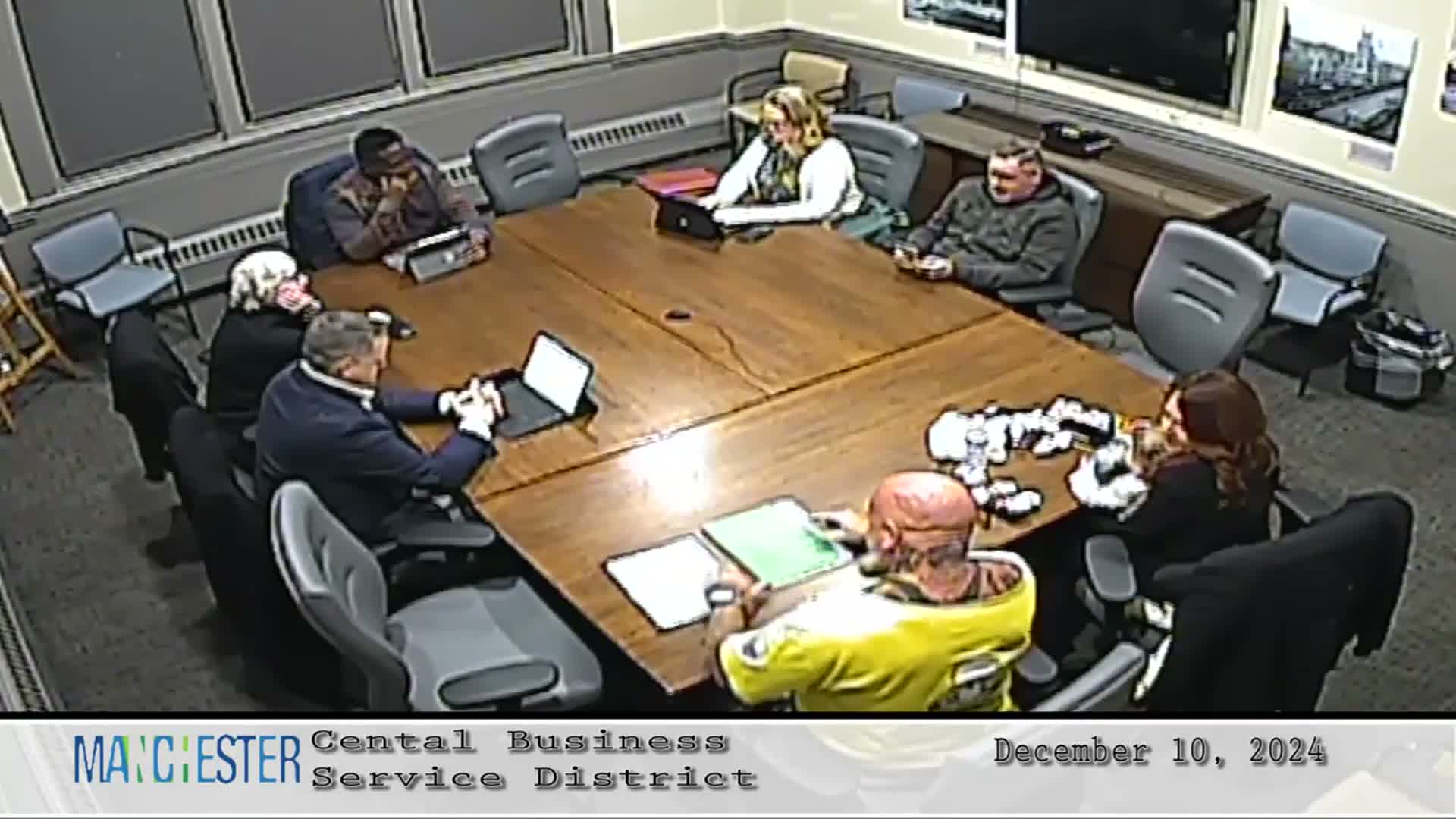
Manchester working group backs ARPA buyout of leased downtown equipment and plans inflation-based tax adjustment
Summary
A Manchester working group recommended using $200,000 in approved ARPA funds to buy equipment currently leased under a Street Plus contract and asked staff to seek an inflation adjustment to the Central Business Special District (CBSD) tax to fund FY26 services while zoning boundaries are finalized.
Speaker 3 called for using one-time ARPA funds to produce ongoing savings and described a two-step approach to stabilize downtown service funding. "We successfully rest wrestled about $200,000 for our benefit," Speaker 3 said, recommending the ARPA money pay off equipment leases so future years avoid higher lease costs.
The proposal aims to convert leased equipment into owned assets, reducing annual operating costs and allowing the committee to recommend an inflation-based adjustment to the Central Business Special District (CBSD) tax to cover enhanced cleaning, lighting and event support. Speaker 3 outlined the proposed FY26 downtown budget as a total of "593,000," with a $480,000 Street Plus cleaning-services contract, $40,000 for seasonal planters, $35,000 for lighting, $10,000 for special-event support, $15,000 for holiday decorations, $10,000 for infrastructure updates and $3,000 contingency.
Speaker 3 framed the ARPA buyout as consistent with commonly accepted federal guidance against using one-time funds for ongoing expenses. "Don't use one-time funds to subsidize things that won't be able to continue being subsidized," Speaker 3 said, adding that buying the leased equipment would yield roughly $35,000 in annual savings and about $112,000 over three years.
The working group discussed how district boundaries and tax base changes — including expiring 79e agreements and whether large properties such as the Milliard are included — could affect who pays the CBSD tax and the total revenue available. Speaker 4 proposed narrowing the district footprint in some areas, saying a smaller, focused zone could increase the visible return on investment along corridors such as Bridge Street to Grant Street.
On tax rate sizing, members offered differing estimates. Speaker 3 recalled the group had discussed "up to 30%" as a possible inflation adjustment. Speaker 5 ran a separate calculation suggesting that adjusting the tax by 2.5% annually over 16 years would raise revenue from about 258 (current baseline cited) to roughly 383 — a 48% difference — illustrating how different methods produce different results.
The group noted alternative revenue strategies, including seeking grants, sponsorships or a sponsored "adopt-a-block" program used in other cities. Participants cautioned that using private funds can encounter federal, state or municipal constraints; Speaker 6 cited prior difficulties when privatizing signage programs.
Action steps: members asked staff (Jody) to prepare the formal budget letter and an itemized list of leased equipment for review at the February meeting. Speaker 3 said the ARPA funds have been approved and recommended the working group use the next year to finalize boundaries, refine the budget and prepare outreach to major taxpayers about any proposed changes.
The working group did not take a formal vote to change rates at the meeting; instead, members signaled broad support for the conceptual approach and directed staff to prepare the materials the Board of Mayor and Aldermen would need to consider a rate adjustment.
The next scheduled check-in was set for February (conditional) with March 11 as the next regular meeting date.