Get Full Government Meeting Transcripts, Videos, & Alerts Forever!
Get email alerts on the State Of State topic
No spam. Unsubscribe anytime.
Pillen touts balanced budget, school-funding overhaul and agency consolidation in State of the State
Summary
Gov. Jim Pillen told the Legislature Nebraska is 'extraordinarily strong' while proposing a mostly balanced budget that trims spending, a blue-ribbon commission to remake the TEOSA school-funding formula, a new Department of Water, Energy and Environment, and bills to limit classroom phones and tighten food-labeling rules.
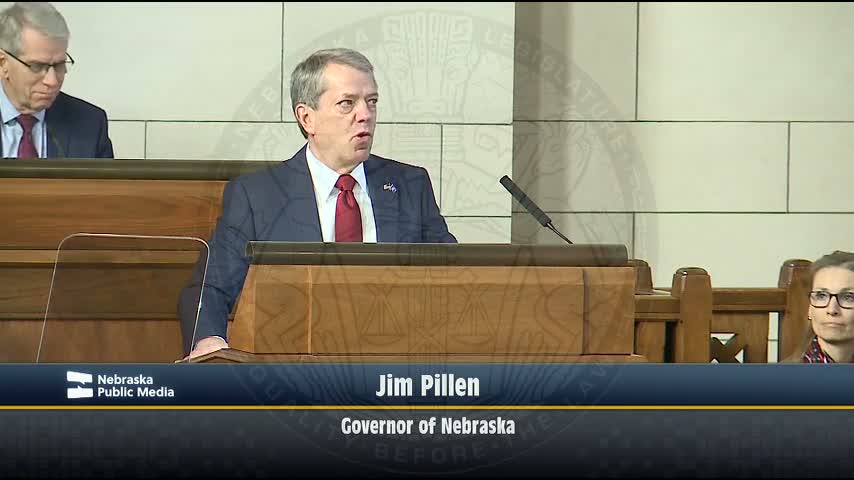
Gov. Jim Pillen delivered the State of the State to the Nebraska Legislature, framing the condition of the state as "extraordinarily strong" and outlining a budget and policy agenda focused on spending restraint, school-funding reform and administrative consolidation.
Pillen said the budget he presented would "shrink state spending by half a percent over the next biennium" and that, excluding federally required unreimbursed Medicaid increases, state spending would fall by about 2.3 percent. He highlighted investments the administration proposes for the University of Nebraska Medical Center and for continued support of Offutt Air Force Base.
Why it matters: The governor positioned fiscal restraint alongside targeted investments as the center of his policy pitch for the coming session, meaning key committees will consider both cuts and one-time or multigenerational appropriations as the Legislature drafts the biennial budget.
Pillen singled out Nebraska's school-funding system—TEOSA, a 30-year-old formula—as in need of "serious and lasting fixes." "I will establish a blue ribbon commission of experts to cut through the bureaucracy," he said, calling for a new funding model and noting that Senator Hughes will carry a bill to increase foundation aid per student. Pillen criticized the current distribution of state aid, saying far fewer districts receive help today than was intended when TEOSA was enacted.
On administrative structure, Pillen endorsed legislation (carried by Senator Brandt) to merge the Department of Environment and Energy and the Department of Natural Resources into a combined Department of Water, Energy and Environment. He argued the consolidation would eliminate duplicative overhead and better align policies for water quality and quantity.
Pillen also urged the chamber to return Nebraska to a winner-take-all allocation of presidential electors, saying the state's split-by-district approach has "divided our voice and diminished our impact" and thanking Senator Lippincott for leading the effort.
The governor announced a package of bills aimed at protecting children from online harms, including measures to ban phones in classrooms and to update child-protection laws to include AI-generated images. "We need to level the playing field between parents and the big tech giants," he said, asking the Legislature to consider a "patch package" sponsored by several senators.
On social issues he urged passage of a revived "Stand for Women Act" to restrict access to certain women-only spaces in schools; and on agriculture he praised proposed protections for farmers' data and stricter labeling for lab-produced meat alternatives, calling some products "a masquerade of the original".
Pillen closed by recognizing the state's emergency responders and the Nebraska Emergency Management Agency (NEMA) after a year of extreme weather events, introducing Chris Potter, chief of the Kennard Volunteer Fire Department, and asking lawmakers to thank first responders for their work.
The governor's address set the policy agenda the administration expects to press this session; most proposals will now be referred to committees for hearings and potential amendment. No formal votes on the governor's proposals occurred during the address.