Get Full Government Meeting Transcripts, Videos, & Alerts Forever!
Get email alerts on the Expert Testimony topic
No spam. Unsubscribe anytime.
Experts urge caution: millionaire's tax offsets, Medicaid risk and immigration could sway FY26 outlook
Summary
Independent analysts and academics told the committee that millionaire's tax collections may be offsetting general revenue and that federal policy changes (Medicaid funding, immigration, tariffs) and capital‑gains volatility are key fiscal risks. Several witnesses recommended conservative budgeting and more transparent surtax estimates.
A coalition of independent analysts and academic economists told the Joint Committee on Ways and Means that while Massachusetts’ economy shows resilience, several federal and behavioral risks warrant a conservative approach to FY26 budgeting.
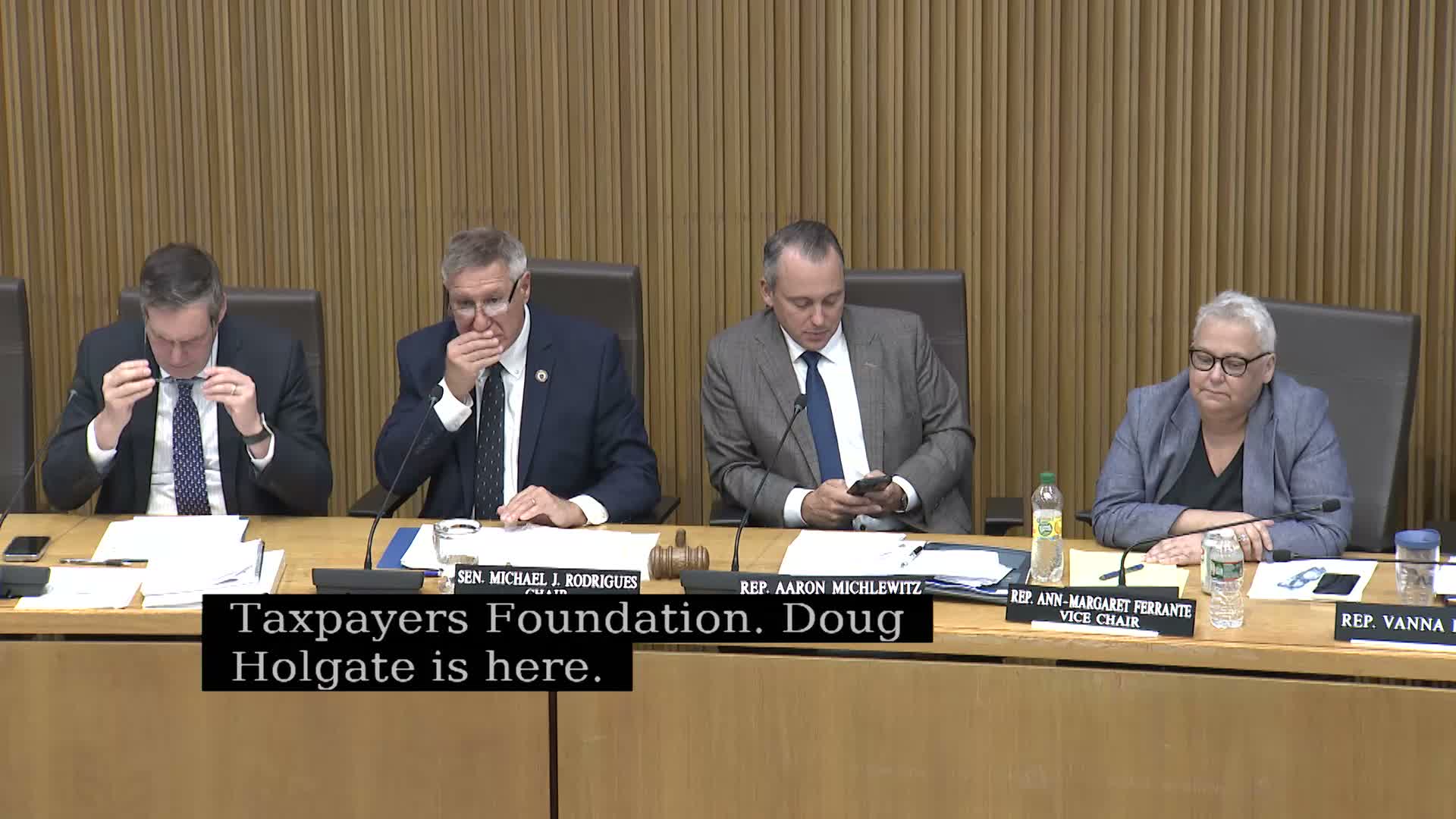
Doug Haugate, president of the Massachusetts Taxpayers Foundation, presented MTF’s estimates — projecting non‑surtax revenue of about $39.7 billion for FY25 and roughly $40.9 billion for FY26 — and offered three practical recommendations: include an explicit surtax estimate in the consensus revenue benchmark rather than a fixed operating threshold; publish monthly surtax estimates (with error bands) to aid transparency; and consider a modest corridor to allow limited prospective adjustments to the surtax threshold. “I think it’s equally important this year that we keep spending at 3% or less,” Haugate said, arguing that lower spending growth helps preserve flexibility against future shocks.
Academic witnesses emphasized macro risks. Michael Goodman of UMass Dartmouth said the commonwealth remains in relatively solid shape but warned that potential federal actions could be disruptive — particularly severe immigration enforcement and large cuts or structural changes to Medicaid reimbursements. Goodman described scenarios where tough immigration enforcement would reduce the available labor force in agriculture, construction, hospitality and higher education, with notable regional impacts.
Evan Horowitz of Tufts’ Center for State Policy Analysis outlined a specific technical concern about the new millionaire’s tax: early evidence suggests headline millionaire’s tax receipts (FY24 certified at about $2.2 billion, with some forecasts at $2.4 billion) have been associated with declines in other income‑tax collections. Horowitz said his analysis suggests offsets in the neighborhood of $850 million to $1.0 billion, meaning that surtax receipts cannot be treated as freely available general revenue because they are constitutionally restricted and do not replace lost unrestricted dollars.
Alan Clayton Matthews (Northeastern) emphasized that surtax forecasting is feasible when its components (capital gains, high‑income withholding, passthrough income) are modeled separately and that interest‑rate dynamics remain a key driver of capital‑gains volatility.
Witnesses and committee members agreed on the need for transparent monthly reporting on surtax receipts and for cautious assumptions when moving from forecasts to spending commitments. No committee votes were taken; the testimony will feed into technical sessions before the January consensus figure is set.