Get Full Government Meeting Transcripts, Videos, & Alerts Forever!
Get email alerts on the Commission Creation topic
No spam. Unsubscribe anytime.
Columbus hearing lays out plan for Commission on Immigrant and Refugee Affairs after OSU study and broad community support
Summary
Council presentations and two hours of public testimony backed a proposed ordinance (25/17/2024) to create a 15-member Commission on Immigrant and Refugee Affairs to advise city policy, improve language access and coordination, and foster belonging; staff said the commission could be seated by early 2025.
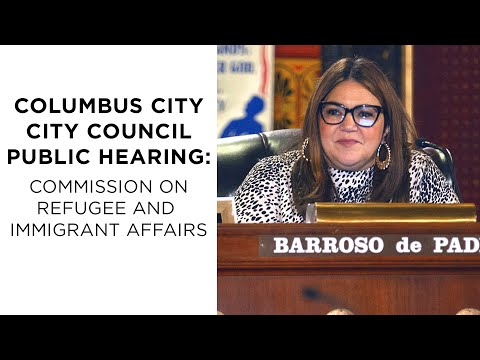
Columbus Councilmember Lourdes Barroso de Padilla introduced a proposal to create a City of Columbus Commission on Immigrant and Refugee Affairs, saying the body would give immigrant and refugee residents a formal platform to shape local services. The ordinance number referenced in the hearing was 25/17/2024; staff said the final text is still in development and expected to return to council for consideration.
Christopher Maitland of the council's legislative research office said the commission would consist of 15 members appointed by city council, with initial staggered terms of two to three years, and later three-year appointments. He said the commission would adopt bylaws, elect leadership, form subcommittees, develop an annual workplan with metrics, and work with city staff to monitor federal, state and local legislation that affects immigrant communities.
The hearing included a research presentation by Arati Makalu of The Ohio State University College of Social Work, lead author of the Immigrants Make Columbus project. Makalu described a mixed-methods study that engaged residents from 23 countries of origin and found a complex relationship between integration, belonging and quality of life: integration alone did not reliably raise quality of life, but when combined with a stronger sense of belonging the benefits of integration were more pronounced. "A dedicated commission on immigrant and refugee affairs definitely is a transformative move for our city," Makalu said, arguing the city should prioritize programs that foster belonging alongside service access.
Dr. Dorothy Hassan, who served on the study's community advisory committee, urged that the commission be backed by authority, budget and infrastructure so community members can "step up and be engaged." She and other witnesses repeatedly stressed that immigrant communities are not a monolith and need tailored, culturally responsive services.
City staff described operational needs the commission could help address. Hannah Jones, deputy director in the Department of Development, said housing issues—larger family sizes, language barriers and tenant-rights questions—would benefit from a culturally informed feedback loop. Assistant Chief Potts of the Columbus Division of Police said the commission could help the division improve language access and recruitment so the force better reflects the people it serves. Tiffany Krause of Columbus Public Health said the department completed nearly 6,000 interpretation requests since January and that almost 80% of children at immunization clinics have English as a second language; she said the commission could help prioritize culturally appropriate services and language access.
Speakers from dozens of community organizations, refugee-resettlement groups and immigrant-run businesses delivered two hours of testimony supporting the commission. Alpha Tongore, a local entrepreneur representing Liberian residents, said immigrant entrepreneurs drive local business formation and argued the commission was both "the right thing to do" and an economic necessity. Organizations including Jewish Family Services, the Central Ohio Workers Center, Somali Community Link, the Ohio Immigrant Center and numerous ethnic and faith-based groups highlighted needs ranging from expanded ESL offerings and workforce pipelines to centralized resource hubs and anti-hate protections for Haitian and Black immigrant communities.
Some speakers urged additional or linked actions: Michael Greenman, a long-time community volunteer, said a city photo ID program (not part of the draft commission language) would enable undocumented residents to access services and recommended council consider it alongside the commission. One public commenter raised critical concerns about crime and resource strain attributed to immigrants; council and most witnesses countered with data on economic contributions and service gaps.
Councilmember Barroso de Padilla closed the evening by thanking presenters and testimony providers and said staff will bring the ordinance back to council so it can be codified; she said the aim is to have a seated commission by the start of 2025. She also reminded listeners to verify voter registration by Oct. 7 ahead of early voting.
The hearing produced no formal motion or vote; ordinance language and final council action remain pending. The city will return the ordinance for council consideration and public comment before any appointments are made.