Get Full Government Meeting Transcripts, Videos, & Alerts Forever!
Get email alerts on the Pond Safety topic
No spam. Unsubscribe anytime.
Columbus hearing advances draft ordinance to classify dangerous retention ponds as public nuisances
Summary
City officials presented a draft amendment to Title 45 to create a public-nuisance process for certain private, manmade ponds at multiunit residential sites, require safety features (submerged safety benches for new ponds, signage, lifesaving equipment), formalize 14-day interdepartmental reporting, and allow abatement measures up to pond removal. No vote was taken at the hearing.
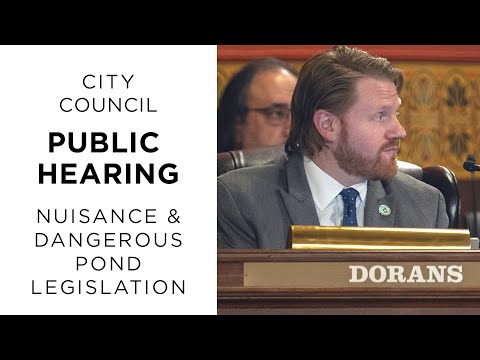
Columbus city leaders held a public hearing on draft legislation to amend Title 45 of the city housing code so certain private, manmade ponds at multiunit residential developments can be declared a public nuisance and required to carry specific safety measures.
President Pro Tem opened the hearing and said the proposal responds to “dozens” of child drownings and near-fatal incidents in Columbus over the past decade tied largely to manmade retention ponds at apartment and multifamily sites. He said the draft ordinance is intended to give the Department of Building and Zoning Services (BZS) tools to require safety improvements on ponds that pose a danger to nearby residents.
Columbus Public Health presented county data and equity concerns. Karen Gray, representing Columbus Public Health, said Franklin County Child Fatality Review found 47 children died in the county between 2013 and 2022 and that 53 percent of those deaths were from drowning. She said there were 11 pond drownings over a 10-year period and that Black children and children from first-generation immigrant families were overrepresented among victims: Black children accounted for about 60 percent of child drowning deaths and 82 percent of pond drownings; roughly 73 percent of pond-drowning victims were first-generation immigrants or in immigrant families. Gray urged “stacking layers of protection” and highlighted outreach materials (a “HOTT” card) available in English, Spanish, Arabic, French, Haitian Creole and Nepali.
The coroner supported the proposal. Franklin County Coroner Dr. Nate Obermeyer said pond drownings are “preventable” and described county cases from 2013–2022: 11 pond-related deaths, including six victims aged 1–4, four aged 5–9 and one aged 15–17. He recounted a September 2022 case where a 1-year-old was found 15 to 20 feet from an apartment and the police dive team took about 25 minutes to recover the child.
Key elements of the draft ordinance explained at the hearing include:
- Definition and scope: A pond is defined in the draft as a human-made pond on private property used for multiunit residential purposes that retains a permanent pool of water greater than 20 feet across at its widest point.
- Nuisance process and triggers: The legislation would create a public-nuisance process managed by BZS. When the Division of Fire responds to an injury or fatality at a pond, the bill requires the fire division to notify BZS within 14 days; public health would also be required to notify BZS when it becomes aware of a pond incident. Residents could also report potentially nuisance ponds directly through 311.
- Prescribed remedies: If BZS declares a pond a nuisance, it could prescribe abatement measures ranging from signage, fencing and lifesaving equipment to vegetative buffers, parking protections, relocation or, if the pond cannot be made safe, elimination of the pond. Property owners would retain appeal rights to the city’s property appeals board.
- Design and operational requirements: All new ponds at multiunit residential properties would be required to include a submerged safety bench (a gentler slope design that can reduce the hazard for people entering the water). Owners would also be required to post signage warning of danger, furnish lifesaving equipment such as safety rings, and send an annual notice to nearby residents informing them of the pond’s hazards.
- Implementation: Director Scott Messer said the city already maintains interdepartmental communication for many nuisance issues, but the ordinance adds a formal written notice requirement to create records and, in Messer’s words, “a little more leeway” to share information across departments. Messer also described plans to create a dedicated unit within code enforcement to manage pond nuisance cases on a pond-by-pond basis.
Councilors asked clarifying questions about which ponds are covered, permit and enforcement mechanics, and whether signage applies to existing as well as new ponds; Messer confirmed signage and basic safety requirements would apply to all ponds. Deputy Director for Neighborhoods (311) described the ways residents can submit reports—phone, online form, email or voicemail—and said 311 will coordinate with BZS to capture the information needed for enforcement.
No formal vote or motion was taken at the hearing. President Pro Tem said the ordinance is expected for first reading on Dec. 9, with a goal of a final council vote before the end of the year.
The hearing concluded with outreach details for residents: the office of the chair provided a phone number and email for questions and encouraged use of 311 to report hazardous ponds.
Next steps: first reading Dec. 9; final vote anticipated before year-end. The council did not adopt the ordinance during the hearing.