Get Full Government Meeting Transcripts, Videos, & Alerts Forever!
Get email alerts on the Budget Overview topic
No spam. Unsubscribe anytime.
Columbus council hears tight 2025 budget, plans hires for public safety while drawing on reserves
Summary
Officials presented a $2.5 billion proposed operating budget and a $1.23 billion general fund plan described as "austere," citing rising insurance and labor costs, use of a $19.7 million basic city services transfer, paused rainy-day deposits, and planned hiring of 180 police officers and 45 firefighters.
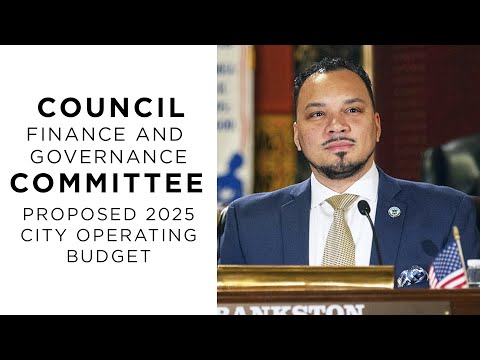
Council leaders and city finance officials on the Columbus City Council's Finance & Governance committee detailed a constrained proposed 2025 operating budget they say balances competing priorities with limited revenue growth.
The administration's proposal totals $2.5 billion in all funds, with $1.23 billion earmarked for general fund operations. Deputy Director Adam Robbins of the Department of Finance and Management said income tax—the city's largest general fund source—was forecast to grow 3% in 2025 (an estimate the auditor also used), producing an income tax projection of $898,474,000. Robbins said roughly 70% of general fund spending is personnel costs and noted rising insurance expenses and recently negotiated labor agreements as key drivers of budget pressure.
"Safety continues to be a top priority," Robbins said, explaining the proposed budget includes funding to hire 180 new police officers (plus 10 lateral transfers) and 45 new firefighters, and funds a $20.4 million neighborhood safety strategy.
Facing a tighter fiscal environment, the administration proposed several balancing measures: using a $19.7 million transfer from the Basic City Services Fund to the general fund for 2025, suspending the usual deposit into the Rainy Day Fund for the first time in recent years, and temporarily not making the annual contribution to the 27th-pay-period reserve. Robbins told council that the Basic City Services Fund would end 2025 with a zero balance if the transfer is used as proposed.
Auditor Megan Kilgore and Robbins both described the budget as a maintenance or continuation budget focused on core services—public safety, housing, transportation and workforce development—rather than expansion. Kilgore urged continued investment in staff training and requested reconsideration of a data security and analytics position for the auditor's office that was not included in the mayor's proposed budget.
Council members asked for clarity about the durability of the one-time transfers and reserves. When asked how the city could replenish the 27th-pay-period fund's roughly $3 million gap, Robbins proposed options that include making a double payment or spreading contributions across multiple years.
Council members also pressed staff on which line items might be legally or practically eligible to shift between restricted funds and the general fund. Robbins replied that some movements are possible but constraints and legal restrictions (and debt-service priorities) limit flexibility.
The committee was told the administration expects continued pressure on insurance and contract costs and that revenue assumptions leave little room for added spending. The finance director said the city is maintaining a AAA bond rating and is counting on investment earnings to help meet earlier Rainy Day Fund targets despite not making a deposit in 2025.
Next steps: the Finance & Governance hearing concluded with staff promising to return additional details in subsequent department-level hearings next week, including dedicated public safety budget hearings.