Get Full Government Meeting Transcripts, Videos, & Alerts Forever!
Get email alerts on the Bike Plus topic
No spam. Unsubscribe anytime.
Columbus committee hears Bike Plus plan calling for 500-mile vision network, near-term projects and stronger maintenance
Summary
City staff presented the Bike Plus bikeways and micromobility plan, a prioritized 26-policy implementation package and a near-term build of 10–12 projects; public commenters urged more immediate intersection safety fixes, dedicated maintenance funding and a capital boost to implement the plan.
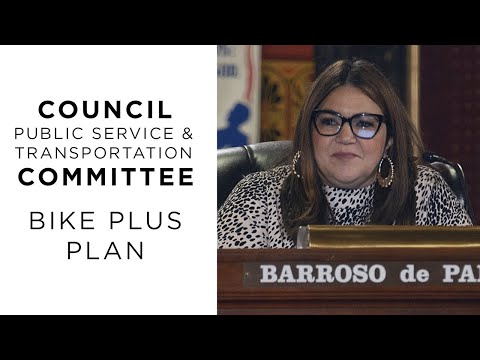
Council Chair Rosa de Padilla convened a committee hearing where Department of Public Service staff and consultant Tool Design Group presented the Bike Plus plan, a citywide update of Columbus’s 2008 bikeways strategy that lays out an almost 500-mile vision network and a near-term program of 10–12 projects to be built over the next few years. The plan aims to increase safe, connected options for people who "don't call themselves cyclists" and to advance equity and Vision Zero goals.
The presentation described three goals: build safe streets with protected infrastructure, get more people biking and rolling through programs and policy changes, and plan for equity by prioritizing "Communities of Interest" where residents are more likely to be harmed as pedestrians or cyclists. Brian Ashworth, Transportation Planning Manager for the Department of Public Service, said the plan pairs technical analysis with extensive outreach: "We had nearly 100 in-person events, almost 12,000 engagement touchpoints, and about 6,000 public comments," he said, noting that many short trips—"a third of trips taken in 2023 were 2 miles or less"—could be shifted to active modes if safe routes exist.
Why it matters: staff said adoption is critical to secure grants and to coordinate with LinkUs, Vision Zero and other regional efforts. Tool Design and City staff distilled roughly 150 initial policy ideas into 26 priority policies and programs—including a bikeways maintenance policy, a complete-streets commitment, quick-build pilots and expanded bike-share access—intended to guide both internal decisions and grant applications.
Public commenters broadly supported the plan but pressed for faster safety work and stronger funding. Brian Estabrook, board president of advocacy group Yay Bikes, urged the council to increase the annual capital budget for bike and pedestrian projects to at least $25,000,000 to support staff capacity, quick builds and high-priority infrastructure. Transit Columbus member Brianna Miller said infrastructure must lead: "Infrastructure speaks louder than campaigns, period," she said, and asked the city to prioritize immediate intersection safety upgrades across the network after staff noted thousands of high-stress intersections in the analysis.
Implementation details and near-term projects: presenters highlighted 4th Street and East Broad Street as examples already in design or under construction, and described a maintenance policy being drafted to standardize sweeping, plowing and repairs across agencies. Staff said quick-build pop-ups—temporary, testable installations—help test designs and community acceptance before permanent construction.
Remaining questions and conditions: advocates and residents reiterated long-standing concerns about sidewalks, gaps in low-income and edge neighborhoods, maintenance funding, and the need for formal interagency and community advisory forums. David Roseman, a long-time advocate, asked when Columbus will adopt a formal Complete Streets policy and reestablish pedestrian/bicycle advisory committees; staff responded that an updated Complete Streets policy is nearing completion internally. Several speakers stressed the need for dedicated maintenance funding and staff capacity to avoid the fate of past plans that were not fully implemented.
What's next: Chair de Padilla said the committee will present the Bike Plus plan to council on Dec. 9, 2024, where adoption will be considered. The hearing closed with an emphasis on safety and equity as the guiding principles for the city's next steps.