Get Full Government Meeting Transcripts, Videos, & Alerts Forever!
Get email alerts on the Tree Preservation topic
No spam. Unsubscribe anytime.
Canton Township reviews draft tree-preservation ordinance, delays technical mitigation section
Summary
Planning staff presented a draft tree and woodland preservation ordinance, highlighting permit procedures, exemptions for small parcels, and that technical mitigation standards (Section 8) will be held for later review with consultants; commissioners pressed for clarity on homeowner and HOA impacts and enforcement.
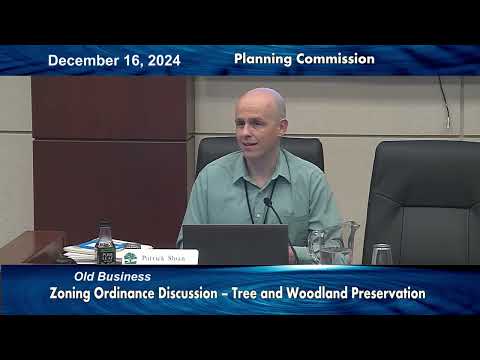
Canton Township planning staff reviewed a draft tree and woodland preservation ordinance and outlined next steps for public hearings and technical standards.
At the meeting staff said the draft, dated July 24, has been discussed with the Planning Commission at meetings in August, September and October and that the board would examine sections 7, 9 and 10 this evening while deferring Section 8 (mitigation) because it contains detailed mathematical standards that staff intends to finalize with consultants. "Once we have a grasp of all the other sections of the ordinance, then the very last one we can deal with is tree mitigation," staff said.
Why it matters: the ordinance would set procedures and criteria governing tree removal permits, require professional surveys and mitigation plans in specified cases, and create exemptions intended to limit costs for typical homeowners. The board must balance tree preservation goals with costs for residents and HOAs and clarify enforcement and exemption thresholds before setting a public hearing.
Key details: staff described Section 7 permit procedures that require a tree survey prepared by an arborist and, where planting or other mitigation is required, a mitigation plan prepared by a landscape architect. The draft contains seven decision criteria emphasizing preservation, includes terms of permit and performance guarantees, and allows staff to refer subjective or significant applications to the Planning Commission.
On exemptions, staff noted the current zoning text exempts occupied parcels under 2 acres from permitting but the ordinance team is considering lowering that threshold (options discussed included 1 acre, ½ acre or ¼ acre) and adding numeric limits on exempted removals (staff used an example of allowing removal of up to five trees per acre in some scenarios). "If there's a single-family homeowner that's just removing a few trees, that could be cost prohibitive," staff said, arguing the exemptions should protect typical single-family maintenance while capturing large-scale removals by developers or HOAs.
Enforcement and outreach: staff described enforcement as limited today but said the township has sent outreach emails to HOAs reminding them of planting obligations. The township's tree-planting contract allows HOAs that meet a threshold to purchase trees at the township unit price, and a forthcoming rebid of the tree removal/trimming contract will include language intended to streamline replacement and reduce reliance on enforcement letters.
Critical root zone and expert review: commissioners asked about objective standards for the critical root zone. The meeting packet contained a graphic and a formula discussed at the meeting (described as 'one and a half feet per inch of DBH'), which staff said they would update and verify with the township's landscape-architect and arborist consultants. Staff said any increase in protection area recommended by a township arborist should be grounded in species, slope, soil or erosion reasoning and tied back to the ordinance's evaluation criteria.
Next steps: staff recommended compiling comments from tonight's session, finishing mitigation section(s) with technical consultants, and then setting a public hearing likely in late winter or early spring once mitigation standards are ready.
At the meeting three procedural motions were recorded: the minutes of Dec. 2 were approved with a correction to roll-call wording; the agenda (as amended to renumber old business items 1–3) was approved; and the board adjourned by unanimous voice vote.