Get Full Government Meeting Transcripts, Videos, & Alerts Forever!
Get email alerts on the Urban Camping topic
No spam. Unsubscribe anytime.
Missoula council bans camping in parks, narrows camping windows and tightens enforcement in amended ordinance
Summary
The Missoula City Council on Dec. 2 approved amendments to Title 1260 that prohibit camping in city parks, narrow permitted camping hours during winter and revise enforcement procedures. The ordinance passed 9–3 after weeks of debate and more than two hours of public comment.
Missoula City Council voted 9–3 on Dec. 2 to approve an amended ordinance changing Title 1260 of the Missoula Municipal Code, removing city parks from permitted camping locations, adjusting winter camping hours and altering enforcement procedures.
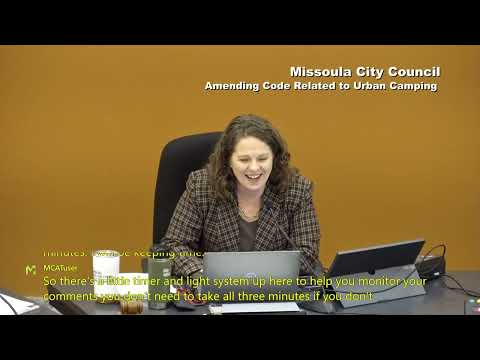
Council President Cheryl Sherrill, one of the ordinance sponsors, told the council she supported changes because parks pose conflicts and safety issues for both campers and other users. "I believe the vast majority of our community does not want people camping in our parks, and neither do I," she said during sponsor remarks.
The approved ordinance keeps in place the city's broader urban-camping framework while adopting several changes the council accepted in friendly and published amendments. Key elements that city staff and the sponsors highlighted in prior briefings and in legal walkthroughs include:
- Prohibiting overnight camping on lands classified as city parks (chapter/section changes to Title 1260 and references to Chapter 1240).
- Narrowing the permitted night-time window for camping outside buffer zones during winter to allow camping from 6 p.m. to 8 a.m. between Nov. 1 and March 1 (a sponsor'accepted friendly amendment).
- Changes to vehicle camping rules, including removing the 120-hour unpermitted allowance and allowing up to two permitted vehicles on a block where feasible.
- Enforcement and penalties: staff and the city attorney outlined moving certain proceedings from a civil municipal-infraction track back to misdemeanor prosecution in order to streamline enforcement; the ordinance preserves a $50 fine structure while aiming to rely on established misdemeanor procedures rather than a newer municipal-infraction process that staff called burdensome in practice.
City administrative staff said enforcement and implementation have been active since the ordinance originally passed in June: Chief Administrative Officer Dale Bickel reported the city had "issued over a 128 written warnings and over 28 citations under the ordinance," and described operational challenges including personnel turnover and the difficulty of a civil-infraction process. "The civil infraction process...is proving difficult and complicated," Bickel said, explaining staff support for reverting some matters to misdemeanor procedure.
Erin Pahan of Community Planning, Development and Innovation summarized the city's continuum of services, citing a Johnson Street emergency shelter funded at about $1,000,000 annually that serves roughly "an average number of about 135 individuals per night." She also described the city's community strategy work and partnerships with providers and national initiatives such as Built for Zero.
Council debate and public testimony
Council discussion through the hearing reflected deep divisions. Supporters of the amendments—some sponsors and dozens of neighbors testifying at the meeting—cited public-safety complaints, needles and trash in park playgrounds, and repeated local incidents at places such as McLeod Park.
"We need to have equal law for everybody," said David Moore of the local No Camp Missoula group during public comment, urging enforcement. Multiple residents described finding syringes and other hazards in parks and urged the council to remove parks as allowable locations.
Opponents warned that the changes would criminalize people without housing and urged the city to ensure shelter capacity and services before tightening enforcement. "Criminalizing homeless people is not the answer," said criminal-defense attorney Mariah Welch during an online public comment, describing how misdemeanors can carry collateral consequences for people on probation.
Several council members emphasized limits on city resources and urged the state and federal partners to provide increased funding and treatment capacity. Councilor Jones noted the city's current investments and ongoing strategy work: "We are going to have our homeless strategy...coming out in January," she said, urging focus on long-term solutions.
Amendments and votes
Two notable published amendments were adopted during the meeting: a sponsor amendment (attachment 8) that directs the city to compile a resource guide and work with willing service providers to identify services and temporary designated sites, which passed 9–3; and a change (attachment 10) that alters a permit-approval clause so council approval reads "may" rather than "shall," which passed unanimously. Several other proposed amendments (including councilor Carlino's measures to bar citations or abatements when no indoor shelter was available) were considered and defeated by roll call.
What happens next
With the ordinance adopted as amended, staff said the city will continue outreach-led enforcement and will implement adjustments to permit programs and enforcement processes described in the amended code. Staff and sponsors repeatedly said the ordinance is a management tool and not a substitute for additional state and federal support for addiction treatment, mental-health services and housing development.
The council approved the consent agenda items that followed the hearing and adjourned at about 11:55 p.m.
The council and staff said they plan near-term follow-up on implementation details, including publication of the resource guide and continued coordination with providers and the Missoula Coordinated Entry System.
Ending note
The ordinance passed amid sharp public disagreement: some neighborhood residents welcomed restrictions on park camping; service providers, unhoused residents and advocates warned the changes could increase harms unless paired with concrete new shelter options and services. The city has signaled a parallel track of strategy and planning to pursue those programmatic goals in early 2025.