Get Full Government Meeting Transcripts, Videos, & Alerts Forever!
Get email alerts on the Telecommunications topic
No spam. Unsubscribe anytime.
Cheektowaga panel tables Verizon monopole at Public Storage parcel amid fall‑zone, setback and visual‑impact concerns
Summary
An application for a roughly 120‑foot Verizon monopole at 2733 William Street was tabled after committee members urged the applicant to consider alternative pad locations, confirm breakaway/fall‑zone engineering and submit responses to planning‑board comments and FAA/engineering materials.
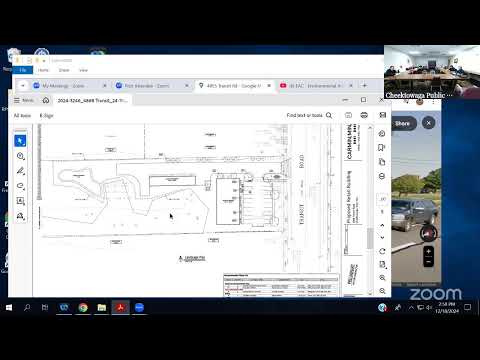
The Environmental Advisory Committee on Dec. 18 tabled further action on a proposed special‑use permit for a roughly 120‑foot telecommunications monopole at 2733 William Street after planners and committee members flagged setbacks, fall‑zone and visual‑impact concerns.
Applicant representative (first referenced as Applicant representative (6)) said Verizon is seeking the site on a 4.6‑acre parcel owned by Public Storage Inc. to remedy local coverage and capacity gaps and described supporting materials in the application, including an RF report and a site‑selection analysis. He said the application included a waiver request under town code section 255‑27 because the preferred location does not meet the standard setback calculation.
Committee members expressed concern about the tower's "breakpoint" and fall radius. The applicant described typical design practice and cited an estimated fall‑zone radius of about 60 feet for the proposed structure but agreed to confirm engineering details in supplemental materials. One member urged moving the pad toward the center of the storage complex (even if units must be removed) or roughly 70 feet north and east to increase setback distance and reduce visual impacts.
Other technical questions included whether on‑site equipment would produce noise (the applicant said testing/maintenance is expected to be low, with generator testing described as biweekly) and whether FAA coordination was complete (applicant said an FAA filing was made and the initial response required no further notice). The applicant said he will provide additional engineering responses and consider alternative pad locations before the next meeting. The committee voted to table the item and asked the applicant to return with updated submittals.
Next steps: applicant to provide written engineering responses to planner comments, confirm fall‑zone and setback measurements, respond to planning‑board concerns and supply any FAA documentation or DOT replies for the committee's next meeting.