Get Full Government Meeting Transcripts, Videos, & Alerts Forever!
Get email alerts on the Wastewater Treatment topic
No spam. Unsubscribe anytime.
Milton approves fast‑track task order for new wastewater plant, prioritizes removing effluent from Blackwater River
Summary
On Dec. 19 the Milton City Council approved a $2.53 million fast‑track task order with Baskerville Donovan Inc./BDI to redesign and relocate the city’s wastewater treatment facilities to an 80‑acre site and directed the engineer to prioritize effluent disposal to stop discharge to the Blackwater River. Council voted by voice; exact headcount was not recorded in the transcript.
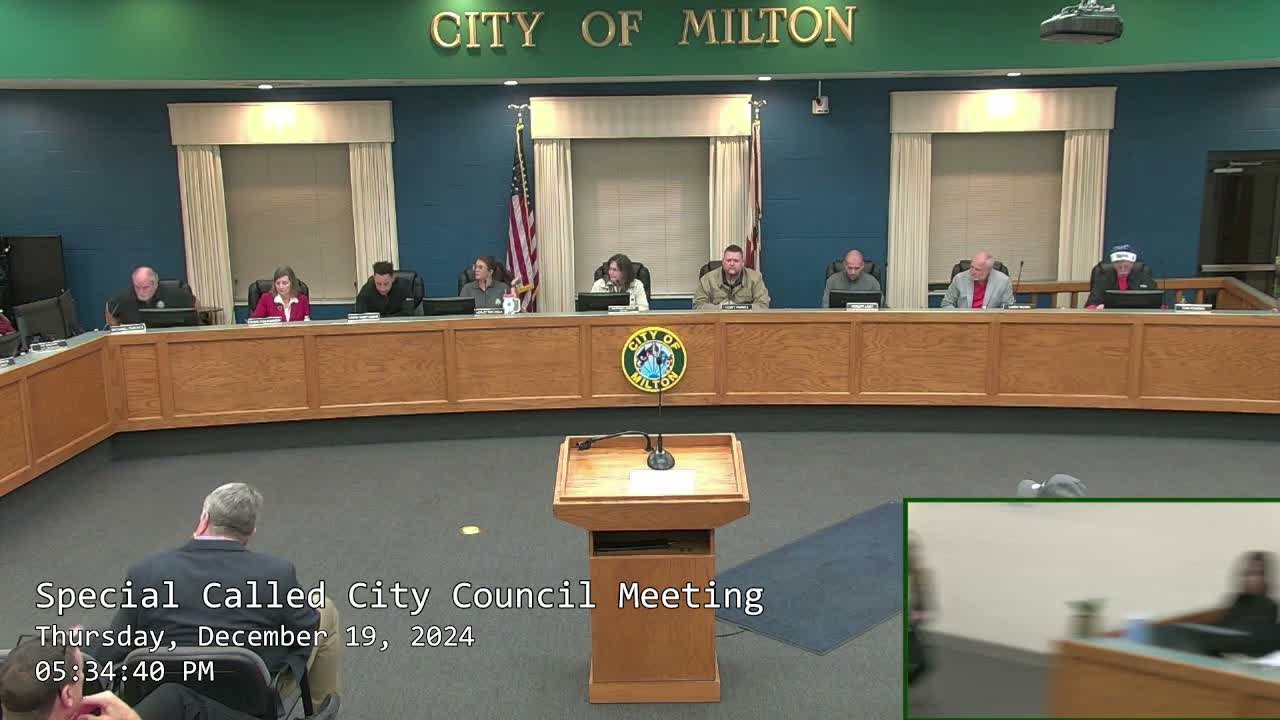
The Milton City Council on Dec. 19 approved a fast‑track task order for redesign work on a new wastewater treatment plant and ordered the city engineer to prioritize design work that removes treated effluent from the Blackwater River.
The motion, moved by Councilman Leek and seconded by Councilman Powell, authorized a fast‑track task order priced at $2,531,825 to Baskerville Donovan Inc. (BDI). Because the meeting’s Wi‑Fi was down, council took a voice vote; the mayor announced all members present voted in favor and the motion passed.
The council faced two options presented by city staff: a ‘‘fast track’’ approach to relocate the intermediate storage tank, lined pond and treatment plant to the 80‑acre site (estimated at about 465 days and roughly $2.5 million for the task order scope presented) or a full ‘‘blank‑page’’ redesign guided by public input (about 675 days and approximately $6 million for the preliminary engineering scope). Staff said both task orders were sized for a 4,000,000 gallon‑per‑day plant so the city would begin with full capacity rather than phased expansion.
Ed Spears, who introduced the task orders, told the council the fast‑track approach would preserve the city’s remaining ARPA funding eligibility and allow staff to identify projects that keep ARPA funds available for the city. Finance staff said their audit work and project list would likely limit potential ARPA losses to about $1,000,000 if the council delayed a decision beyond the stated deadline.
Spears and BDI engineers described key constraints: the city must secure an easement across a parcel that Santa Rosa County is reclaiming under a reverter clause; the county has agreed in principle to an easement but formal documents remain under attorney review. Staff estimated the city needs several hundred additional acres for disposal capacity depending on the allowable discharge rate (staff cited ranges such as roughly 211 to 434 acres in different scenarios) and used a current valuation of about $606,750 per acre in cost calculations.
City operations staff also reported the existing downtown plant is near full capacity. The plant operator, identified in the meeting as Mister Cook, said the facility is being patched and kept running but cannot clearly take additional sustainable capacity without upgrades: "We are almost at full capacity... We just had to buy one new pump, and we gotta buy two more pumps for it here in the last month," he said.
Multiple council members and members of the public pressed to prioritize removing treated effluent from the Blackwater River rather than delay and redesign the entire plant. A public commenter, Joe Lewis, urged the council to "focus on fixing our current problems now rather than developing new areas," and several environmental advocates and river‑protection groups asked the council to protect the 24‑ and 100‑acre parcels and to post fuller cost breakdowns publicly before votes.
BDI representatives told the council the projects could be sequenced so the city advances effluent‑disposal facilities (lined pond, intermediate storage and reuse pump station) ahead of or in parallel with full plant design, but warned siting the plant after effluent work may create site‑specific tradeoffs and additional capital cost. BDI and the city estimated a roughly 345–465 day engineering effort to produce biddable documents for the effluent/disposal work under a prioritized approach, with construction estimated thereafter (BDI estimated approximately 18 months of construction in discussion).
On funding, staff reported available city funds for this effort (not counting ARPA) at roughly $18.7 million and estimated a potential $700,000 from sales of two smaller parcels; Spears said the estimated full deficit to construct a 4,000,000 gpd plant and disposal area is about $90,600,000 and that the city will pursue grants, revenue sources and other financing options to close the gap.
The council’s formal action approved the fast‑track task order and included an explicit request to BDI to give "full consideration and try to focus on the effluent side of it, trying to get the effluent out of the river." The meeting concluded immediately after the voice vote.
What’s next: staff and BDI will proceed with the task order work; permitted designs, conditional‑use and county review will follow as required. Staff said they will also pursue permit renewal language with the Florida Department of Environmental Protection (FDEP) to align compliance deadlines and will report back to council with updates and a budget presentation in January.