Get Full Government Meeting Transcripts, Videos, & Alerts Forever!
Get email alerts on the Historic Signage topic
No spam. Unsubscribe anytime.
Milton historic-signage plan advances as board assigns photo sourcing and weighs QR links
Summary
Milton’s Historic Preservation Board reviewed lamppost sign specifications, agreed to start with 10 locations, and assigned members to source higher-resolution images and write sign verbiage; staff will check whether QR codes and walking-tour integration are feasible before the Jan. 9 follow-up meeting.
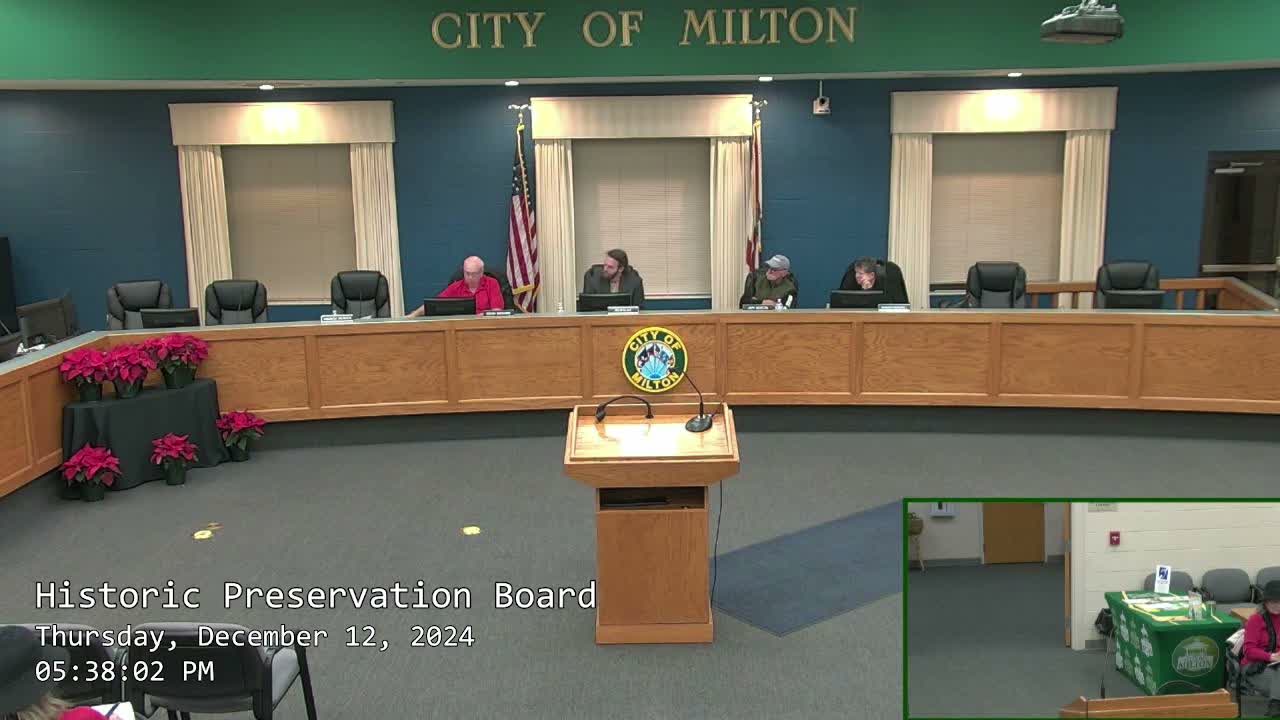
The Historic Preservation Board in Milton on an evening meeting reviewed proposed lamppost signage and agreed to gather higher-quality images and written context before finalizing designs.
Planning Department staff told the board the signs would be aluminum and two-sided and noted size and production limits, saying, "if it'll fit on 18 by 20 4 area it can be printed in vinyl and then covered with UV protectant." The board agreed to begin with 10 locations for the initial rollout and emphasized legibility and image quality.
Councilwoman Ferrell, introduced at the start of the meeting as the city-council liaison appointed by the mayor, thanked board members and staff for their work but did not propose changes to the draft sign specifications.
Board members pressed for photos that add narrative interest, suggesting images of graduating classes, street scenes or aerial/contextual views. One member noted archival sources to check, including the Voices Museum and university archives, and another suggested Sanborn maps and period postcards as possible leads.
Volunteers were assigned: Teresa to follow up on school archives; Brian to contact the Methodist Church and a former pastor; another member to search the Voices Museum; and the chair to pursue a post office photo and permission for use. David Farrow, a Milton resident, urged including people in images that link buildings to community life.
Members also discussed linking the signs to a digital walking tour. Planning staff said the city's signs are printed from a PDF submitted to the sign company and that they would "see if I'm sure they can design as a QR code" and check whether the walking-tour system has a limit on points. A board member cautioned that QR codes may not be accessible to all users and suggested ensuring the lampposts are included in the walking tour itself.
No formal vote was taken on sign text, photographic selections or QR-code use; staff will collect photo and verbiage options and return the item to the board at the Jan. 9 meeting for further consideration.