Get Full Government Meeting Transcripts, Videos, & Alerts Forever!
Get email alerts on the Homelessness Enforcement topic
No spam. Unsubscribe anytime.
Council advances first readings of camping and weapons code changes amid heated discussion on homelessness and park enforcement
Summary
Council held extended discussion of proposed changes to the city's prohibited-camping ordinance and a new code to ban certain tools and implements on city real property, advanced first readings (Ordinances 3605 and 3606), and debated enforcement limits, transitional court options, environmental-priority areas and staffing constraints.
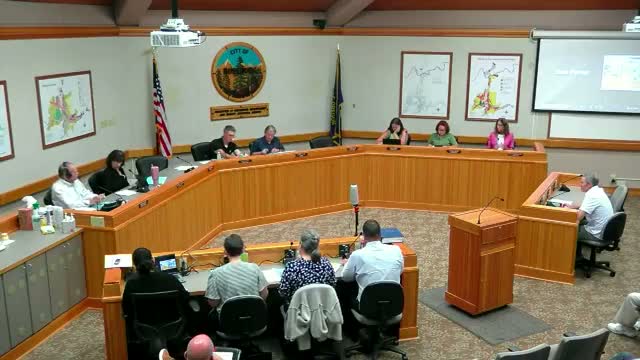
The Roseburg City Council on Aug. 12 advanced first readings of two related code amendments while holding an extended debate over enforcement and the city's response to homelessness.
Staff presented two code changes. The first (Ordinance 3605) would amend the prohibited-camping ordinance to allow prosecution beyond the current "violation" classification, require courts to consider mitigating factors (for example, whether a person immediately removed personal property or engaged with the Roseburg transitional court program run with ADAPT), and cap penalties (first conviction not to exceed $100, second up to $250, third and subsequent convictions may include up to seven days incarceration). The proposal also would add prohibited camping back to the list of offenses that can be used to exclude persons from enhanced law-enforcement areas.
The second proposal (Ordinance 3606) adds a code section prohibiting possession of specified weapons, tools and implements on city real property where those items are being used to damage public property (examples listed include machetes, bull whips and certain digging tools). Staff emphasized the ordinance would not attempt to regulate firearms protected by the Second Amendment and that authorized city staff and permitted activities would be exempt.
Council asked detailed questions about how the transitional court operates, whether there will be a city education period before enforcement, how environmentally sensitive riverbank areas are prioritized, and whether contractors or park employees would be exempt when performing work. Staff said the transitional court is a post-conviction option that ADAPT helps administer and that the city planned outreach by the homeless liaison officer before enforcement begins. Staff also explained the cleanup process: posting notices, evidence tagging, work crews, dumpsters and report writing, and said cleanups can take multiple days.
Councilors pressed on resource constraints: the police chief and staff said enforcement is limited by staffing and that additional personnel would be needed to change operational practices ("give me six more," the chief said when asked if more officers would help). Council agreed to proceed with first readings of both ordinances.
Next steps: both ordinances were given first reading and will return for further readings; staff will begin outreach/education work and coordination with the homeless liaison officer and partner agencies prior to possible enforcement changes.