Get Full Government Meeting Transcripts, Videos, & Alerts Forever!
Get email alerts on the Urban Growth Boundary topic
No spam. Unsubscribe anytime.
Roseburg council moves forward with Charter Oaks UGB swap after hours-long hearing
Summary
After a public hearing with dozens of speakers, the Roseburg City Council voted 8–0 to ask staff to prepare findings and move forward with a proposed urban growth boundary swap to include the Charter Oaks area and remove two existing properties, a change city staff says would add capacity for roughly 673 theoretical dwelling units.
The Roseburg City Council on July 22 voted unanimously to ask staff to prepare findings supporting a proposed urban growth boundary (UGB) swap that would add the Charter Oaks area to the city's UGB and remove two privately held properties currently inside the boundary.
Staff presentations framed the swap as a tool to expand housing opportunity. “Our objective in regards to this — the entirety of this UGB swap — is to provide housing opportunity,” said a city planning staff member during the presentation, describing the multi-year process and the materials in the council packet, including Planning Commission findings and letters of support and concern.
The staff report described a targeted exchange: about 290 acres would be removed from the UGB while roughly 220 acres would be added, and project analysts estimated 673 dwelling units would be removed and 673 added in the swap’s accounting. City staff emphasized that the swap does not guarantee development at that intensity and that buildout could be substantially less. The report cited the city’s 2019 Housing Needs Analysis, which forecasts the UGB population growing from 30,256 to 35,771 and a demand for 2,768 new dwelling units over 20 years; staff noted Charter Oaks would supply at most a portion of that need.
Infrastructure witnesses addressed capacity and cost. Jim Baird, general manager of the Roseburg Urban Sanitary Authority, said engineering solutions exist to extend sewer into the area but that construction would be developer-driven and expensive; he noted the treatment plant’s design capacity of 7.9 million gallons per day and current average summer flows around 3 million. “For enough money and time, you pretty much can do anything,” Baird said when describing routing and pump station options.
Chief Tyler Kristofferson of the Roseburg Fire Department said city service coverage would improve response times and water delivery if the area ultimately becomes city property: city engines could reach the area in roughly six minutes with three engines and 12 firefighters fully staffed, he said, noting the department’s favorable ISO rating.
Traffic consultant Kelly Sando summarized a high-level study done to meet state planning-rule requirements for a maximum-buildout scenario. She identified several intersections that would require improvements — including Garden Valley at Stewart/Parkway and Troost at Calkins — and said many of the needed changes match projects already identified in the city’s Transportation System Plan.
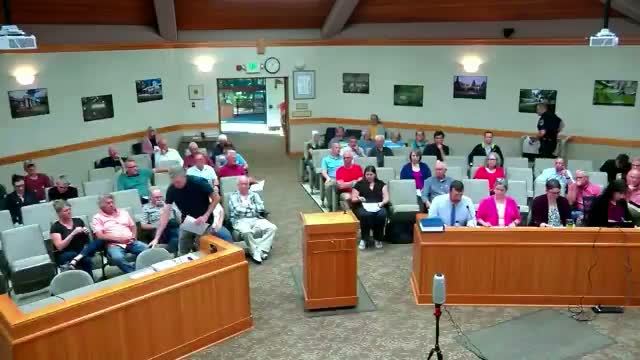
Public comment split sharply. Dozens of residents attended and spoke. Opponents raised traffic safety concerns and criticized the application and analysis as flawed or incomplete: “The traffic study is way off the mark,” said Joe Meyer of Charter Oaks, who also questioned whether nearby proposed schools or other trip-generating uses were accounted for. Several speakers submitted written materials for the record, including an 18-page legal letter flagged by a resident as raising Goal 14 and Oregon land‑use concerns. Other residents and local leaders, including builders, the county’s economic development director and Roseburg School District Superintendent Jared Gordon, urged approval to expand the housing supply and improve the city’s ability to recruit employees and retain employers.
After a period of council discussion in which members acknowledged both the neighborhood’s concerns and the broader housing shortage, Councilor David Moore moved to request staff prepare findings and to approve the set of land‑use actions listed in file CPA‑23‑002 (UGB amendment, de‑annexation of the Sarafin and Atkinson properties, annexation of the Troost right‑of‑way to the new UGB edge, city comprehensive plan map and zoning amendments for Charter Oaks, and amendment of the Urban Growth Management Agreement to include Charter Oaks). The motion was seconded and carried by voice vote reported as 8–0.
The action authorizes staff to draft formal findings and conclusions for a future adoption step; it does not itself adopt zoning or authorize construction. Staff and multiple councilors stressed there will be subsequent land‑use review, utility planning and development‑specific approvals before any new subdivisions are built.
Next steps: staff will prepare written findings and return recommended ordinances and maps for council consideration as required by the land‑use process; the matter could also advance to Douglas County review as appropriate under the intergovernmental agreements and area jurisdiction provisions.