Get Full Government Meeting Transcripts, Videos, & Alerts Forever!
Get email alerts on the Downtown Redevelopment topic
No spam. Unsubscribe anytime.
Commission approves IRB advisability and authorizes economic deal for 727 Points Ave redevelopment (3–2)
Summary
The commission approved a performance‑based industrial revenue bond (IRB) and authorized an economic development agreement for the proposed 'Hartford' mixed‑use project at 727 Points Ave by Hutton Development, contingent on annual performance and occupancy thresholds; the votes were 3–2 after a lengthy public hearing.
The Manhattan City Commission voted 3–2 on Dec. 17 to determine the advisability of issuing industrial revenue bonds and to authorize city administration to finalize an economic development agreement for the proposed Hartford mixed‑use redevelopment at 727 Points Avenue (the Commerce Bank site).
City staff described a performance‑based abatement and IRB structure that links the percentage of property‑tax abatement to construction investment and first‑floor commercial occupancy. Staff said the full project would represent roughly a $15 million investment, with about 19,000 square feet of first‑floor commercial space and 54 residential units on the floors above. Staff also noted a sales‑tax exemption on construction materials and proposed a baseline payment model intended to guarantee some tax receipts to taxing entities while allowing an incentive for redevelopment.
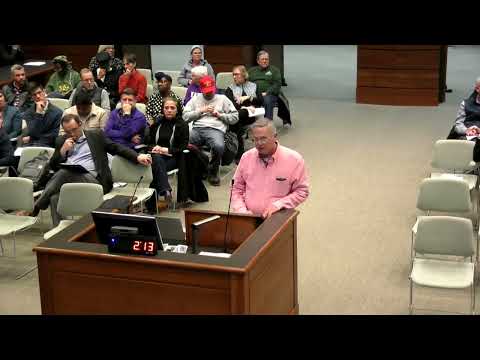
Developer Hutton Development presented design concepts and community commitments including on‑site parking, landscaping, salvage of reusable materials in partnership with Habitat for Humanity, and K‑State internship opportunities. “We’ve tried to listen, adapt, adjust, and keep moving forward,” Kyle Blasdell of Hutton said during the presentation.
The project drew both support and opposition. Supporters, including downtown stakeholders and the Chamber of Commerce, said the proposal advances the Beyond Tomorrow Downtown Plan, adds housing downtown and helps activate underutilized property. The Chamber’s Jason Smith emphasized infill benefits and argued that, “without the incentive, the project won’t move forward as it stands.”
Opponents, primarily residents of the adjacent Houston‑Pierre historic district, raised concerns about project scale relative to the neighborhood, potential light and noise pollution, vehicle traffic and angled parking impacts on bicycle routes, and a lack of explicit workforce‑housing commitments. Several speakers urged the commission to require stronger screening, reduce building massing, or send the proposal back for additional review by the Historic Resources Board; staff and the HRB representative said HRB review is not required for this site under current code.
The commission first voted to adopt a resolution (121724 GS) determining the advisability of issuing IRBs for the Commerce Bank/Hartford project; the roll call recorded yes votes from Commissioner Motta, Commissioner Minton and Mayor Adamczak, and no votes from Commissioner McCullough and Commissioner Opelt, for a 3–2 outcome. The commission then authorized staff to finalize and execute an economic development agreement with Hartford/Hutton on the same 3–2 vote.
Staff emphasized the structure is performance‑based: abatement levels are tied to certified investment and measured first‑floor occupancy thresholds (year‑one occupancy minimums begin at 35% for top‑tier abatement and increase in later years). Staff said abatements would be recalculated annually and could decline if commercial performance falls.
Next steps include drafting the final economic development agreement and the IRB issuance ordinances; staff noted future actions the governing body will need to consider when the abatement and IRB instruments are finalized.