Get Full Government Meeting Transcripts, Videos, & Alerts Forever!
Get email alerts on the Land Use And Zoning topic
No spam. Unsubscribe anytime.
Rexburg planning commission forwards fencing and billboard code changes, keeps existing billboards grandfathered
Summary
The Rexburg Planning and Zoning Commission voted Aug. 8 to recommend changes to city code that clarify fence sight-triangles, gate and permit rules and to grandfather existing billboards while barring new billboards in city limits. Commissioners debated barbed-wire limits for livestock before approving the recommendation for city council review.
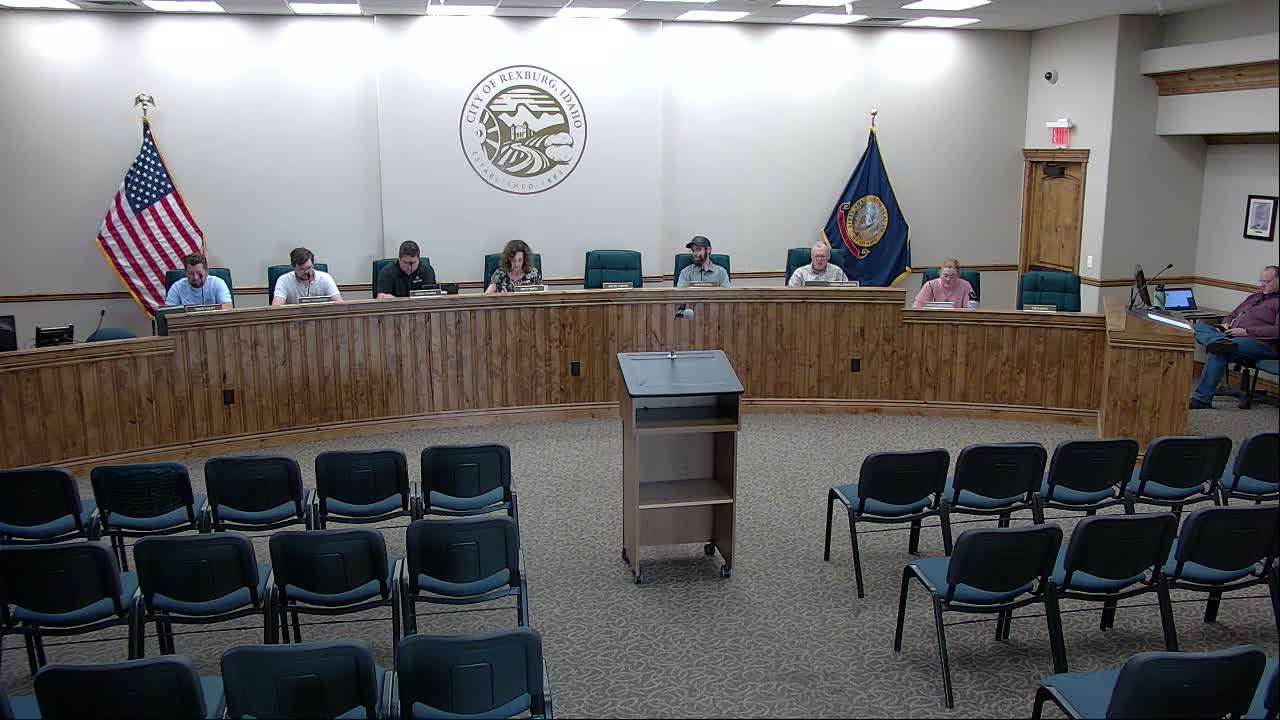
The Rexburg City Planning and Zoning Commission on Aug. 8 voted to recommend that City Council adopt amendments clarifying standards for fences and billboards, including explicit sight-triangle measurements, gate and permit rules and a provision to grandfather existing billboards while prohibiting new ones inside city limits.
Commissioners reopened a previously tabled public hearing on the package and discussed multiple changes. Speaker 5, the meeting chair, summarized the draft as tightening definitions and adding a quick-reference infographic for sight triangles and fences while clarifying that "no new billboard signs will be allowed" and that "existing approved billboard signs shall be designated as having a grandfathered status and may be repaired or replaced." The chair and staff said the change removes a prior 50% rebuild restriction so grandfathered signs can be maintained.
The amendments include technical clarifications intended to improve safety and enforceability. Staff (Speaker 1) told the commission that the side-triangle for private driveways and alleys is set at 15 feet from the property line, that gates next to sidewalks and bike paths must open into the yard rather than over the public way, and that tree branches affecting sight lines should be cleared to about 10 feet to preserve visibility at intersections. Staff also said fences generally may be 3 to 6 feet tall; anything above roughly 7 feet would require a building permit and structural anchoring.
A central point of debate was whether barbed wire should be allowed outside core urban areas. Several commissioners and residents argued that barbed wire is an agricultural tool needed to contain livestock on larger lots; Speaker 4 said allowing it in rural and larger residential lots could be reasonable to reduce cost and improve containment. Staff and other commissioners emphasized aesthetics and public safety in residential neighborhoods and noted the code historically limited barbed wire to agricultural/transitional-agriculture zones. As one staff speaker put it, barbed wire "is designed specifically for animals," and the proposal keeps it restricted in urban zones while recognizing grandfathered agricultural uses.
Commissioners discussed potential zone-based approaches (for example, limiting barbed wire to TransAg, RR-1 or RR-2 or to parcels of one acre or more) and noted that existing barbed-wire fences would remain grandfathered where they are now. Staff described enforcement as mostly complaint-driven, supplemented by periodic inspections, and said the department has contacted local fence contractors to inform them of the new code provisions; DIY builders are the greatest enforcement challenge.
The commission also clarified other operational details: dog runs must be set back at least 10 feet from adjacent property lines; masonry or sports-containment fences may require case-by-case review and permits; and utilities must remain accessible (fences cannot block access to transformers or gas valves).
After discussion and no public testimony, Speaker 7 moved that the commission recommend city council approve the new language in the fencing and billboards sections "as written." Speaker 3 seconded the motion and the commission approved it by voice vote. The amendments will now be forwarded to Rexburg City Council for consideration.
The commission adjourned at the end of the meeting; no additional public hearings on these items were held that night.