Get Full Government Meeting Transcripts, Videos, & Alerts Forever!
Get email alerts on the Fencing And Billboards topic
No spam. Unsubscribe anytime.
Rexburg planning commission recommends code changes to fencing and billboard rules
Summary
On Aug. 8, 2024 the Rexburg planning and zoning commission voted to recommend city council approve amendments that grandfather existing billboards, allow repair and replacement without a 50% rebuild threshold, clarify fence site-triangles and heights, and limit barbed wire to agricultural contexts or grandfathered uses.
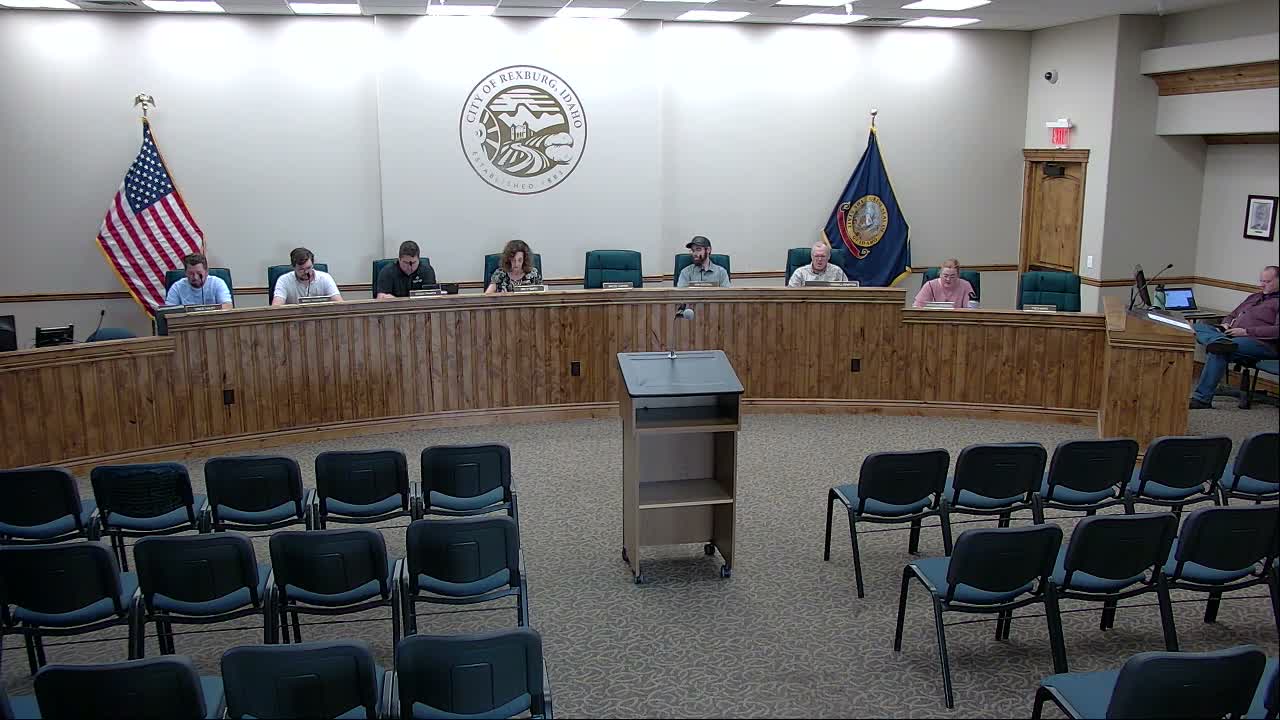
Rexburg — The planning and zoning commission on Aug. 8, 2024 voted to recommend city council approve amendments to the city code covering fences and billboards, forwarding language that city staff said clarifies where fences may be placed, how they must be built, and how existing billboards will be treated.
City staff (Speaker 1) told the commission the changes revise definitions for fences and side (sight) triangles, add a 15-foot side-triangle requirement for private driveways and alleyways, reorganize fence provisions and illustrations, and add a billboard section that designates existing billboards as grandfathered. "No new billboard signs will be allowed," Speaker 1 said, and staff read the draft language that "Existing approved billboard signs shall be designated as having a grandfathered status and may be repaired or replaced," noting these grandfathered billboards would be exempt from the former 50% replacement threshold.
The draft fencing language clarifies that front-yard fences generally stay at 3 feet, rear-yard fences may range from 3 to 6 feet, and that any fence exceeding 7 feet in height would require a building permit and appropriate structural anchoring. Staff also outlined operational details: gates adjacent to public sidewalks and bike paths must swing inward to avoid creating blind spots for pedestrians and cyclists; trees and shrubbery must be trimmed to maintain sight-line clearance (low branches cleared to roughly 10 feet where they obstruct visibility); and utilities must be kept accessible when fences are placed near power or gas equipment.
One recurring point of debate was barbed wire. Staff said existing barbed-wire fences are grandfathered and that, under the proposed code, barbed wire and electric-security fences would be allowed only in agricultural/transitional-agriculture (TAG) contexts or other limited security circumstances, subject to administrator approval. Several commissioners questioned that limitation, arguing that allowing large animals in some zoning categories but excluding barbed wire could make containment costly or difficult for owners. Others cautioned about aesthetics and public-safety implications of barbed wire in residential areas. "If we allow that large of an animal ... but we're not going to allow barbed wire, then why are we allowing that animal in that zone?" Speaker 4 asked.
Staff described implementation steps: the planning department contacted local fence companies to notify them of the updated code; although the ordinance does not require a building permit for routine fences, property owners must check with staff by phone or submit a quick sketch for approval. Enforcement will be complaint-driven, with staff outreach used first and citations reserved for persistent noncompliance.
Speaker 9 moved to recommend that city council approve the new language in the fencing and billboards sections "as written," and Speaker 3 seconded the motion. The commission approved the recommendation by voice vote; the transcript records ayes and no opposed statements but does not include a roll-call tally of individual votes.
The commission also confirmed that grandfathering protects existing agricultural uses and billboards so long as those uses remain in place; if land is redeveloped into housing or otherwise changes use, the new rules would apply at the time of development. The commission closed the public-input portion of the hearing after no members of the public came forward to speak.
The recommendation will go to the Rexburg City Council for consideration. The planning and zoning commission adjourned after completing the motion.