Get Full Government Meeting Transcripts, Videos, & Alerts Forever!
Get email alerts on the Foreign Policy Ceasefire topic
No spam. Unsubscribe anytime.
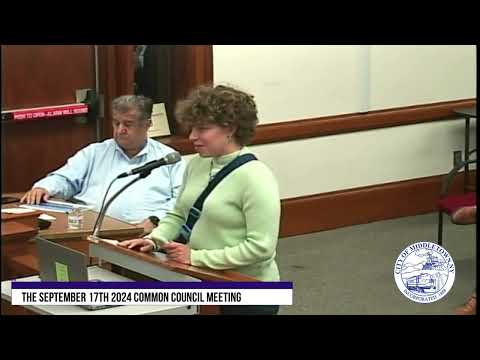
Middletown residents urge Common Council to adopt ceasefire resolution; council president questions organizers' credibility
Summary
Community members urged the Middletown Common Council to pass a symbolic ceasefire resolution calling on federal divestment from weapons sales to Israel; President Reza Rodriguez challenged speakers’ organizational ties and asked for greater transparency about who organized the effort.
Several Middletown residents used the council's public-comment period to press the Common Council to adopt a ceasefire resolution related to the Israel–Palestine conflict, saying symbolic action could pressure federal lawmakers and reflect the community’s values.
Jason Neachman, a Middletown community member and outreach worker for a local shelter, told the council the resolution would show residents’ concerns about federal funding for weapons. ‘‘People will remember where Middletown stood on this issue,’’ Neachman said, urging the council to join other cities that have passed similar measures. He clarified that the city does not directly send money to Israel but argued that federal tax dollars from local households contribute to U.S. military assistance.
Amanda Crump, a 4th Ward resident, described an incident outside a previous meeting in which someone drove past and threw an object that injured her and friends; she said police are investigating and urged respectful dialogue. Crump also cited the International Court of Justice advisory opinion titled "legal consequences arising from the policies and practices of Israel in the occupied Palestinian territory, including East Jerusalem," and recommended aldermen read paragraph 146 of that document.
Several other speakers framed the plea as moral testimony. Melad, who identified as a Christian Palestinian American, described alleged abuses of Palestinian detainees and said passing a ceasefire resolution would also protect U.S. service members. Steve Swift recounted family history from World War II to argue that an arms embargo and a ceasefire are moral imperatives. Mark Maranoff, speaking as a U.S. citizen, said passing a resolution is a 'least we can do' symbolic step.
President Reza Rodriguez, responding to the speakers, said he had already stated his position and challenged the organizers’ credibility, saying the initiative had origins in the Mid-Hudson Valley Democratic Socialists of America and asking that groups identify themselves when they lobby the council. Rodriguez asked proponents to report where else they had made the request and how many communities had passed the measure.
The meeting record shows no vote on a ceasefire resolution during this session. After the public comments, council business proceeded to a series of routine resolutions and roll-call votes.
What happens next: The transcript does not record the council taking formal action on a ceasefire resolution at this meeting; proponents and opponents remain on record in the public-comment minutes.