Get Full Government Meeting Transcripts, Videos, & Alerts Forever!
Get email alerts on the Easements topic
No spam. Unsubscribe anytime.
Prescott Valley staff outline plan to reduce utility easement conflicts, emphasize homeowner education
Summary
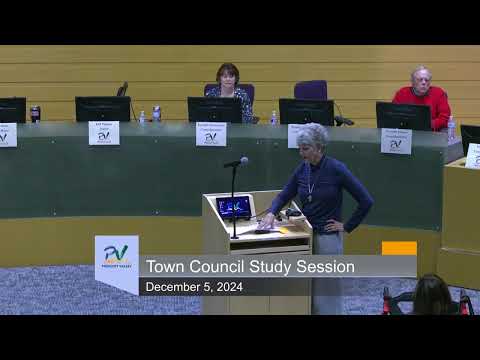
Town staff told council they will begin a prolonged public education campaign, offer tools and voluntary affidavits for fence encroachments, and coordinate with utilities to ease access to rear-lot public utility easements after a study-session presentation on Dec. 5, 2024.
Prescott Valley officials laid out a package of education, voluntary title notices and enforcement options on Dec. 5 as they responded to frequent complaints about obstructed rear-lot public utility easements.
At a study session, Neil Wadsworth, speaking for Public Works and utilities coordination, said many older subdivisions in and near Prescott Valley have 12-foot public utility easements (typically six feet on each adjacent property) that are now blocked by fences, sheds, trees or landscaping, hampering repairs and sometimes forcing crews to hand-dig. "When a water line gets broken back there and we have to fix it, if we can't get to it right away, we are having water that is coming out of the pipes and going over people's properties," Wadsworth said, describing longer repair times and higher costs where access is limited.
Why it matters: blocked easements can delay emergency repairs, increase cost for utilities (APS and others have sometimes needed cranes), and create health and safety concerns such as standing water or pest problems. Staff said the town's ability to respond is also complicated where easements were created when areas were county jurisdiction, such as parts of Prescott Country Club and Castle Canyon.
What staff proposed: Stephanie from Code Enforcement said the town will expand outreach (website content, utility-bill inserts and move-in materials), promote its "neighborhood toolbox" (short-term rentals of bush hogs and weed eaters for homeowners), and pursue voluntary recorded affidavits for fences that encroach into easements—a model taken from Sedona that would notify future buyers that a structure may be removable and is not the town’s responsibility. Staff emphasized education as the first tool, and enforcement (noted as possible under current code) as a last resort. "We always try to get voluntary compliance," Stephanie said.
Legal and operational context: Ivan, the town's legal/planning representative, explained that easements remain privately owned land where the town holds access rights for water, sewer and drainage; code currently allows wood, wire or removable fencing and encourages measuring from the easement line. He said some noncompliant permanent structures could be removed under existing legal authority, but that recorded affidavits would likely be voluntary rather than a retroactive requirement.
Next steps and resident options: Staff said they will increase homeowner education, consider using recorded affidavits when owners request permits or when new development occurs, and refine permit review procedures to require blue-stake/811 contact where appropriate. For residents who prefer anonymity, the town’s mobile app "Our PV" can be used to report easement issues for follow-up by neighborhood services. Council members urged a prolonged education campaign before pursuing stricter code changes.
The town did not adopt any ordinance at the session; staff said they will return with detailed draft language and outreach plans for future consideration.