Get Full Government Meeting Transcripts, Videos, & Alerts Forever!
Get email alerts on the Radioactive Waste topic
No spam. Unsubscribe anytime.
Committee advances bill to ban certain low-activity radioactive waste from class 2 and 3 landfills
Summary
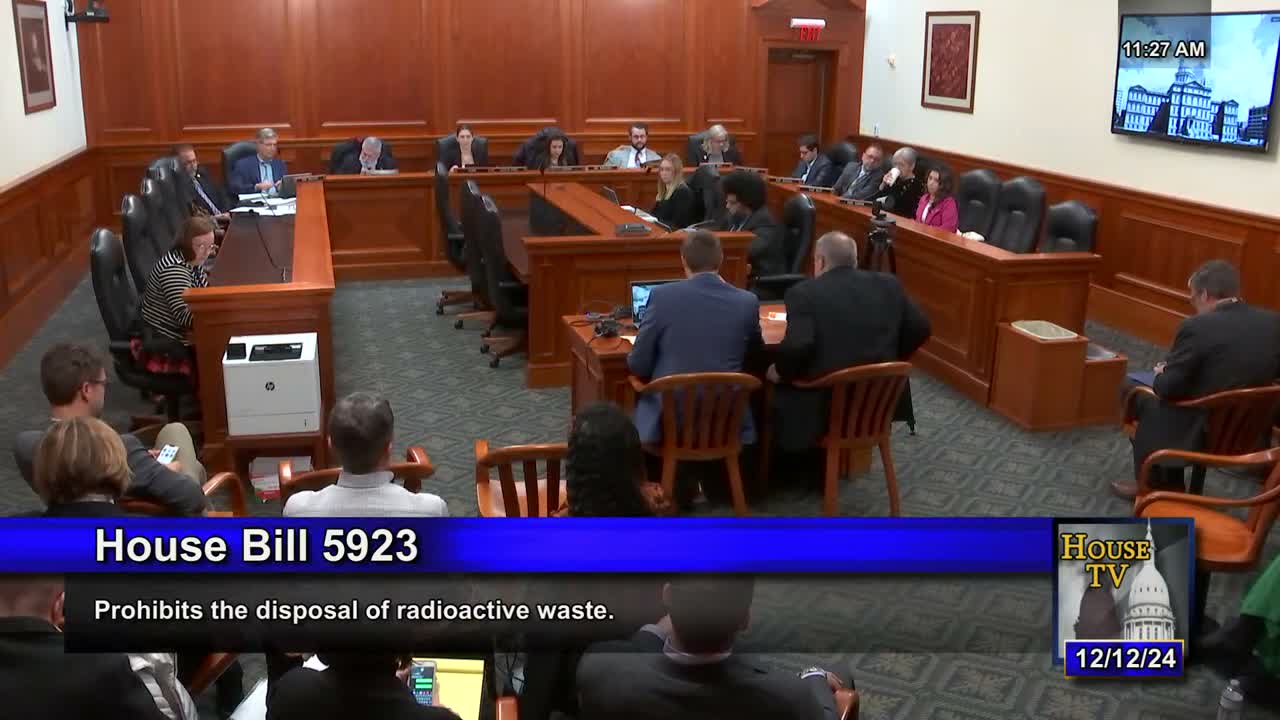
House Bill 5923 would define low-activity radioactive waste and prohibit its disposal in Michigan class 2 and 3 landfills, lower allowable radionuclide thresholds for specific isotopes and require testing, reporting and radiation safety programs; township officials and residents warned of high volumes of out-of-state waste arriving at local landfills.
Jackson Paul, legislative director for Representative Miller, told the committee that House Bill 5923 would create a statutory definition for low-activity radioactive waste and ban its disposal in class 2 and class 3 landfills in Michigan; he said the bill also lowers numeric thresholds for radionuclides such as radium-226 and radium-228 and would require monitoring and reporting and radiation-safety programs for landfills.
Kevin McNamara, Van Buren Township supervisor, and local residents testified that large volumes of out-of-state low-activity waste have been routed to Michigan landfills in recent years. McNamara said the state previously allowed certain material, but that other states began refusing shipments and large quantities came to Michigan: "We've now accepted almost a 1,000,000 tons of low level radioactive in the state of Michigan," he told the committee. A resident said that a landfill accepting t-norm waste is located within a few miles of schools, a lake, and other community assets and expressed concern about potential leachate pathways into watershed systems.
The committee adopted an H-1 substitute for HB 5923 and reported the bill with recommendation (6 yeas, 2 nays). Sponsors and supporters said the measure increases safeguards for public health and groundwater and creates a framework for testing and limits on specific radionuclides; opponents and local residents urged additional restrictions and safeguards.