Get Full Government Meeting Transcripts, Videos, & Alerts Forever!
Get email alerts on the On Site Wastewater Code topic
No spam. Unsubscribe anytime.
Lawmakers advance bills to create statewide septic code, risk-based inspections and registry
Summary
The House Natural Resources committee advanced House Bills 4479 and 4480 to establish an on-site wastewater (septic) code, a stakeholder technical advisory committee and an EGLE-maintained registry; sponsors said a hybrid time-of-sale and risk-based inspection framework and phased timetable will address failing systems and protect Michigan waters.
Representative Skaggs introduced legislation to create a statewide on-site wastewater treatment code, saying Michigan is currently the only state without a uniform septic code and that the bills would protect public health and freshwater resources. "We all know that Michiganders love water," Rep Skaggs said, noting estimates of hundreds of thousands of failing systems and beach closures attributed to contamination.
The package (House Bills 4479 and 4480) would add an on-site wastewater system code to the public health code, establish a technical advisory committee of stakeholders to advise EGLE, and require an online database tracking septic system locations and inspection histories to be maintained by local health departments and accessed through EGLE. Rep Skaggs described a hybrid inspection model: counties that already require time-of-sale inspections may keep them while the legislation also creates a risk-based periodic inspection regime keyed to factors such as proximity to surface water, presence in critical dunes, unknown construction permits (systems with unknown age), systems older than 30 years, and changes of use that increase system load.
Professor Anthony Kendall of Michigan State University, an earth and environmental scientist who testified in support, said broad sampling showed human-associated pathogens and nutrient pollution across Michigan watersheds and stressed that data gaps (no comprehensive septic registry) limit management: "We have no records of that," he said of many septic systems, and recommended a registry similar to the state's existing WellLogic well database.
Stakeholders who testified included Brad Ward of the Michigan Realtors, who said his organization supports a statewide code "in concept" but opposes immediately adding a seller-disclosure requirement (House Bill 6173) because the statewide inspection program may not be implemented for years, creating legal and transactional problems on a uniform statutory seller-disclosure form. Larry Stevens, a consulting engineer and past MAURA president, urged that the bills include education and certification standards for system designers and installers, noting that system replacements can range from roughly $10,000 to upwards of $80,000 and that poor design or construction contributes to failures.
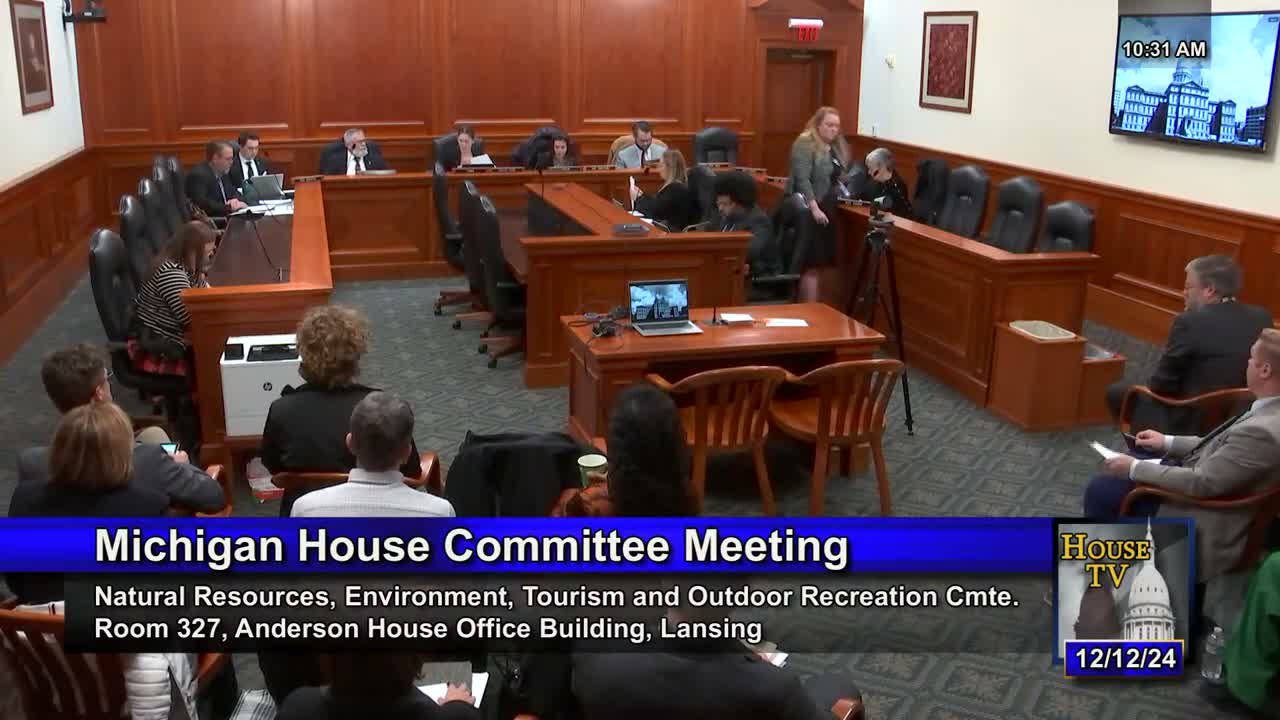
The committee adopted an H-2 substitute for House Bill 4479 and reported the bill with recommendation (recorded tally 6 yeas, 2 nays). An H-1 substitute for House Bill 4480 was also adopted and the committee reported that bill with recommendation (6 yeas, 2 nays). The sponsors said the TAC (technical advisory committee) will have two years to make recommendations to EGLE and EGLE will have another year to begin rulemaking; risk-based evaluations are intended to be completed in phases so inspections for higher-risk systems are implemented within a multi-year timeframe.