Get Full Government Meeting Transcripts, Videos, & Alerts Forever!
Get email alerts on the Human Trafficking topic
No spam. Unsubscribe anytime.
House Judiciary Committee advances broad human‑trafficking package to expand survivor protections and prosecutorial tools
Summary
The House Judiciary Committee heard prosecutors, detectives and survivors and voted to report more than a dozen house bills and three senate bills to the floor. Measures include set-aside convictions, an affirmative defense for trafficking victims, safe-harbor protections for minors, rules for expert testimony, language changes to reduce stigma, expanded 'other acts' evidence, and survivor immunity while testifying.
LANSING — The House Judiciary Committee advanced a multi-bill package intended to strengthen protections for survivors of human trafficking and to give prosecutors additional tools to hold traffickers accountable.
Assistant Attorney General Melissa Palapoo, who leads the AG’s human-trafficking initiative and chairs the Michigan Human Trafficking Commission, presented the package and said it is designed to be "victim-centered" while improving prevention and accountability. Palapoo cited Polaris hotline data for 2023—"779 signals," of which she said 254 cases were confirmed and 506 victims identified—to illustrate both the scale of reports and the gap between reported signals and confirmed cases.
Key provisions explained to the committee included:
- HB 5836 and HB 5838: Allow survivors to set aside criminal convictions that were a direct result of being trafficked. Palapoo said convictions tied to coercion can hinder housing and employment and these bills help remove that barrier.
- HB 5837: Creates an affirmative defense for conduct the defendant committed as a direct result of being trafficked, similar in structure to other affirmative defenses such as self‑defense or entrapment; the prosecutor would bear the burden to show the defense does not apply.
- HB 5839: Extends safe-harbor protections for minors who are victims of sex and labor trafficking to ensure they get access to resources and are not further endangered.
- HB 5840: Establishes criteria for expert testimony in human-trafficking cases so juries can better understand victim behavior, trauma responses and the coercive dynamics of trafficking.
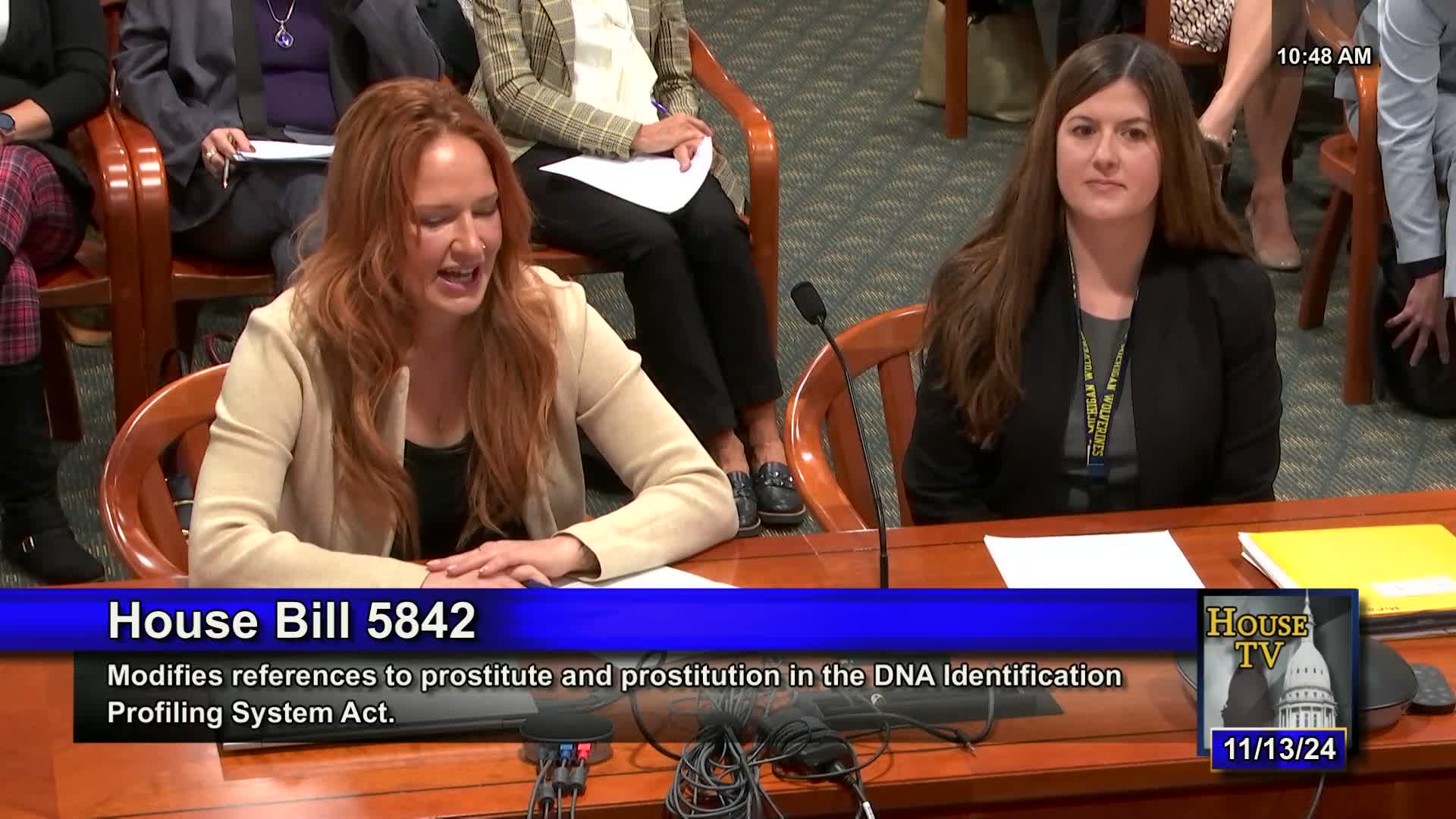
- HB 5841–5854 and HB 5864: Replace terminology such as "prostitution" with "commercial sexual activity" in select Michigan Compiled Laws to reduce stigma that can prejudice victims and to better reflect coercion or trafficking contexts.
- SB 516: Expands when other-acts evidence may be admissible in trafficking cases; Palapoo and law enforcement witnesses said the change is modeled on rules already used in crimes-against-children and domestic-violence prosecutions but retains relevancy and prejudice safeguards.
- SB 517: Allows compelled testimony from survivors with use-immunity protections so a victim can provide evidence without that testimony being used to prosecute the survivor for offenses committed while trafficked.
Law enforcement and prosecutor witnesses described concrete courtroom and investigative problems the measures aim to fix. Cindy Brown, section leader of the trafficking unit at the Oakland County Prosecutor’s Office, and Detective Brian Martin (Auburn Hills Police Department; investigator with Oakland County Prosecutor's Office) recounted a case in which three victims were rescued but two were too ill—experiencing withdrawals—to testify at a preliminary exam. Brown said MCL 768.27(c) presently allows hearsay statements at a preliminary exam but not at trial, and argued the proposed change to that statute to permit limited hearsay in trafficking trials would be "transformative." Detective Martin described the burden of presenting victims in custody while they were still sick and said the change would allow victims to recover in a hospital rather than testify while withdrawing from substances.
Survivors and service providers also testified. Karen Moore, executive director of Sanctum House, and a former resident known as Irene described long-term residential services, cited DHHS and HUD funding, and urged allowances for virtual testimony to reduce retraumatization. Robin Bowles, a survivor and director of operations for area anti-trafficking coalitions, urged replacing stigmatizing statutory language and stressed the value of lived-experience experts to explain trauma bonds and complex recovery timelines.
Representative Fink and others questioned constitutional and evidentiary implications. Fink asked whether SB 516’s expanded other-acts language would go beyond Federal Rule of Evidence 404(b); Palapoo said the proposal is broader but still requires the same relevancy and prejudice analyses (references to 402/403 thresholds). On SB 517’s compelled testimony and Fifth Amendment implications, Palapoo acknowledged there is potential for a claim under the Fifth Amendment but said use-immunity is already used in analogous contexts and the solicitor general's office reviewed the package.
Votes at a glance
The committee adopted substitute language where offered and reported the package to the House floor with recommendation. The clerk repeatedly announced 12 ayes and no nays for the motions and substitute adoptions during the session; the committee reported multiple bills including HB 5836–HB 5854, HB 5864 and SB 515–SB 517 to the House floor.
Why it matters
Advocates and prosecutors said the measures will make it easier for survivors to come forward, remove collateral consequences of trafficking-driven conduct, and give juries and prosecutors better tools to explain and prove trafficking schemes. Supporters argued those changes will increase convictions of traffickers and decrease re-victimization of survivors during prosecution.
What’s next
All reported bills will move to the House floor for further consideration. Committee members repeatedly urged parallel investment in training for law enforcement, judges and service providers so the new tools are applied effectively.