Get Full Government Meeting Transcripts, Videos, & Alerts Forever!
Get email alerts on the Community Violence Intervention topic
No spam. Unsubscribe anytime.
House committee advances bill to let Medicaid reimburse hospital and community violence-intervention workers
Summary
The Michigan House Health Policy Committee advanced HB 6046 to allow Medicaid reimbursement for hospital‑based and community‑based community violence intervention (CVI) workers. Supporters said the change would sustain frontline CVI teams and shift some costs from local grants to federal Medicaid dollars.
The Michigan House Health Policy Committee on the motion of Representative Carter advanced HB 6046, a bill sponsored by Rep. Morse that would allow the state to seek Medicaid reimbursement for community violence intervention (CVI) workers who operate in hospitals and under community organizations. The committee voted to report the bill out, with the clerk announcing 12 yeas, 0 nays and 6 passes.
Sponsor Morse told the committee HB 6046 would “allow for the state to obtain Medicaid reimbursement for community violence intervention workers that are both hospital based and ... working under community orgs,” and directed the Department of Health and Human Services (DHHS) to develop training and the administrative process to pursue federal Medicaid reimbursement. Morse said the policy grew out of town halls and conversations with communities that asked for sustainable, not just grant, funding.
Dr. Brian Stork, a Muskegon urologist and researcher, described a local effort to screen and intervene with at‑risk youth in emergency departments and testified that his team’s chart review found Medicaid reimbursed the hospital system in the mid‑hundreds of thousands over a four‑year period; he added that one gunshot victim’s hospital care exceeded $250,000. Stork outlined a Safer Teens one‑on‑one intervention and said a recent Department of Justice grant of $300,000 will help school implementation.
A frontline practitioner associated with Urban Alliance Kalamazoo testified that CVI workers respond directly in hospitals to victims and potential retaliators, that “retaliation is real,” and that these teams have prevented escalation even when the prevented incidents cannot be directly counted. Beth Berglund, who worked on the legislation, clarified the bill focuses on community violence intervention carried out in hospitals and is not intended to address domestic‑violence services, which follow different Medicaid billing pathways.
Committee members pressed witnesses on how Medicaid payments would flow. Witnesses and sponsors said the Department would design billing procedures and that other states have created biller organizations that receive Medicaid payments and distribute funds to participating CVI providers, often routing reimbursement through hospitals.
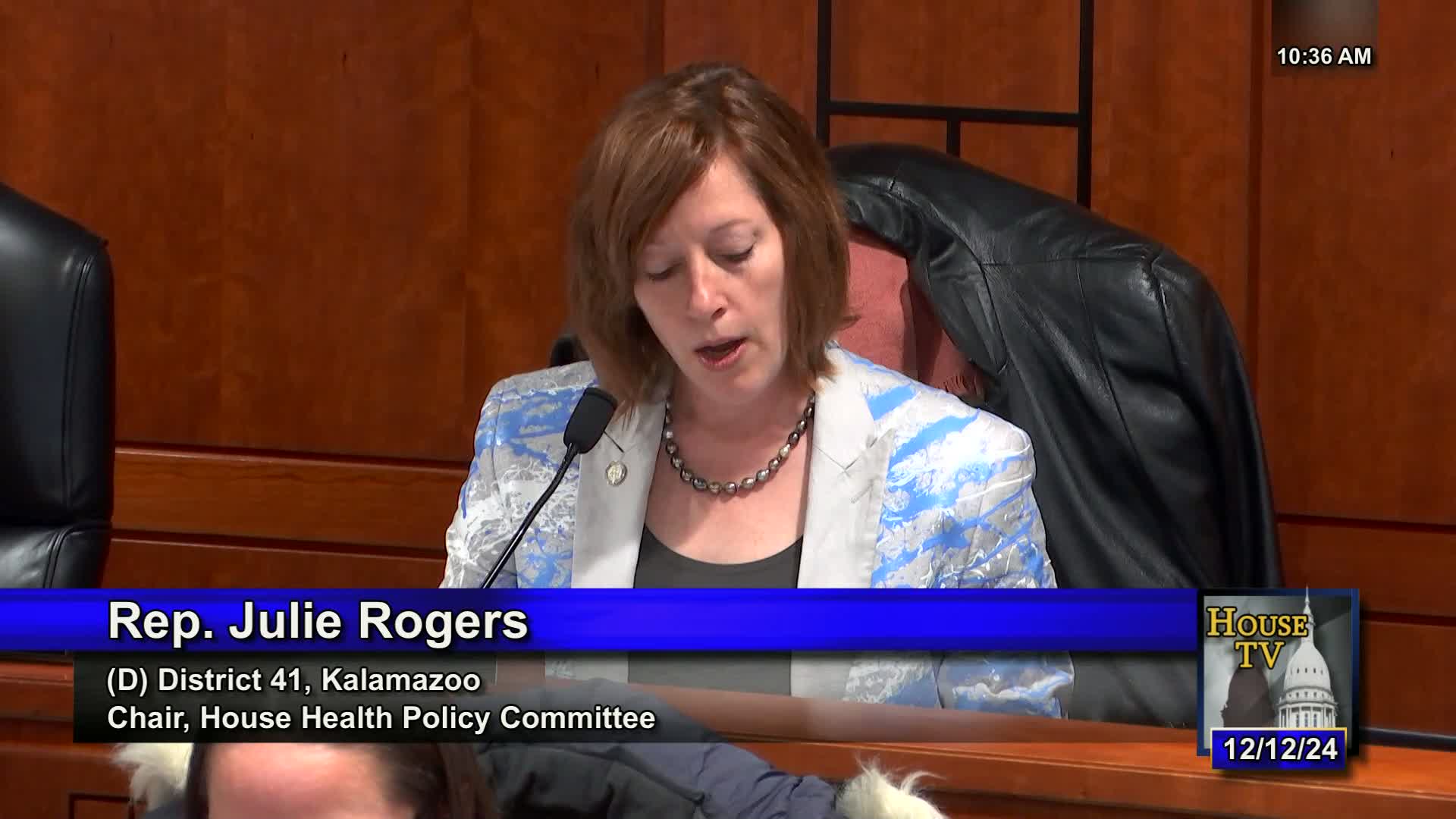
Chair Rogers read multiple letters of support into the record, including endorsements from the Michigan State Medical Society, Michigan Nurses Association, Trinity Health Michigan, Everytown, and local public safety and municipal officials.
The committee recorded the motion to report HB 6046 and the vote was taken; Chair Rogers announced the motion prevailed. The committee did not adopt amendments during the session and directed staff and the department to proceed with the implementation planning steps described in testimony.
What’s next: HB 6046 was reported out of committee and will proceed through the House process for further consideration.