Get Full Government Meeting Transcripts, Videos, & Alerts Forever!
Get email alerts on the Open Meetings Act topic
No spam. Unsubscribe anytime.
Committee backs bill to allow appointed members with disabilities to join meetings remotely
Summary
The House Government Operations Committee voted to report Senate Bill 870, which would amend Michigan's Open Meetings Act to permit appointed public-body members with disabilities to participate and vote remotely when they request accommodation and are physically located in Michigan.
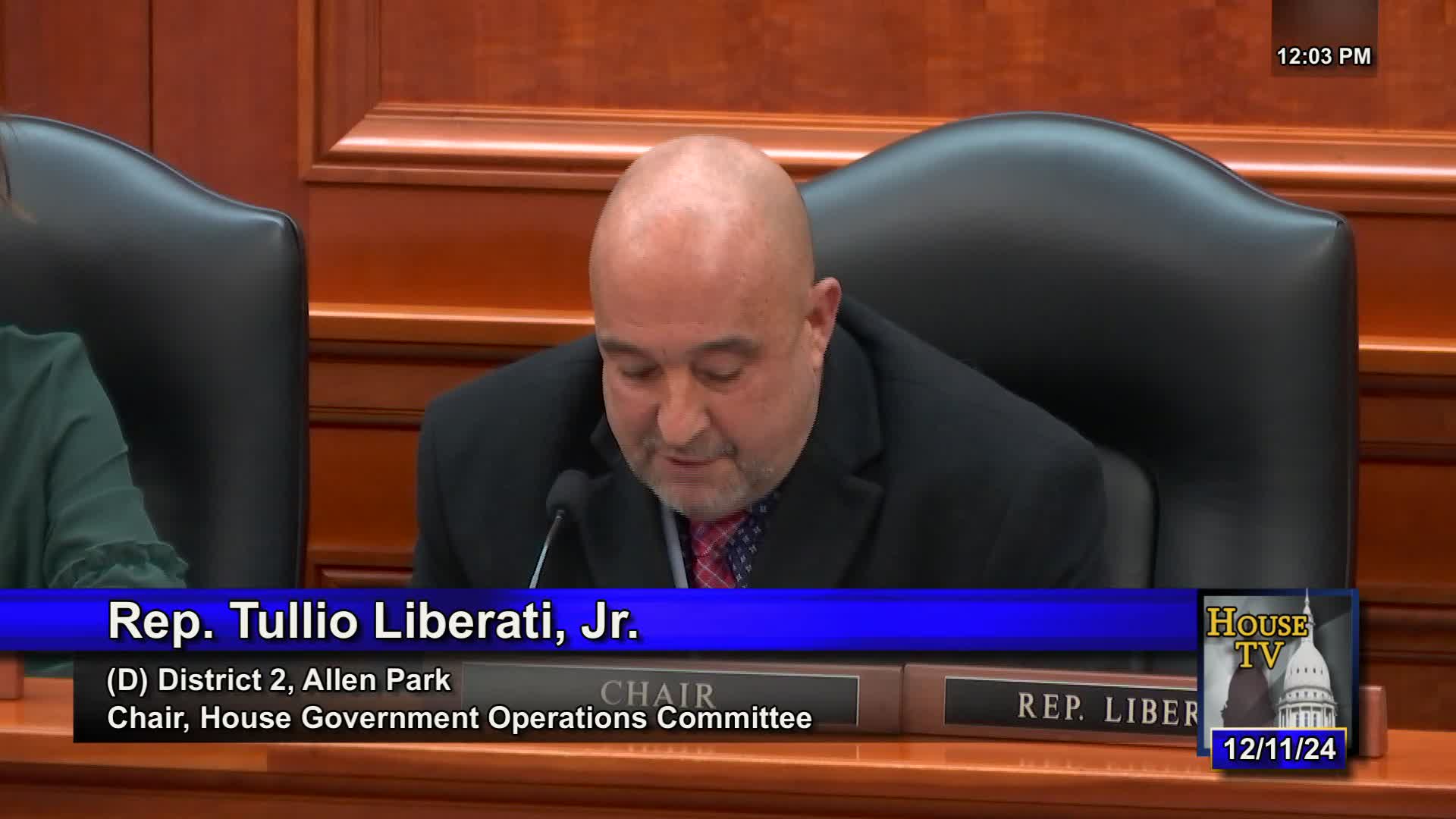
The House Government Operations Committee on the record moved Senate Bill 870 forward after testimony from the bill sponsor and disability advocates saying the measure would reduce barriers to civic service.
Senator McCann, who introduced the bill to the committee, said the proposal "amends Michigan's Open Meetings Act to allow for virtual participation for persons with disabilities who request accommodation" so long as the member is physically present in Michigan. Terri Langley, executive director of Disability Network Michigan, told the committee the change is permissive rather than mandatory and cited the difficulty of travel for some appointed members, saying one statewide board member in the Upper Peninsula endures "an 8-hour, one-way commute" to attend brief meetings.
Supporters argued the bill removes a practical barrier to inclusion and noted a 2022 opinion from Attorney General Dana Nessel that state boards generally must hold meetings in person but individual members with disabilities may participate remotely under the Americans with Disabilities and Rehabilitation Act. Terri Langley said the bill uses an all-encompassing definition of disability covering physical or mental characteristics that substantially limit one or more major life activities and that existing appointment vetting would mitigate frivolous claims.
Committee members asked whether the change applies only to appointed (non-elected) positions; sponsors confirmed the bill applies to appointed boards and commissions. The committee received written and oral support from several groups and, after a roll call motion, voted to report the bill with recommendation to the next legislative stage.
The committee's action was procedural: the committee "reported" Senate Bill 870 with recommendation, moving it out of the committee for further consideration. The committee did not take final floor action on the bill during this meeting.