Get Full Government Meeting Transcripts, Videos, & Alerts Forever!
Get email alerts on the Affordable Housing Policy topic
No spam. Unsubscribe anytime.
Loveland council hears pilot results and chooses broad approach to ADUs, occupancy limits
Summary
Council heard a multi‑part affordable housing briefing — builders reported a successful Wilson Commons pilot using fee waivers to deliver homes at 70% AMI, and staff asked for direction on implementing state house bills that would remove local occupancy limits and expand ADU rights; council signaled support for eliminating the 'boarding house' category and applying citywide ADU standards.
City staff and partner builders used the Nov. 12 study session to report progress on a number of housing initiatives and to ask the council for policy guidance on how to align local land‑use code with recent state laws.
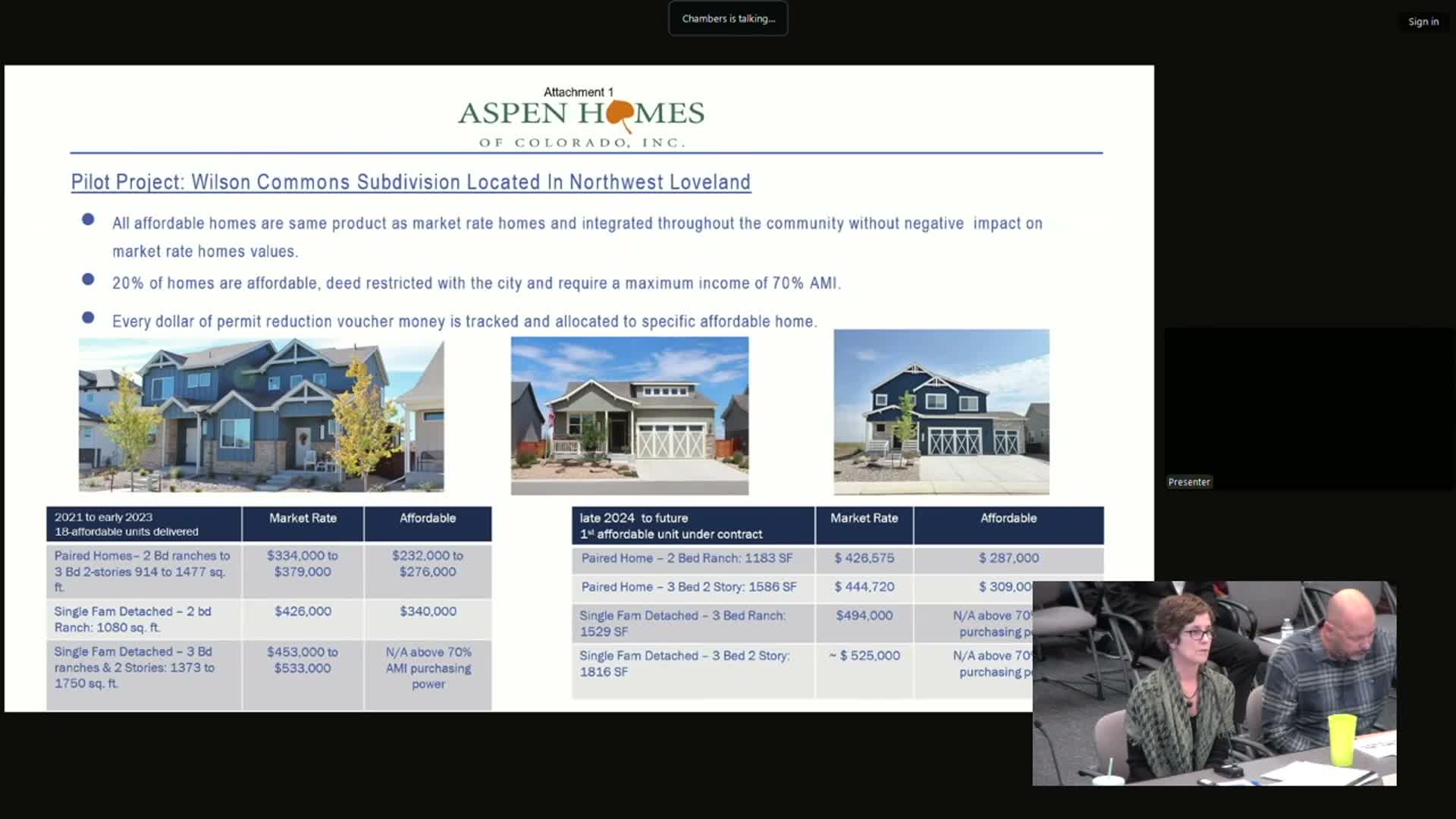
Wilson Commons pilot and builder model “Instead of just putting the voucher…we would price all of our regular homes at market rate and then take all that money and put it into that one affordable house,” said Jamie Sabin of Aspen Homes, describing a 5‑to‑1 approach used in the Wilson Commons pilot. Sabin told council the pilot enabled the builder and partners to deliver affordable single‑family homes priced in early phases between $232,000 and $276,000 and more recently around $287,000–$309,000, with the city providing fee reductions that amount to roughly six figures on some lots and the developer/partner contributing additional subsidy.
Sabin and staff emphasized transparency and tracking: the city’s fee waivers are documented and tracked so the city can show where permitting and capital expansion fee reductions are applied. He warned that rising interest rates and elevated construction costs make the pool of eligible buyers smaller at the 70% AMI level and that the model must be adaptable.
Code accomplishments and in‑process work Planning staff recapped recent UDC amendments — density incentives, cottage development allowances, ADU policy changes and administrative fast‑track options for deed‑restricted units — and listed unfinished items such as broader ADU uptake, prototypical designs with builders and scalable capital expansion fee (CEF) methodologies for water and wastewater.
Scalable fees and small‑lot standards Jim Lees, the utility accounting manager, described work on exploring scalable capital expansion fees for water and wastewater to make infrastructure charges more equitable for small‑lot and smaller‑unit development. Nicole Hahn, city engineer, said engineering staff are drafting small‑lot standards to reduce infrastructure costs for higher‑density build forms.
State house bills and staff policy options Carrie Burchette (Planning) framed two state laws requiring local code changes: HB24‑1007 (residential occupancy limits) and HB24‑1152 (ADUs). She said HB24‑1007 removes local restrictions on the number of unrelated occupants and asked whether the city should eliminate the UDC’s separate "boarding house" category (staff recommendation) or retain and re‑define it using non‑occupancy triggers such as number of individual leases. She said option 1 would legalize co‑living arrangements in single‑family‑form neighborhoods while leaving building and fire‑safety codes intact.
On ADUs, Burchette said the state restricts local architectural matching standards and neighborhood hearing requirements; staff recommended superseding legacy PUD design standards so ADU rules are clear and equitable citywide, but she noted that doing so could allow more modular and manufactured ADU products in backyards and might conflict with some neighborhood design expectations.
Council reaction and next steps Many councilors expressed preliminary support for staff’s recommendations to remove the boarding‑house land‑use category and to apply citywide ADU rules rather than enforce 72 legacy PUDs case‑by‑case; concerns raised included off‑street parking, neighborhood expectations and potential property‑rights or HOA conflicts. Council members asked staff to return with specific code language, economic impacts and an outreach plan for residents and homeowners associations before formal adoption.
What the city will do next Planning staff will prepare UDC amendments that reflect council direction, conduct outreach with commissions and stakeholders, and return with draft ordinance language and impact estimates ahead of formal hearings.
(Reporting is based on the Nov. 12 Loveland City Council study session presentations from city staff, builder Jamie Sabin and public comment from Affordable Housing Task Force members.)