Get Full Government Meeting Transcripts, Videos, & Alerts Forever!
Get email alerts on the Food Safety Modernization topic
No spam. Unsubscribe anytime.
Committee advances six‑bill food‑safety and cottage‑food package, including larger cottage‑food caps and 2017 food‑code adoption
Summary
The committee recommended House Bills 6128–6133, a six‑bill package to modernize Michigan’s food law: moving certain rules into statute, adopting the 2017 FDA Food Code, revising FOIA protections, updating mobile‑food rules, raising cottage‑food sales caps with a registration system, and clarifying enforcement for cage‑free egg labeling. An amendment on labeling lab‑grown substitutes was adopted.
LANSING — The House Committee on Agriculture on Nov. 13 recommended a six‑bill package (HB 6128–6133) that MDARD officials and stakeholders said would modernize Michigan’s food law, strengthen consumer protections and make targeted changes to cottage‑food rules.
Tim Slowinski, director of MDARD’s Bureau of Food Safety and Animal Health, summarized the package and said the department’s goals include aligning definitions with federal standards, adopting the 2017 FDA Food Code, improving investigation tools and modernizing cottage‑food rules.
Key elements presented to the committee:
• HB 6128 — Move smoked‑fish regulation (rule 569) into statute without content changes; maintain existing standards.
• HB 6129 — Clarify MDARD’s authority in investigations (including access to growing/harvesting areas), request ability to record video during investigations, seek FOIA protections for certain industry‑owned documents, and require mobile‑food operators to communicate schedules to local health departments when operating in jurisdictions beyond their license area.
• HB 6130 — Adopt the 2017 FDA Food Code, which would expand the certified‑food‑protection‑manager requirement to one certified person on site during all operating hours and update shellfish guidance and allergen definitions (including sesame). Implementation timelines were discussed (one‑year/ two‑year phases for some requirements).
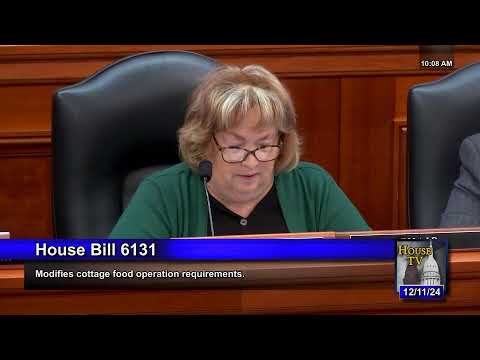
• HB 6131 — Update cottage‑food labeling: replace home‑address requirement with a voluntary MSU registration number plus phone contact, allow virtual direct interactions (not strictly face‑to‑face), and raise the gross annual sales cap (committee discussed $45,000 for most operators and a $75,000 exception for high‑priced single items such as wedding cakes). It would add a CPI adjustment mechanism for future changes.
• HB 6132 — Modify distribution of the food‑safety education fund, merge certain grant lines for flexibility, and align the food law with the state’s cage‑free egg requirement so MDARD can act on noncompliant eggs in market channels.
• HB 6133 — Authorize limited dual jurisdiction with local health departments in specific manufacturing/wholesale situations, while avoiding duplicate license fees.
Representative Nyar successfully offered an amendment to HB 6130 prohibiting labeling laboratory‑grown substitutes as "meat." Committee members asked for clarifying guidance on mobile‑food scheduling requirements (the bill requires notice to a jurisdiction within four days of operating there if outside the license jurisdiction), FOIA protections, and the practical effects of raising the cottage‑food cap. MDARD said the $45,000 cap in HB 6131 was informed by stakeholder data and that further increases could be considered later.
The committee moved each bill out of committee with recommendations after roll‑call votes. Vote tallies varied across bills as recorded by the clerk; all motions prevailed.
What happens next: Each bill will proceed according to legislative scheduling. Committee testimony included implementation timelines for some provisions (e.g., phased adoption of the 2017 Food Code), but final rules, MOU details and FOIA penalty structures were not settled in committee.