Get Full Government Meeting Transcripts, Videos, & Alerts Forever!
Get email alerts on the School Finance topic
No spam. Unsubscribe anytime.
BESE task force reviews MFP Levels 1 and 2; staff details weights, local-share math and timeline for March adoption
Summary
Department of Education staff told the MFP task force that Level 1 (student-driven) and Level 2 (local-effort reward) together determine Louisiana’s MFP allocations; staff laid out weights, the base-per-pupil calculation and a March submission timeline to the State Board of Elementary and Secondary Education (BESE).
At a meeting of the MFP task force, Department of Education staff summarized how the Minimum Foundation Program’s Levels 1 and 2 determine state school funding and described the calculations the State Board of Elementary and Secondary Education (BESE) will be asked to adopt ahead of the legislature.
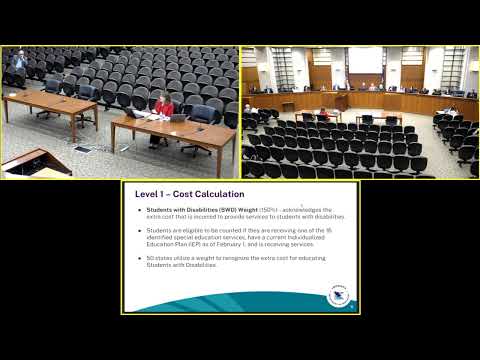
Beth, a Department of Education presenter, said Level 1 is the formula’s “main component,” built from a February 1 base student count plus a set of weights that raise the effective student count for specific needs. She described five categories used in Level 1: an Economically Disadvantaged weight set at 22 percent, a Career and Technical Education weight at 6 percent, a Students with Disabilities weight described as 150 percent, a Gifted and Talented weight, and an economy-of-scale weight intended to aid small districts. According to staff, the weighted membership overall exceeds 900,000 when weights are applied to the base count.
Staff explained the base per-pupil dollar amount the formula applies to the weighted membership and the wealth calculation that determines how the total cost is split between the state and local systems. The department described the wealth calculation as using net assessed taxable property and a sales-tax base to estimate a district’s potential local revenue; caps (10 percent for assessed-value spikes, 15 percent for sales-tax spikes) are applied to smooth one-year fluctuations. At the statewide level, staff said the formula preserves an approximate 65/35 state/local split even though individual district shares vary with wealth.
Level 2 was described as a reward for local effort: the department measures actual local collections and computes an eligible overage, subject to a cap, and then applies a factor (described in staff materials as 1.72, based on prior school-finance work) to establish the Level 2 local-share allocation and the state portion of the reward. Staff cited a Level 2 state allocation of about $517,000,000, roughly 13 percent of current MFP distributions.
Members asked technical questions about how students can be included in multiple weights (staff answered that students may qualify for multiple weights in addition to the base) and requested copies of the last formal cost estimate and methodology; staff said they would seek and share the 1996 cost study and related documentation. The department also said a fresh cost study would be a substantial research project, likely requiring independent consultants and about a year of work.
Task-force members discussed timing: BESE must adopt a formula for submission to the legislature by mid-March. Staff said BESE cannot adopt a legally contingent resolution (for example, a resolution that would only take effect if a ballot amendment passes) but can present alternative formula options and reconvene if circumstances change. The committee adjourned after planning dates for follow-up meetings ahead of the March BESE calendar.