Get Full Government Meeting Transcripts, Videos, & Alerts Forever!
Get email alerts on the Education Funding TRSL topic
No spam. Unsubscribe anytime.
BESE committee hears how proposed constitutional amendment would eliminate Education Excellence Fund and reshape school retirement funding
Summary
BESE staff briefed members on Act 1 (House Bill 7), a constitutional amendment slated for a March 29, 2025 ballot that would eliminate the Education Excellence Fund and related 8(g) funds; staff and TRSL modeled potential liquidation proceeds and projected savings that could be used to reduce TRSL employer contribution rates and fund targeted pay raises, but speakers warned of market and timing uncertainties and program impacts.
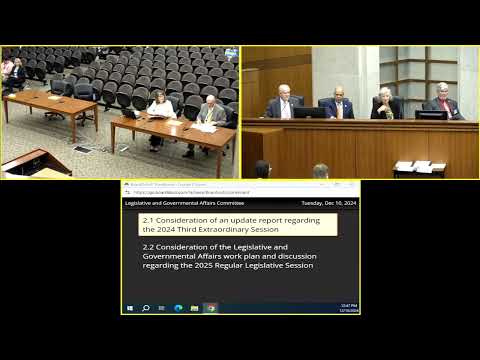
BESE Legislative and Government Affairs Committee members on [date] heard staff describe a proposed constitutional amendment (House Bill 7, Act 1) that would place elimination of the Education Excellence Fund (EAF) and related 8(g) funds on the March 29, 2025 ballot and outline possible fiscal effects if voters approve the measure.
"This is a bill that actually places a constitutional amendment on the ballot for a March 29, 2025, election," department staff member Beth said, summarizing the legislation that staff told the board could result in liquidation of trust investments. Staff cited a Treasury estimate that the invested balances related to EAF/8(g) total about $196,000,000 and described a scenario in which the investments might generate up to $2,000,000,000 to be transferred to the Teachers' Retirement System (TRSL) to pay down the unfunded accrued liability (UAL).
Why it matters: BESE staff and TRSL modeled how using those proceeds to reduce TRSL's UAL could lower employer contribution rates paid by school systems and participating charters. Department presenters said a rate reduction could yield recurring savings on the order of $219,000,000 and that, under the companion bill (Act 8), participating employers would be required to allocate those savings toward pay increases (staff cited a possible $2,000 raise for certificated staff and $1,000 for support personnel in a best-case scenario).
But presenters and members emphasized uncertainty. Member Mr. Appel asked about the actuarial and investment assumptions behind the projections; Beth said staff ran multiple simulations with TRSL and that proceeds would depend on market conditions and required transfer timing if the amendment passes. Beth cautioned that TRSL and Treasury would need to certify the transfer and that, as explained to the committee, the funds would have to be moved to TRSL by May 1 if the amendment is approved.
Practical program and operations impacts: Mr. Walker, another BESE staff presenter, explained the practical effects of eliminating 8(g). He said the annual 8(g) allocation is roughly $20.5 million, with about $870,000 currently used for operational costs such as a portion of staff salaries, rent and overhead. "If the 8(g) fund is eliminated and does not appear in any form or fashion, those employees' positions would no longer be needed," Walker said, and recommended the board identify a clear legislative ask to backfill priority programs (early childhood, STEM, professional development) and to consider a baseline state general-fund supplement to maintain essential functions.
Public comment and advocacy: Madeline Batson, director of policy and research at the Louisiana Policy Institute for Children, urged BESE to defend early childhood funding. Batson said recent actions had already reduced access to child care and that, if 8(g) and EAF were eliminated, 720 children had already lost access and roughly 2,000 more could be at immediate risk. "Only 1 in 5 birth-to-4 children in our state who need care have access to high-quality and affordable early childhood programs," Batson said, arguing that reductions would compound existing shortages of seats and workers.
What the committee did: A motion to "receive" the Item 2.1 report was made and, with no objection, the committee approved receipt of the report. Staff told members they would continue working with TRSL, Treasury and the Legislature to clarify timing, certification and any needed appropriations; they also said BESE had submitted a budget request to the division seeking to be "maintained whole" and to include the $20.5 million allocation in its executive budget request.
What remains unresolved: The board and staff told members several details remain unresolved or contingent on outside events: the exact market proceeds if investments are liquidated; whether any additional proceeds beyond modeled estimates could be applied to UAL; whether the liquidation would satisfy constitutionally required paydown dates; and how appropriations or executive-budget actions might be used to backfill districts that would otherwise fall short of required raises. Staff repeatedly recommended consulting TRSL and Treasury for statutory and technical clarifications.
The committee moved the item forward for receipt; staff said they will return with recommended legislative language and a reorganization plan if elimination of 8(g) requires position changes or budget realignment.