Get Full Government Meeting Transcripts, Videos, & Alerts Forever!
Get email alerts on the Evaluation And Replication topic
No spam. Unsubscribe anytime.
Notre Dame researchers offer randomized‑trial evidence as Louisiana council eyes replication
Summary
A researcher from the University of Notre Dame’s LEO lab described randomized controlled trial methods and four evaluated anti‑poverty programs (job training, wraparound case management, one‑time homelessness prevention assistance, and a community college persistence program) and encouraged Louisiana pilots and replication.
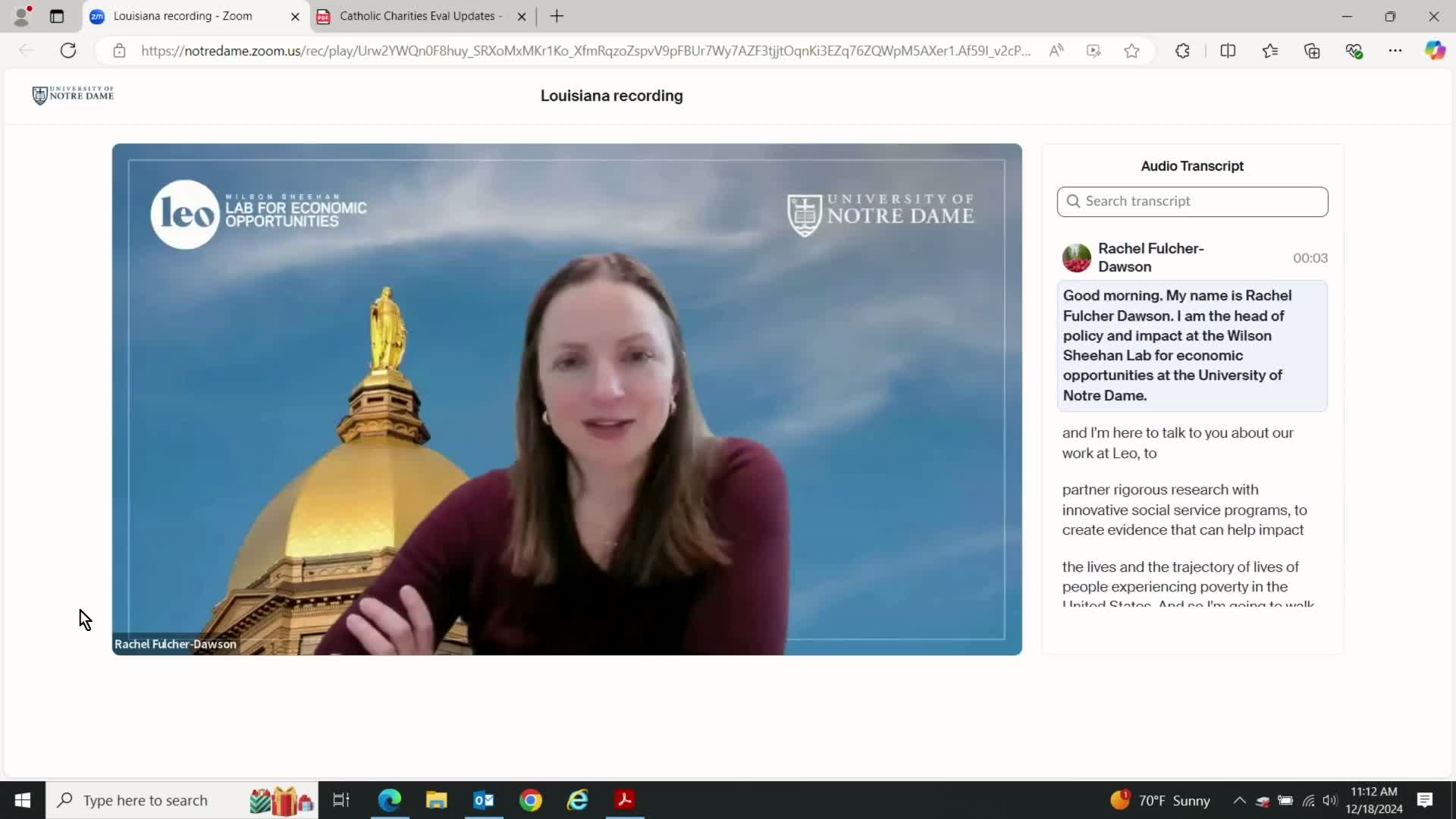
Rachel Fulcher Dawson of the University of Notre Dame’s Wilson Sheehan Lab for Economic Opportunities told the Empowering Families council that rigorous partner evaluations can reveal what interventions reliably move people out of poverty and which should be scaled.
Dawson summarized four LEO evaluations: Goodwill EXCEL (an accelerated adult learning program that the presenter said increased formal employment and produced a 38% increase in earnings among participants); a wraparound case‑management model developed by Catholic Charities Fort Worth (described as increasing full‑time employment by 25% on average and producing a 46% earnings lift for those unemployed at baseline); a Santa Clara County homelessness‑prevention program (one‑time financial assistance that reduced chronic homelessness and produced sizable county savings per dollar invested); and Stay the Course (case management plus emergency financial assistance for community‑college students, which the presenter said raised associate‑degree completion substantially, with a 31% boost for women).
Dawson described randomized controlled trials (RCTs) as a method to isolate program effects and said LEO works with providers to design ethical RCTs when programs have more eligible people than slots. She and council members discussed replication: which models might translate to Louisiana and how the council could pursue pilot funding, common assessment tools, and standards of care.
Council members welcomed the research approach and asked Notre Dame to return with slide materials and program specifics. Tom Costanza and others said the council could use LEO’s evidence to identify candidate programs for a Louisiana replication effort.