Get Full Government Meeting Transcripts, Videos, & Alerts Forever!
Get email alerts on the Council Funding And Program Updates topic
No spam. Unsubscribe anytime.
Empowering Families council reconvenes; Catholic Charities say $225,000 pilot grant set to end in March
Summary
The Empowering Families to Live Well Council met Dec. 18, heard updates from Catholic Charities in New Orleans and Baton Rouge on reentry, homeless and early‑childhood pilots, and learned that a $225,000 state allocation funding those pilots and an independent evaluation expires in March unless renewed.
Senator Barrow convened the Empowering Families to Live Well Council on Dec. 18 to revive a state advisory body created to coordinate services for families and children and to hear program updates from Catholic Charities and their independent evaluators.
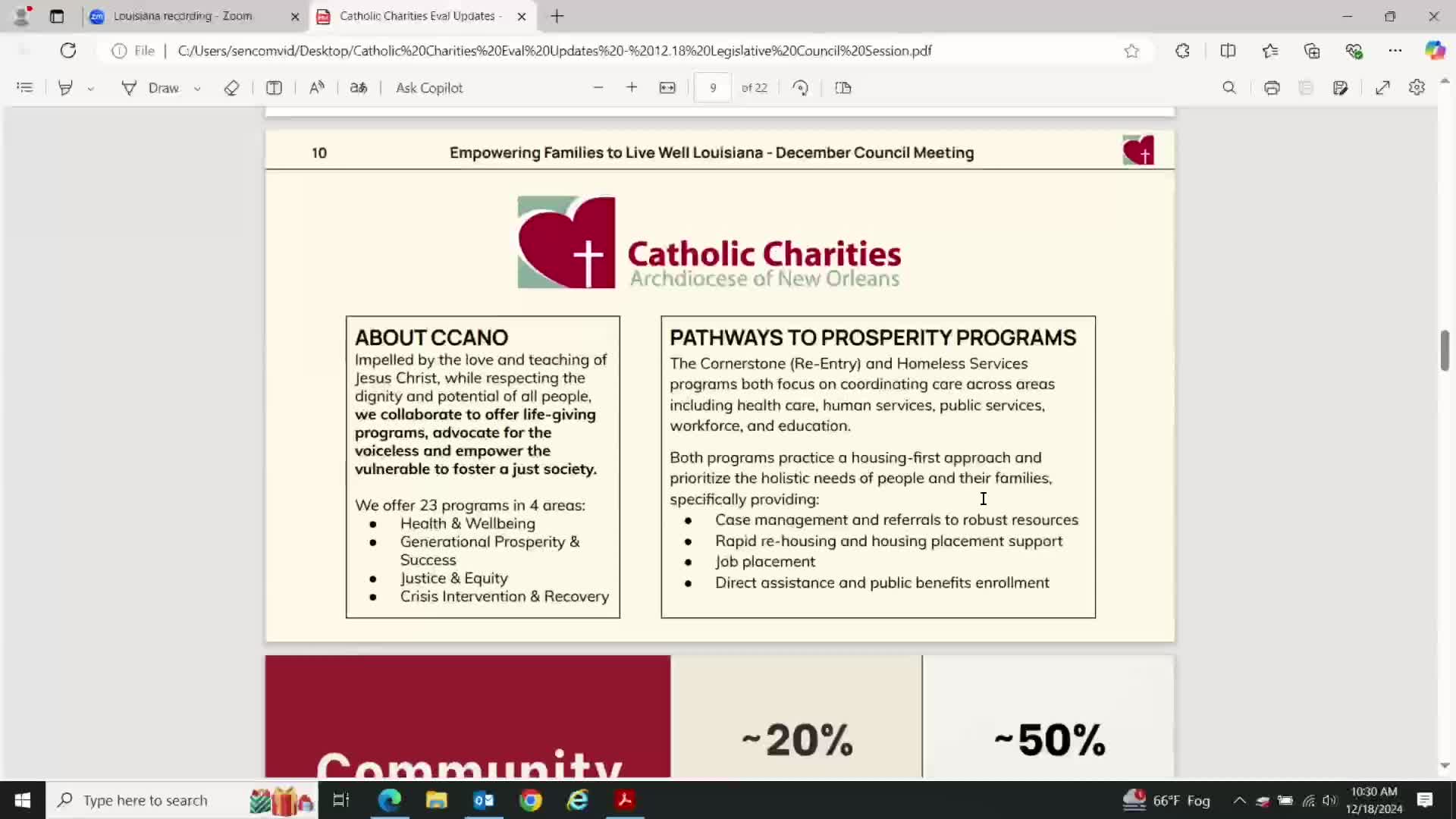
Catholic Charities of the Archdiocese of New Orleans and Catholic Charities of the Diocese of Baton Rouge reported on five‑year pilot projects funded in part through a $225,000 state general fund allocation to the Department of Children and Family Services. Tom Costanza of the Louisiana Conference of Catholic Bishops said the allocation provided $100,000 to each Catholic Charities agency and $25,000 to Tripwise for evaluation work.
"We're ranked 49th in child poverty," Costanza said, framing the pilots as efforts to coordinate services and outsmart poverty. Stephanie Mills of Catholic Charities New Orleans described an intensive reentry program and homeless services that, she reported, have served about 991 people returning from incarceration and provided what she corrected to about $1,000,000 in direct assistance over five years. Mills said case managers use a quarterly life‑area survey to measure client progress across social‑determinant domains and track housing and income gains.
Stephanie Sterling, executive director of Catholic Charities of the Diocese of Baton Rouge, outlined PACT (Parents and Children Together), a home‑visitor model using HIPPY and Vroom for children ages 0–5. Sterling said the program has served 387 families since 2017, and that, with partial DCFS funding, it is currently serving 59 families (67 children) in several parishes. She said the agency’s retention rate is about 92 percent and reiterated rural barriers such as transportation, broadband and childcare.
Council members pressed program staff on intake and eligibility. Mills said reentry referrals come from the Department of Corrections and community providers and that case managers sometimes begin work up to six months before a person's release. Sterling said referrals include call‑ins, word‑of‑mouth and 2‑1‑1 transfers and noted limited funding constrains the number of families the program can serve.
Sammy Guillory, co‑chair and secretary, and other members urged the council to use the coming months to dig into measurement, standards of care and ways to break down interagency silos. Several members asked for copies of the presentations and for Notre Dame's evaluation materials to be circulated to the council.
The council did not take formal votes at the Dec. 18 meeting. Members discussed inviting researchers from the University of Notre Dame to return for a deeper presentation and tentatively agreed to meet again in February to set priorities and pursue funding options.