Get Full Government Meeting Transcripts, Videos, & Alerts Forever!
Get email alerts on the Medicaid Reimbursement topic
No spam. Unsubscribe anytime.
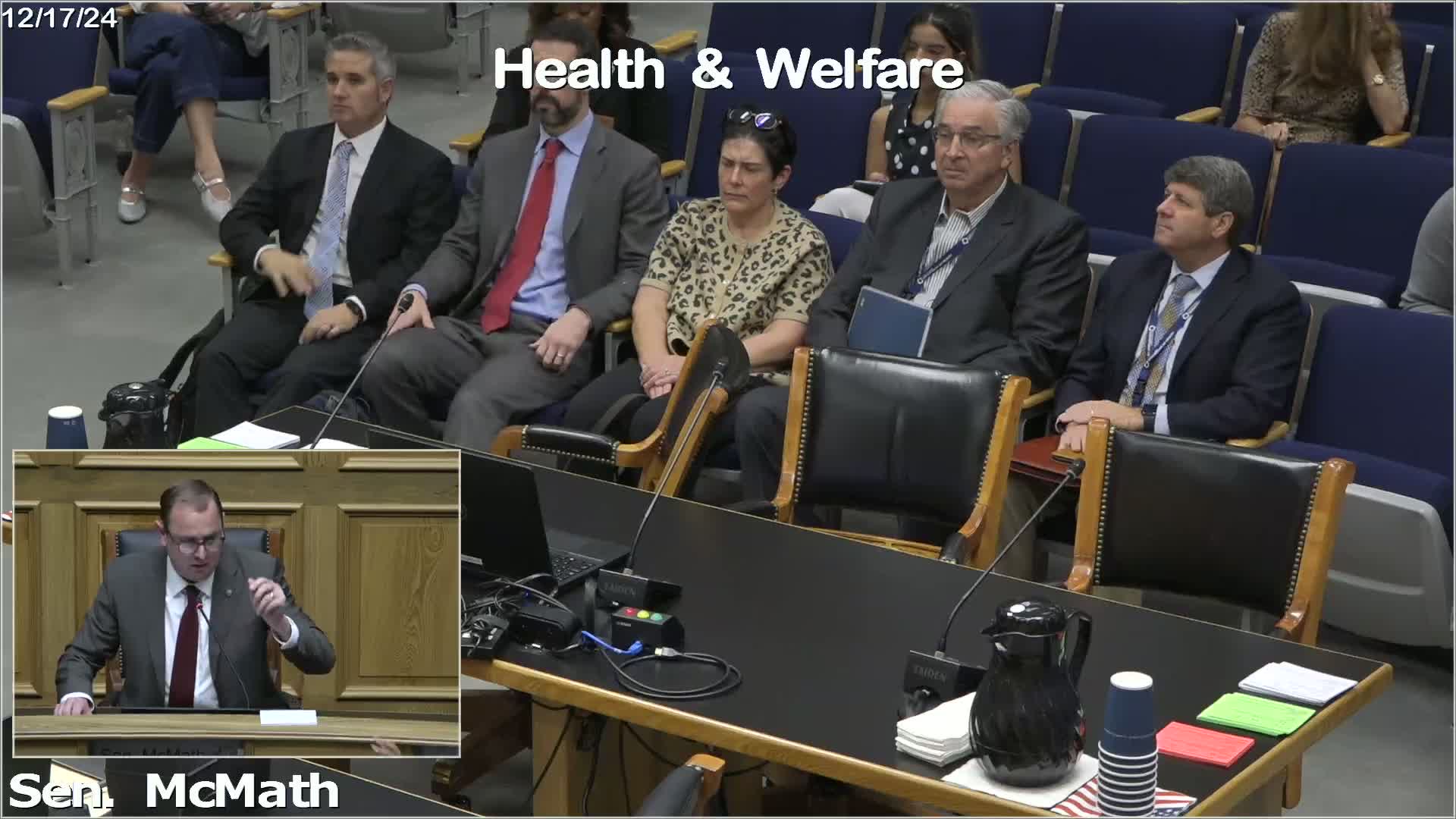
Senate committee hears LDH plan to move Medicaid physician fees toward Medicare parity; lawmakers seek code-level cost detail
Summary
LDH presented a two-year plan under Act 306 / SB 190 to bring Medicaid physician reimbursement toward Medicare parity (85% year one, 100% year two). Lawmakers praised the goal but pressed LDH and Milliman for code-by-code impacts after examples showed some CPT codes could fall sharply.
BATON ROUGE — The Senate Health and Welfare Committee on Dec. 17 held an oversight hearing on the Louisiana Department of Health's plan to raise Medicaid physician reimbursement toward Medicare parity under Act 306 (Senate Bill 190), hearing both an agency overview and pushback from members and provider groups.
LDH officials described a two-year glide path: move the Medicaid physician fee schedule to about 85% of Medicare in year one and to Medicare levels in year two, with an expanded set of CPT codes intended to support care coordination. An LDH official told the committee the proposal is intended to improve access, saying coverage does not always mean access for the state's roughly "1,700,000" Medicaid enrollees and that case management codes would encourage primary care providers to accept more Medicaid patients.
The Department's actuarial contractor, Milliman, told the committee the model shows an aggregate increase in physician reimbursement once the schedule moves to Medicare levels and that first-year funding would come from a mix of hospital assessment and managed-care-organization contributions rather than State General Fund. Milliman's Anders Larson said the modeling assumed no decreases in year one and that "year two being at Medicare" produces an overall increase despite some individual code adjustments.
Still, senators pressed for more granular data after members pointed to examples in the modeling where specific CPT codes would fall sharply. The chair cited CPT 37243, a vascular surgical procedure that the meeting record shows billed about 138 times in fiscal 2023 and is currently reimbursed at roughly $6,200; under the proposed year-two Medicare alignment, the same code was mentioned in committee discussion as modeled at $529 — an example characterized in the hearing as a roughly 92% reduction. Milliman acknowledged there will be some codes with decreases, and said some sleep-study codes "were decreasing pretty significantly," in one instance by "more than 50%."
Provider groups and clinical leaders urged careful code-level review. Dr. Joseph Bocchini, president of the Louisiana Chapter of the American Academy of Pediatrics, said payment parity is important for pediatric access and workforce stability: "Payment levels have a direct impact on access to care," Bocchini testified, urging that codes unique to pediatrics be included and that up-to-date CPTs and RVU values be used. Lisonbee Nunn, president of the Louisiana Association of Nurse Practitioners, said nurse practitioners—who she said provide a large share of rural primary care and whose members accept Medicaid at high rates—should be protected from unintended adverse impacts.
Lawmakers repeatedly asked LDH and Milliman for follow-up materials: a list of specific codes that would decrease, specialty-level impact analyses, the effect on LSU physicians who currently receive enhanced payments, and a hypothetical cost estimate of raising all rates without producing decreases (what members characterized as avoiding "winners and losers"). LDH and Milliman agreed to provide actuarial analyses and cost breakouts, including separating year-two costs for physicians and for mid-level providers.
The hearing produced no votes or formal committee action on the plan. Senator Boudreaux, the sponsor of SB 190, framed the work as "a work in progress," saying the Legislature and stakeholders must avoid unintended consequences and get the design right. The committee adjourned after asking LDH for the additional analyses and modeling requested by members.
What happens next: LDH and Milliman will supply the committee with a detailed code list, cost estimates (including a hypothetical scenario that raises rates without modeled decreases), and specialty-specific impacts; members indicated they expect follow-up hearings and requests from the Finance committee on budgetary implications.
Sources: Committee hearing record, presentations and verbal testimony by LDH officials and Milliman, testimony from Dr. Joseph Bocchini (LAAP) and Lisonbee Nunn (Louisiana Association of Nurse Practitioners).