Get Full Government Meeting Transcripts, Videos, & Alerts Forever!
Get email alerts on the Bridges topic
No spam. Unsubscribe anytime.
DOTD updates committee on LTIF-funded projects, bridge inspections and backlog
Summary
DOTD Secretary Joe Donahue and bridge maintenance administrator Haley Brown briefed the committee on LTIF project lettings and bridge inspection/maintenance challenges, including a statewide backlog, new federal inspection rules (23 CFR 650 subpart C) and high replacement costs for movable spans.
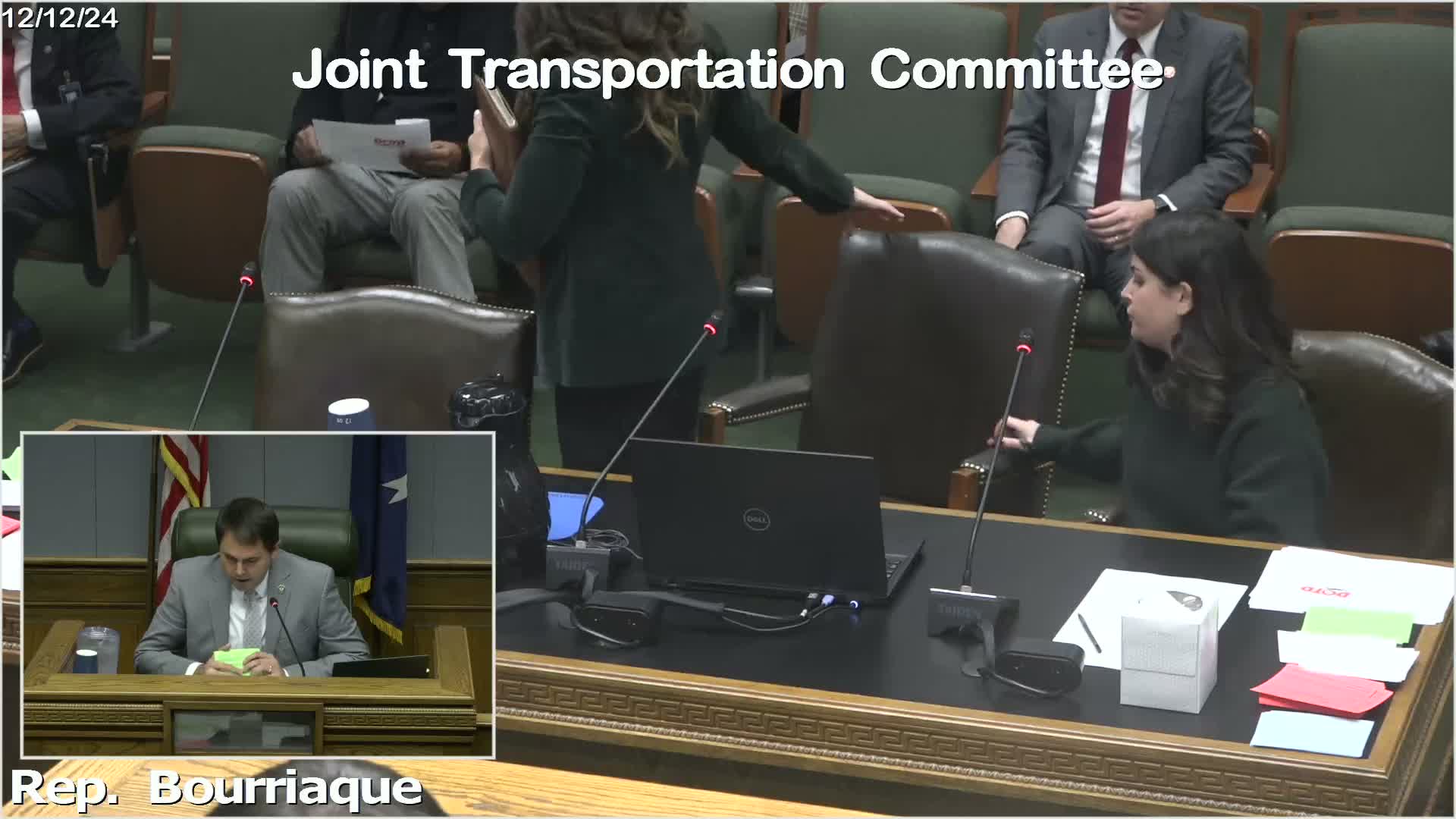
The Department of Transportation and Development told the Joint Transportation Committee on Dec. 12 that recent supplemental funding and the Louisiana Transportation Infrastructure Fund (LTIF) have allowed the department to advance a number of projects, but permit delays, constructability feedback and backlog remain constraints.
Secretary Joe Donahue said the LTIF update covers highway-priority program projects, HB2 individual line items for construction, and three $1 million pre-construction-service projects included in the packet. He said the department ‘‘did let 18 projects in Q1’’ and that additional lettings were anticipated across subsequent quarters; some projects were advanced earlier than originally scheduled while a few slipped owing to permit delays or constructability concerns.
The presentation then shifted to bridge maintenance. Haley Brown, DOTD bridge maintenance administrator, delivered a "Bridge 101" overview: how DOTD defines bridges versus culverts (federal definition: span greater than 20 feet), common substructure and superstructure components, and inspection protocols. Brown summarized inspection frequencies: routine inspections every 24 months, NSTM (formerly fracture-critical) hands-on inspections on a 24-month cycle requiring physical access, interim inspections triggered by condition decline, and underwater inspections every 60 months.
Brown flagged a major federal specification change in 2022 and cited 23 CFR 650 subpart C as the governing regulation; she said the state must implement substantial changes to meet the new requirements by 2028. She also outlined bridge-condition trends the department reports to FHWA and Infobridge: Louisiana maintains poor-condition bridges under 10% of deck area but has seen a shift such that ‘‘fair’’ now outnumbers ‘‘good,’’ and the department's forecast indicates maintenance levels could push that balance further by 2035. Brown added that the state's bridge inventory is roughly 12,000 structures and that Louisiana ranks fourth nationally by deck area.
On movable bridges, Brown said the state owns 100; 13 are in good condition, 55 fair, 27 poor and 5 closed. She warned that rehabilitation costs for movable spans typically range $13 million to $35 million, with replacement costs $50 million to $100 million depending on type.
Committee members raised local safety questions and programmatic follow-ups. Representative Walters described two accidents at a newly implemented J-turn and asked for improved signage; DOTD staff said district staff and the department's David North were aware and would follow up. Representative Jackson asked whether DOTD requires a threshold number of T-bone crashes to justify a turn signal; Donahue and staff cited the Manual on Uniform Traffic Control Devices (MUTCD) and said crash-data warrants and law-enforcement reports inform signal decisions; DOTD agreed to provide existing study reports or update them if conditions have changed.
Members also pressed DOTD about off-system (local) bridges: staff explained the federal off-system program requires a local match, often producing delays when a closed bridge is not already programmed; DOTD noted programmatic changes (spot replacements, box-culvert options) can reduce cost and time but local match and federal standards remain hurdles.
What happens next: DOTD offered to supply requested crash reports, project-scope details for specific highway segments, and LED letters for port projects. The department said it will continue to use supplemental funding for procuring precast components and to prioritize spot replacements to reduce backlog where feasible.
Representative Schammerhorn and others asked about workforce and crew capacity; Brown said DOTD operates multiple bridge crews and has prioritized using supplemental funds to expand replacement work and procure components to accelerate delivery.