Get Full Government Meeting Transcripts, Videos, & Alerts Forever!
Get email alerts on the Orphan Wells Fund Governance And Fees topic
No spam. Unsubscribe anytime.
Committee endorses fee increase, governance shift to tackle orphan oil and gas wells
Summary
The House Natural Resources Committee reported House Bill 23 favorably with amendments after hearing the Department of Energy and Natural Resources present a plan to raise OSR fees, place funds under the Natural Resources Trust Authority, and pursue bonding to plug roughly 4,600 orphan wells estimated at $542 million in liability.
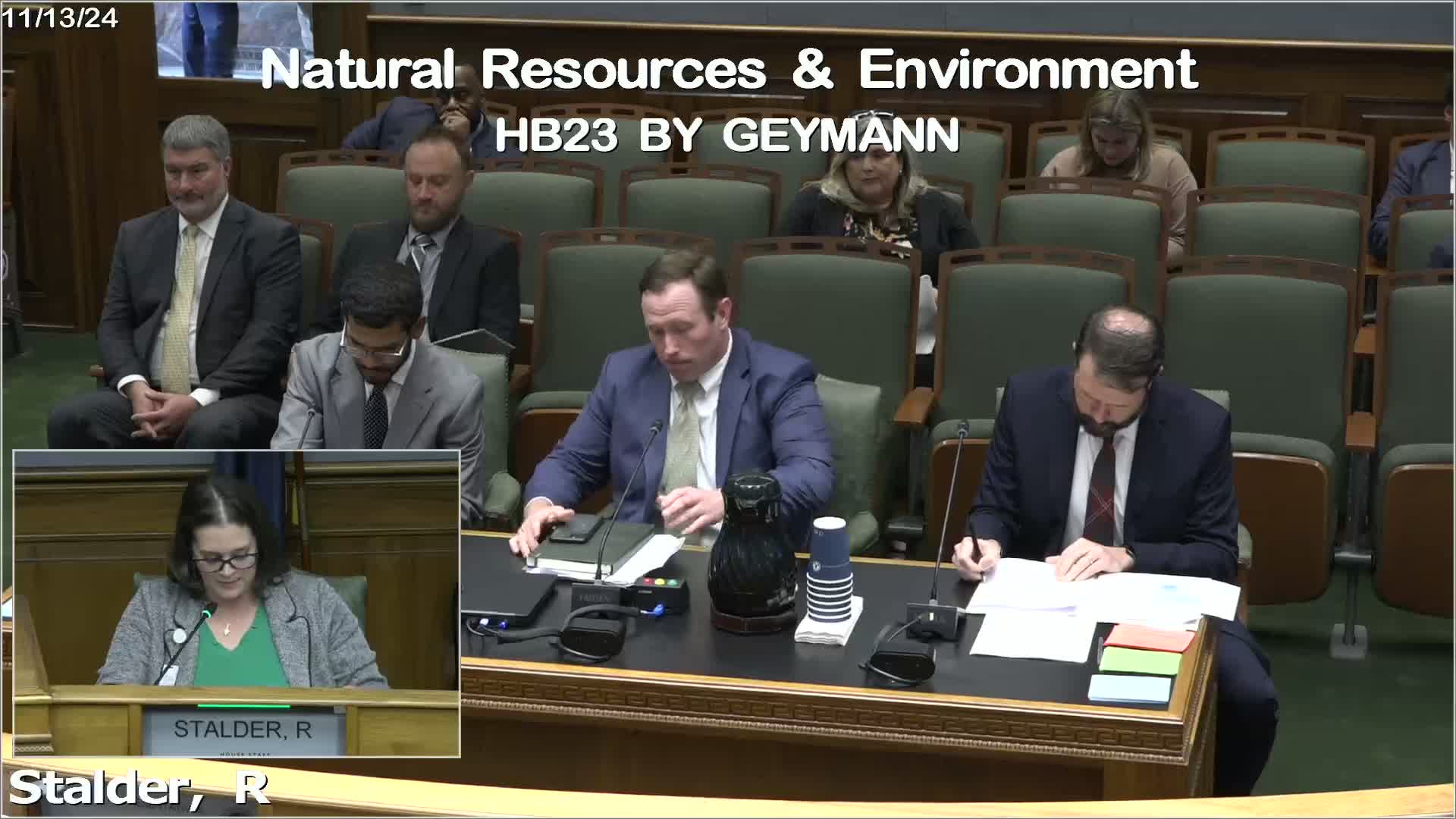
Chairman Guymon on behalf of the House Natural Resources Committee on Dec. 5 took up House Bill 23, a departmental bill that would change how Louisiana manages and funds plugging and abandonment of orphan oil and gas wells.
Deputy Secretary Dustin Davidson, Department of Energy and Natural Resources, told the committee the bill "provides for the administration of the Oilfield Site Restoration Fund" and would allow the state to "raise fees for the oil site restoration, and ensure that we have the money on hand to plug and abandon those orphan wells." He said the bill moves fund administration into the Natural Resources Trust Authority with oversight from the State Mineral and Energy Board.
Department leaders framed the change as part of a broader departmental reorganization directed by the governor and cited Act 727’s creation of the Natural Resources Trust Authority. Secretary Gray and departmental witnesses said the current Oilfield Site Restoration (OSR) program has suffered from insufficient resources and governance challenges, including difficulty maintaining quorums of the OSR Commission.
During discussion staff corrected an earlier figure: officials first said approximately 2,600 orphan wells, then corrected the record to approximately 4,600 orphan wells. Department staff told the committee the total obligation to address those wells is "estimated at $542,000,000." They reported current annual collections into the OSR fund are about $12,000,000 per year and said the amendments to the bill would raise gas-related fee collections by roughly $8,000,000 annually to reach about $20,000,000 per year at the high end. The department explained that, under the proposed scenario, a 30-year bond drawn against an annual $20 million revenue stream would provide roughly $600 million in capital capacity to cover the $542 million liability.
Committee members pressed technical questions about which fuels the amendment targets and whether fees are volumetric or value-based. Department witnesses said the amendment adjusts the gas fee schedule (not oil rates), and that the fee is volumetric by design; the department declined to hard-code a price index because related changes to severance tax treatment were under consideration in other committees.
Officials described the on-the-ground response process for reported leaks: the department maintains a public reporting phone/email and can hire a contractor for immediate stop-gap work below a procurement threshold; larger emergency actions require a declaration by the commissioner of conservation, OSR Commission procedures, and emergency contracting steps. Department staff said much OSR fund cash is currently encumbered under contracts and that federal grants (IIJA/IRA) supplement but cannot be relied upon long term.
On governance, the amendments (set number 82) remove the OSR Commission’s statutory role and transfer administrative functions to the Natural Resources Trust Authority; the State Mineral and Energy Board would provide oversight. Department witnesses said the change intends to centralize financial expertise, improve procurement and contractor lists, and reduce duplication across boards.
After questions and discussion, Chairman Guymon moved to adopt the amendment set; there was no recorded opposition and the committee adopted the amendments. The committee then voted to report House Bill 23 favorably as amended.
What’s next: House Bill 23 was reported favorable with amendments and will proceed to the next step in the legislative process for floor consideration.