Get Full Government Meeting Transcripts, Videos, & Alerts Forever!
Get email alerts on the Judiciary Reform topic
No spam. Unsubscribe anytime.
Committee rejects amendment to allow specialty courts, expand discipline over out-of-state lawyers
Summary
The House Committee on Judiciary voted 5–7 against Senate Bill 1, a proposed constitutional amendment that would have allowed the legislature to create specialty courts and given the Supreme Court disciplinary authority over lawyers not admitted in the state.
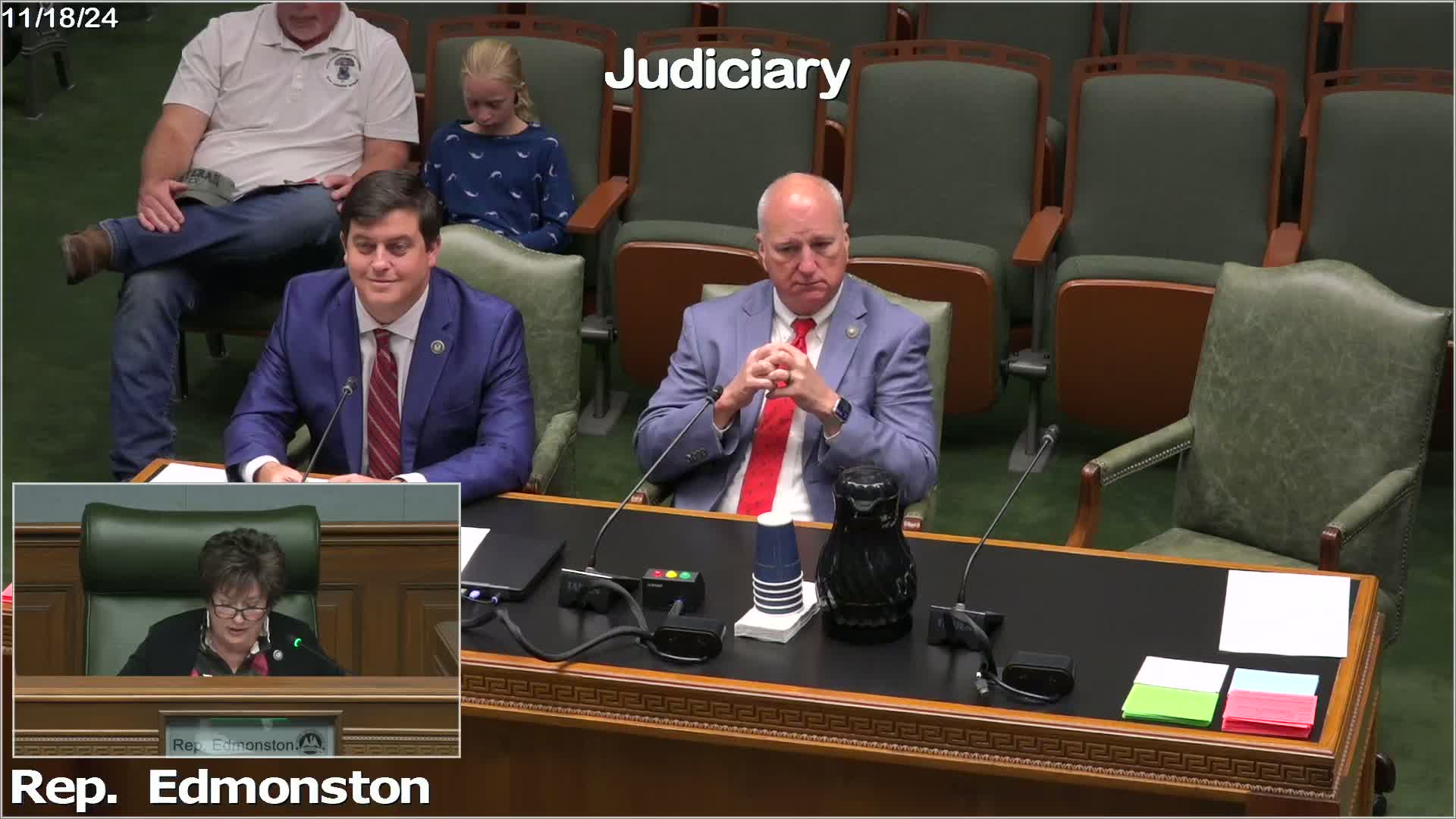
Vice Chair Representative Cathy Edmondson convened the House Committee on Judiciary on Nov. 18, where senators and representatives debated Senate Bill 1, a proposed constitutional amendment from Senator Morris and coauthor Representative McMakin that would expand court jurisdiction and allow the Supreme Court to discipline attorneys who practice in Louisiana but are not admitted here.
Proponents said the amendment merely creates authority for future action. "This comes from the governor's call item 20," Representative McMakin told the committee, and the measure would "allow the supreme court" to discipline "any lawyer not admitted in the state who practices law or renders or offers to render legal services in this state" and would permit the legislature, by a two‑thirds vote, to establish regional or statewide specialty courts.
Supporters framed specialty courts as a tool to address complex caseloads and rural access. McMakin and Senator Morris cited examples such as "regional business courts" and regional drug, veterans or mental‑health courts that, they said, could concentrate expertise and reduce delay on large, complex matters.
Opponents and skeptical members pressed for specifics on selection, accountability and cost. "I'm not sure I'm understanding what the bill actually does," Representative Hughes said when asking whether the measure creates new courts or only authorizes them. Members warned the amendment is broad and could be used to reorganize jurisdiction or alter trial‑by‑jury practices without further guardrails.
Citizen Bruce Riley, speaking during public comment, said the amendment was "very vague" and warned it combined two subjects—lawyer discipline and specialty courts—into one constitutional change that could invite litigation.
Representative Mack moved the bill out of committee for a vote, but after a roll‑call the clerk announced the motion failed, 5 yeas to 7 nays. The committee record shows that the measure did not advance out of the Judiciary Committee.
What happens next: Because the committee did not advance SB1, proponents said they will continue studying the policy and the referenced workload reports; opponents indicated they want more concrete plans and funding proposals before changing the constitution.