Get Full Government Meeting Transcripts, Videos, & Alerts Forever!
Get email alerts on the Legislation Introductions topic
No spam. Unsubscribe anytime.
Nebraska senators introduce dozens of bills on licensure compacts, taxation, and public safety
Summary
Clerks announced a large batch of new bills at the start of the session, including licensure compacts for cosmetology and school psychologists, a renters' income tax credit, motor vehicle and DMV-related measures, and proposals affecting public power and improvement districts.
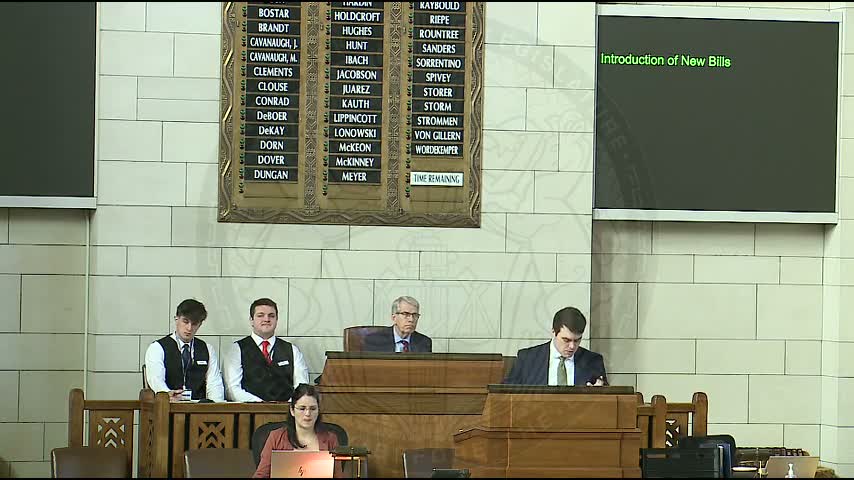
At the start of its third day, the Nebraska Legislature’s clerk read a large set of new bill introductions. The bills cover licensure compacts, tax credits, appropriations, motor vehicle law changes, and several other topics slated for committee referral.
Notable introductions included LB 82–LB 85 (licensure compacts for cosmetology, dentists/dental hygienists and school psychologists), LB 86 and LB 88 (appropriations-related measures), LB 107 (an income tax credit for renters) and LB 108 (a firefighters retirement act for cities of the first class). The Clerk also introduced bills addressing motor vehicle titles and registration, public power conveyances, and amendments to the Nebraska Liquor Control Act.
The Clerk continued reading additional bills later in the session (totaling at least LB 80 through LB 129 and several LR constitutional amendment proposals). The transcript records bill numbers, sponsoring senators and brief one-line descriptions; it does not record committee referrals or hearings for each bill in this reading.
Committee notices announced during the session included a Rules Committee hearing scheduled for January 16, 2025 at 1:30 PM (room 1525) and a meeting of the Committee on Committees in room 2102 immediately upon adjournment.
Because the clerk’s reading is a formal introductory step, most bills now await committee assignment and more detailed public materials; the transcript provides the bill titles and sponsors but not the full text or fiscal notes.