Get Full Government Meeting Transcripts, Videos, & Alerts Forever!
Get email alerts on the Rock Crushing Regulations topic
No spam. Unsubscribe anytime.
Spring Hill defers interim rules for on-site rock crushing after developers and residents press for revisions
Summary
After extensive testimony from developers and contractors, the Board of Mayor and Aldermen voted unanimously to defer interim permitting rules for on-site rock crushing to Jan. 21 to allow staff, stakeholders and elected officials to negotiate changes addressing hours, dust control and site-plan requirements.
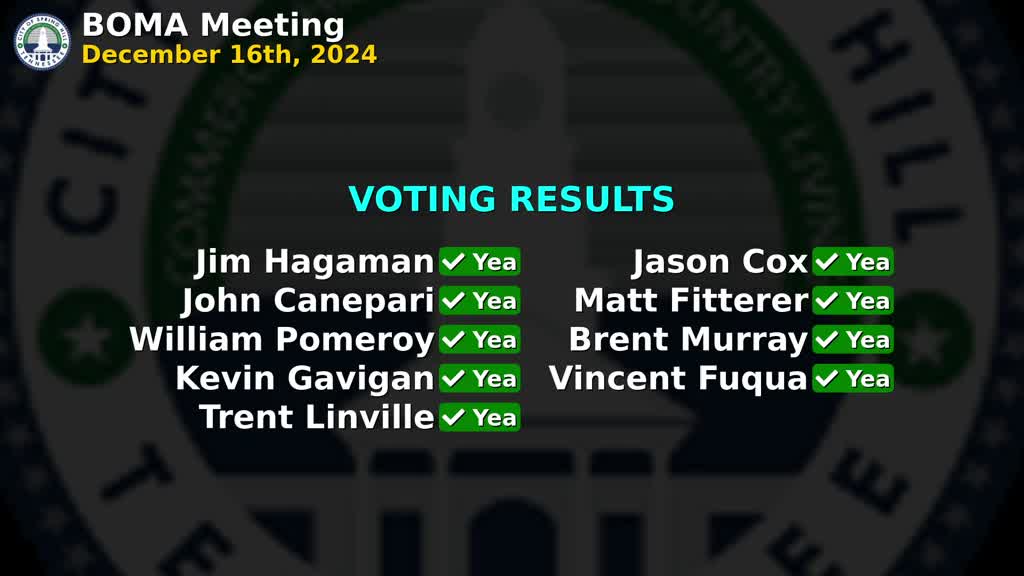
The Board of Mayor and Aldermen unanimously deferred consideration of Resolution 24-303, interim permitting requirements for on-site rock crushing, to the Jan. 21 BOMA meeting after extensive public testimony and board discussion.
The proposal — intended to add interim permit conditions to the Unified Development Code — drew developers and contractors to the dais who warned that a one-size-fits-all approach would cripple routine on-site recycling of blasted rock. "A portable rock crusher is no different than a bulldozer or an excavator — it's portable because it comes to a site, it's used, and then it's removed," said Ralph Cadass of South Star, representing the Legacy Point development. He argued the proposed 1,000-foot buffer and special site-plan requirements would make on-site crushing impractical for large lots and unworkable for many construction geometries.
Proponents on staff said the resolution addresses unauthorized commercial activity and public complaints. "We found several sites in town that do have state permits, but the one we have issues with do not have state permits," Public Works/inspections staff Mr. Hicks said. He and other staff members said the intent was to regulate operators who are selling crushed material or otherwise operating outside the state permitting framework.
Contract operations described industry standards for air quality testing and dust control. "Most jurisdictions defer to the state method 9 test for air quality; we have 60 days to provide a method 9 test once we bring a crusher on-site," said Ray Jeter, chief operations officer for Harness LLC, noting that firms routinely use third-party testing and mitigation measures. Matthew Pogue, owner of Mid 10 Constructors, said on-site crushing can sharply reduce truck traffic and road wear: "If it's set up properly, the dust is minimal... You're helping to keep traffic off the road, protect your roads, which your taxpayers are burdened by the cost of paving."
Board members asked staff to engage the development community and stakeholders to craft a lower-touch, predictable regulatory approach that aligns with neighboring jurisdictions while protecting residents from commercial operations that avoid state permits. Several aldermen emphasized the need to reduce heavy-truck traffic and to ensure crushed material meets TDOT specifications when used in public works.
Alderman Kanapari moved to defer the resolution to the Jan. 21 meeting to allow those consultations; the motion passed 9-0. Staff was directed to return with a revised draft after stakeholder engagement.
The deferral leaves in place the board’s intent to regulate unpermitted commercial crushing while signaling a willingness to adjust operational limits, buffers and test requirements to reflect local geography and industry practice.