Get Full Government Meeting Transcripts, Videos, & Alerts Forever!
Get email alerts on the Bill Introductions topic
No spam. Unsubscribe anytime.
Dozens of bills introduced on the legislature’s second day, covering public health, criminal justice, education and energy
Summary
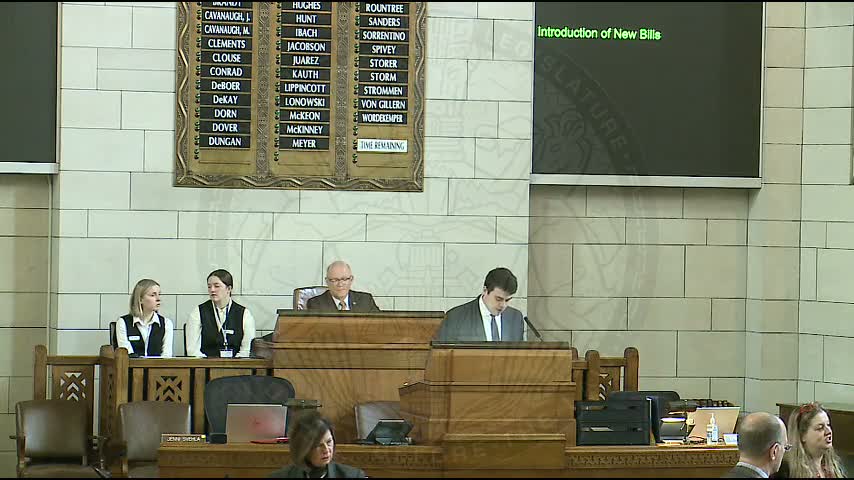
Clerk read a long list of new bills the second day of the 109th Nebraska Legislature. Introductions ranged from technical fixes to a voter-approved medical cannabis provision to bills on student surveillance, daylight saving time and renewable energy; most bills were formally introduced without debate.
The clerk read dozens of bills on the floor after leadership completed opening announcements, presenting measures on criminal justice, public health, education, agriculture, energy and appropriations. Many bills were introduced by individual senators as titles and statutory sections were recited for the record; most introductions included statutory citations but no floor debate.
Why this matters: bill introductions set the scope of the session’s legislative agenda and indicate policy priorities and forthcoming committee workloads. Though introduction does not signal committee placement or final action, sponsors’ filings give early notice to stakeholders about what issues the legislature may tackle this session.
Among the initial items announced by the clerk were LB1 (Sen. Hanson), described as a technical amendment to a voter-adopted medical cannabis initiative to correct an incorrect subdivision reference; LB3 (introduced by Sen. Lippincott at the governor’s request) would revise selection provisions for presidential electors; LB8 (Sen. Duncan) would alter the sustainable aviation fuel tax credit and make it refundable; and LB31 (Sen. Conrad) would direct the State Board of Education to develop a model policy on student surveillance and tracking technology for school districts. The clerk also read LB34 (Sen. Hunt), a proposal to provide for year-round daylight saving time, and a range of appropriations and public-health–related bills, including measures related to the home and community-based services waiver and the Statewide Workforce and Education Reporting System.
Most introductions were read by the clerk as titles and statutory references with no immediate debate. The presiding officer gave senators a last call for bill introductions before the clerk closed the roll of new bills read that day. After bill introductions and a short series of appointments motions, the body recessed for inaugural ceremonies.
Quotes and procedural actions on the floor were delivered by officers and sponsors; for example, Senator Rountree moved that committees be appointed to administer oaths of office, and the motion carried by voice vote.