Get Full Government Meeting Transcripts, Videos, & Alerts Forever!
Get email alerts on the Education Funding topic
No spam. Unsubscribe anytime.
House Education Committee approves Education Excellence Fund expenditure plan
Summary
The House Education Committee voted unanimously on Dec. 12 to approve the Department of Education’s proposed Education Excellence Fund (EAF) expenditure plan, authorizing allocations across instructional programs, early childhood and other approved educational uses from multiple EAF funding pools.
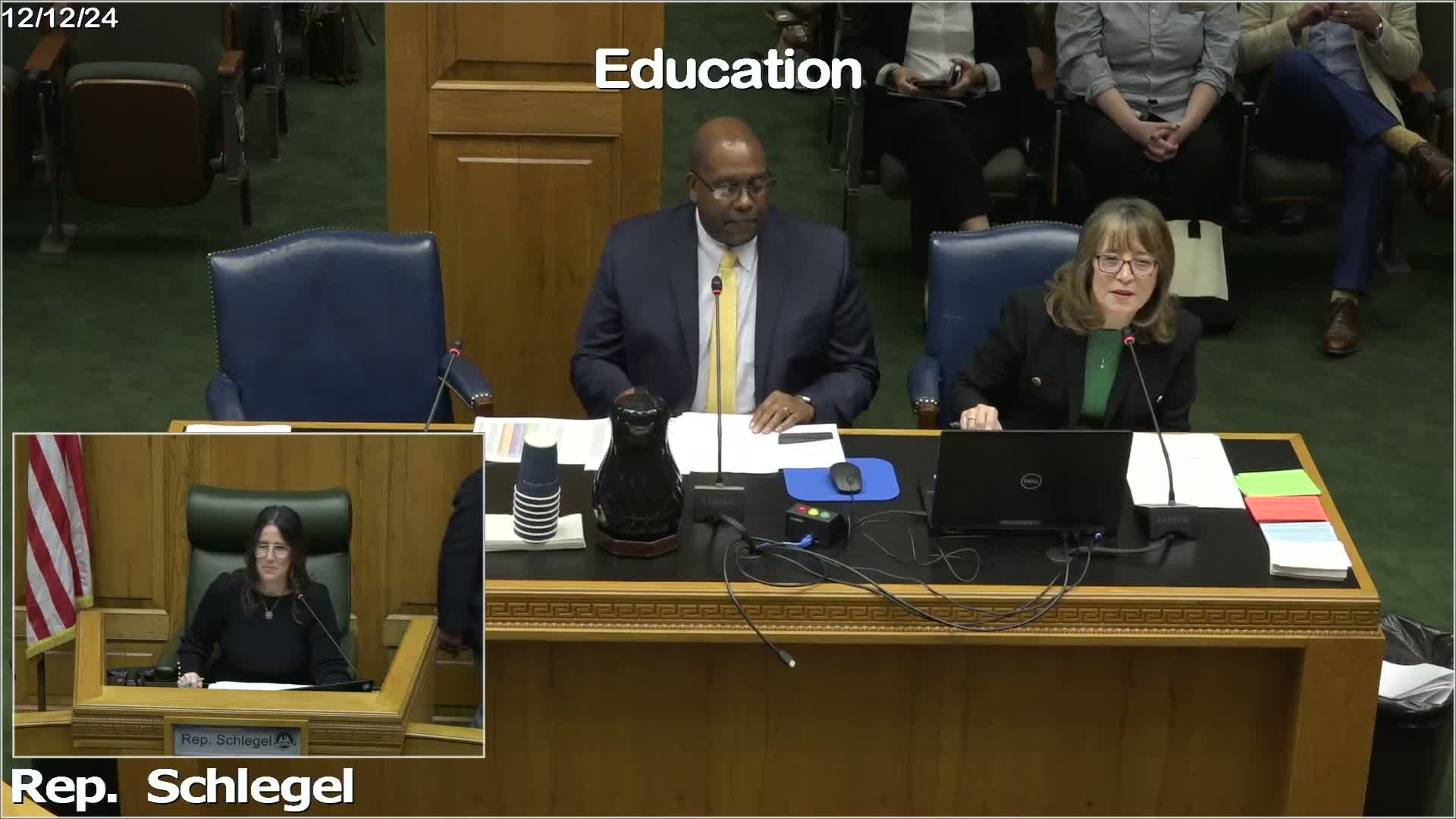
The House Education Committee on Dec. 12 approved the Department of Education’s recommended expenditure plan for the Education Excellence Fund, granting the department permission to distribute funds across school systems and eligible programs.
Chairwoman Schlegel opened the session and the department presented the EAF breakdown, tracing its origin to the 1999 Millennium Fund and describing three statutorily allowed uses: early childhood education, remedial instruction for students who underperform on state assessments, and other legislative-approved educational programs. Department staff told the committee that this fiscal year EAF-related resources total about $65,000,000 split among several pools: an annual allocation of $11,500,000, $26,200,000 in carryover from prior years, a $41,000 reallocation from closed schools, investment accounts held for school systems, and cash-on-hand balances. The department said eligible recipients requested to budget about $23,000,000 this year, with roughly $15,700,000 targeted for instructional programs, $3,600,000 for early childhood and $4,300,000 for other approved educational programs.
Representative Brett Freiberg moved to approve the plan “in globo.” The chair asked for objections; none were recorded and the chair announced the expenditures were approved by the committee. The motion and announcement occurred on the record during the meeting; no roll-call vote tally was entered into the transcript beyond the chair’s statement that there were no objections.
Committee members asked for itemized, district-level breakdowns and clarification about how EAF funds might support services for children younger than pre-K. Department staff directed members to the packet’s parish-by-parish spreadsheets and described eligibility requirements: allocations flow to public city and parish systems (including charter schools) and to qualifying nonpublic schools and entities newly enumerated in a recent constitutional amendment (including specific lab schools and the Louisiana Educational Television Authority). Staff reiterated that recipients must submit a program plan, application and budget demonstrating alignment with the statute before funds are distributed.
Next steps: the committee approved the EAF plan as presented by the Department of Education. The department will proceed with final distributions consistent with the approved plan and continue to provide more detailed parish-level allocation documents to committee members.