
City Council approves interim $80 nightly rate for single‑adult shelter beds amid budget tradeoffs
Get AI-powered insights, summaries, and transcripts
Subscribe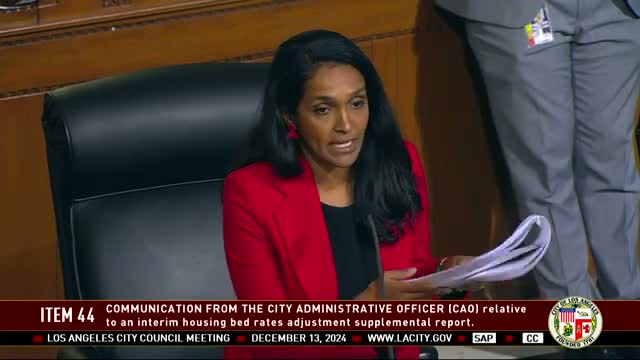
Summary
The Los Angeles City Council voted to raise the interim nightly rate for single‑adult interim beds to $80 beginning Jan. 1, 2025, a move the CAO warned would exhaust available state HAP funds for the fiscal year and limit new projects. Supporters said the increase prevents immediate site closures; opponents said accountability and data remain insufficient.
The Los Angeles City Council on Dec. 13 adopted an interim increase to the nightly rate paid to providers for single‑adult interim shelter beds, setting the rate at $80 per bed per night effective Jan. 1, 2025. Councilmember Imelda Raman, who led the motion, said the increase is intended to prevent immediate provider closures and preserve shelter capacity while a longer procurement and oversight process continues.
The council’s action follows months of committee work and a CAO report that had proposed a lower interim rate. CAO staff member Matt Szabo told the chamber that the $80 figure was based on what the city can afford for the remainder of the fiscal year, and that adopting it would “exhaust every dollar that we have available on our state‑funded side” for HAP and constrain the city’s ability to fund new projects or respond to unexpected needs.
Raman argued the rate is a pragmatic step to keep sites operating and maintain services while the city implements a new scope of required services, staffing expectations and performance monitoring during a systemwide reprocurement. “We have to make sure that sites which have not seen increases in many, many years are not going to shut down in the next few months,” she said on the council floor.
Councilmember Eunice Hernandez and others pushed for stronger accountability and data before committing more dollars. Councilmember Hernandez asked for clear, site‑level performance metrics and report backs to ensure funds translate into measurable outcomes.
The council debated tradeoffs at length: supporters described the vote as necessary to avoid abrupt service losses, while critics warned that increased spending without fully verified data risks depleting funds and leaving no flexibility for other homelessness responses. The clerk recorded the final outcome as adopted; the transcript shows the vote recorded before and after clarification as the motion carried with the council tabulating the final record as the motion passed (tally recorded on the public record as 12 ayes, 2 noes, after a member’s requested adjustment).
What happens next: CAO staff briefed that the $80 interim rate will be used while the city prepares a reprocurement with a new service scope and performance requirements; further council action is expected on family‑bed rates and the CAO and LAHSA will continue reporting on implementation. Councilmembers were urged to work with committee staff to use incoming site‑level data for ongoing oversight.
The council’s action is procedural and financial; it does not itself change the procurement rules but alters the short‑term funding available to keep existing providers operating.
Ending: The measure passed and will take effect as described; councilmembers asked for additional CAO and departmental charting of budget effects and for LAHSA to provide rapid report‑backs to the housing and homelessness committee.